 Back
BackIntroduction to Physiology: Levels of Organization and Core Concepts
Study Guide - Smart Notes
 Tailored notes based on your materials, expanded with key definitions, examples, and context.
Chapter 1: Introduction to Physiology
Overview of Physiology
Physiology is the scientific study of how living organisms and their parts function. It focuses on the mechanisms underlying normal biological function, emphasizing the principle that structure determines function. Understanding physiology requires knowledge of anatomy, as the two disciplines are closely linked. Pathophysiology examines abnormal structure and function, as well as disease mechanisms. Physiology also explores how body systems interact to maintain homeostasis, the stable internal environment necessary for survival.
Student Learning Objectives
Define physiology and its scope.
List and describe the levels of biological organization from atoms to the biosphere.
Name the 10 physiological organ systems and their functions.
Distinguish between mechanistic (how) and teleological (why) explanations.
Levels of Organization
Hierarchy of Biological Organization
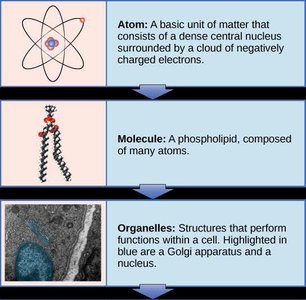
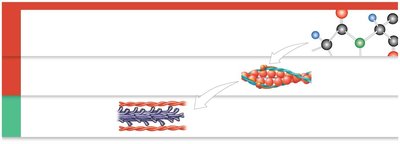
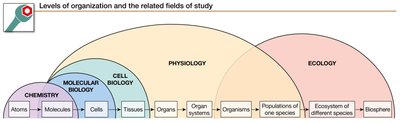
Life is organized into a hierarchy of increasing complexity, from atoms to the biosphere. Each level builds upon the previous, with emergent properties arising at higher levels.
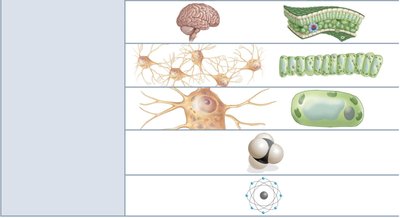
Atom: The smallest unit of matter, e.g., carbon, hydrogen, oxygen, nitrogen.
Molecule: Two or more atoms bonded together, e.g., glucose, fatty acids, amino acids, nucleotides.
Macromolecule: Large molecules formed from molecular subunits, including carbohydrates, lipids, proteins, and nucleic acids.
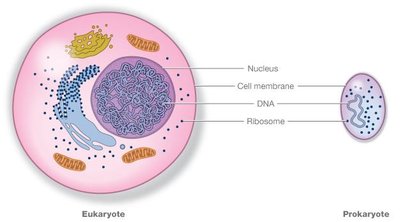
Organelle: Specialized structures within cells, e.g., mitochondria, ribosomes.
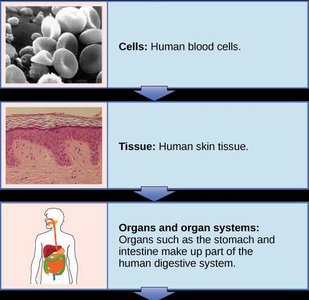
Cell: The smallest functional unit of life, capable of all life processes.
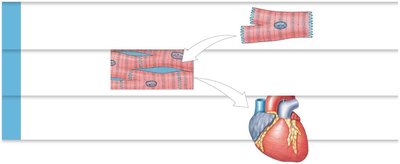
Tissue: Groups of similar cells performing a common function; four types: epithelial, connective, neural, muscle.
Organ: Groups of tissues working together for a specific function, e.g., heart, lungs.
Organ System: Groups of organs that work together, e.g., cardiovascular system.
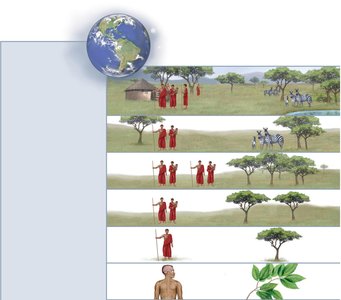
Organism: An individual living entity.
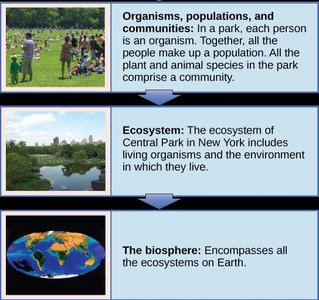
Population: Members of the same species in a specific area.
Community: Different populations interacting in an area.
Ecosystem: Communities and their physical environment.
Biosphere: All ecosystems on Earth.
Metric Units in Physiology
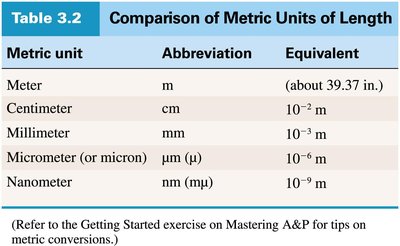
Understanding metric units is fundamental for laboratory work in physiology. The following table summarizes the main metric units used at different levels of organization:
Metric unit | Abbreviation | Equivalent |
|---|---|---|
Meter | m | (about 39.37 in.) |
Centimeter | cm | 10-2 m |
Millimeter | mm | 10-3 m |
Micrometer (or micron) | μm (μ) | 10-6 m |
Nanometer | nm (ημ) | 10-9 m |
Properties of Life
Eight Characteristics of Living Organisms
To classify something as living, it must exhibit the following properties:
Order: Highly organized structures composed of atoms, molecules, organelles, and cells.
Sensitivity to stimuli: Ability to detect and respond to environmental changes.
Adaptation: Evolutionary fit for the environment, shaped by natural selection.
Reproduction: Passing genetic information to the next generation.
Growth & development: Increase in size and complexity, following genetic instructions.
Regulation: Control of internal functions through metabolism and enzymes.
Homeostasis: Maintenance of a stable internal environment.
Energy processing: Acquisition and use of energy for cellular processes.
Order and Entropy
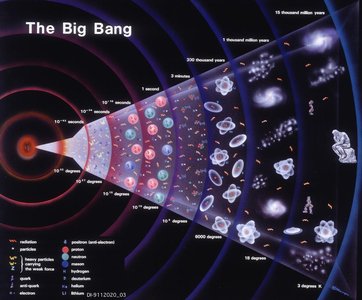
Living organisms maintain order in a universe tending toward disorder (entropy). The Second Law of Thermodynamics states that entropy (S) always increases in the universe. Life represents localized pockets of order, or negative entropy (−ΔS).
Sensitivity to Stimuli
Organisms detect and respond to stimuli. For example, plants bend toward light, and cells move toward chemicals (chemotaxis).
Adaptation
Adaptations are traits that enhance survival and reproduction in a specific environment. These traits evolve over generations through natural selection.
Reproduction
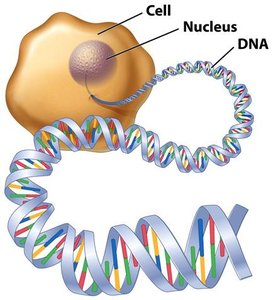
Reproduction ensures the continuation of species. Genetic information is passed via DNA, which encodes RNA and proteins (the Central Dogma of Biology). Single-celled organisms divide by duplicating DNA, while multicellular organisms produce gametes through meiosis.
Growth & Development
Growth is an increase in size and cell number; development includes all changes from fertilization to death. Mitosis is the process of cell division for growth and repair, producing genetically identical cells.
Energy Processing
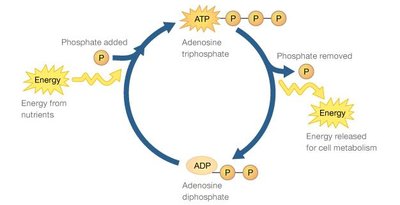
Energy is the capacity to do work. The First Law of Thermodynamics states that energy cannot be created or destroyed, only transformed. Cells use ATP (adenosine triphosphate) as their primary energy currency.
Potential energy: Stored energy (e.g., chemical bonds).
Kinetic energy: Energy of motion (e.g., muscle contraction).
Regulation and Metabolism
Metabolism is the sum of all chemical reactions in an organism, facilitated by enzymes. It includes:
Catabolism: Breakdown of macromolecules to release energy (exergonic).
Anabolism: Synthesis of macromolecules to store energy (endergonic).
Homeostasis
Homeostasis is the maintenance of a stable internal environment, essential for survival. It requires the ability to sense and respond to environmental changes, keeping conditions such as temperature and pH within narrow limits.
Viruses: Living or Non-living?
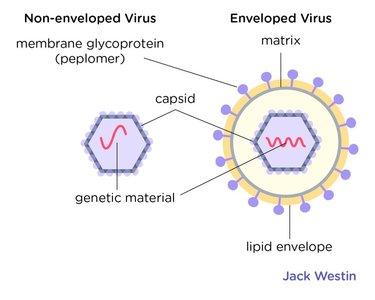
Viruses share some characteristics with living organisms (contain DNA, reproduce, evolve) but lack others (not made of cells, cannot perform homeostasis or energy collection independently). They depend on host cells for replication and metabolism, so they are not considered fully alive.
Physiological Organ Systems
The Ten Physiological Organ Systems
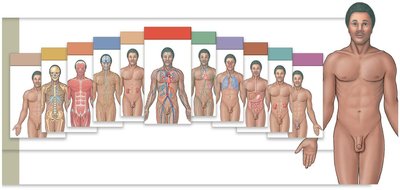
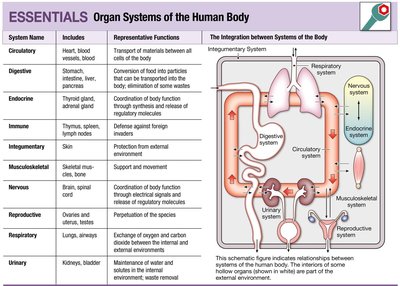
The human body is composed of ten major physiological organ systems, each with specialized functions:
Nervous
Musculoskeletal
Circulatory
Respiratory (pulmonary)
Urinary (renal)
Digestive (gastrointestinal)
Immune
Integumentary
Endocrine
Reproductive
Anatomy vs. Physiology
Anatomy studies body structures, while physiology focuses on function. Structure and function are closely linked at all levels, from molecules to organ systems. In anatomy, there are 11 organ systems (muscular and skeletal are separate; lymphatic is independent), while in physiology, the lymphatic system is integrated with circulatory, digestive, and immune functions.
Core Concepts in Physiology
Key Concepts
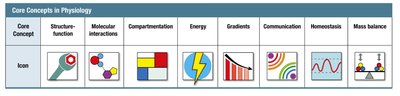
Structure and function: Structure determines function at all levels.
Molecular interactions: Specific, reversible, non-covalent binding between molecules.
Compartmentation: Separation of functions into distinct compartments.
Energy: All living organisms require energy for function.
Gradients: Substances and energy flow through gradients.
Communication: Coordination of body functions via signaling.
Homeostasis: Maintenance of internal stability.
Mass balance: Input and output must remain balanced for stability.
Additional info: This chapter provides foundational knowledge for understanding subsequent topics in physiology, including molecular interactions, compartmentation, energy metabolism, and homeostatic regulation.
