 Back
BackIntroduction to Physiology: Organization of the Human Body
Study Guide - Smart Notes
 Tailored notes based on your materials, expanded with key definitions, examples, and context.
Organization of the Body
Overview of Body Structure and Function
The human body is a complex structure composed of billions of cells, yet its function can be understood through a set of unifying physiological principles. Despite the diversity of cell types and organs, the body operates as an integrated whole, with each part specialized for certain functions but dependent on others for survival. This interdependence is a central theme in physiology.
Cells are the smallest living units, each capable of basic life processes.
Organs are specialized structures composed of multiple tissue types, each performing specific tasks.
Organ systems are groups of organs that work together to carry out major body functions.
Example: Oxygen delivery to cells involves the coordinated action of erythrocytes (produced in bone marrow), the hormone erythropoietin (from kidneys), the heart, lungs, and the gastrointestinal system for energy supply.
Cells, Tissues, Organs, and Organ Systems
Major Cell Types and Tissues
Cells in the human body are classified into four major types based on their structure and function. These cell types form the basis for the four primary tissue types.
Neurons (Nerve cells): Specialized for transmitting electrical signals. They enable sensation, movement, cognition, and emotion.
Muscle cells (Muscle fibers): Specialized for contraction, generating force and movement. Types include skeletal (voluntary movement), cardiac (heart), and smooth muscle (internal organs).
Epithelial cells: Form continuous layers (epithelia) that act as barriers and are involved in absorption, secretion, and protection. They line surfaces and cavities throughout the body.
Connective tissue cells: The most diverse group, including blood cells, bone cells, fat cells, and fibroblasts. They provide support, connect, and anchor body parts, and include the extracellular matrix.
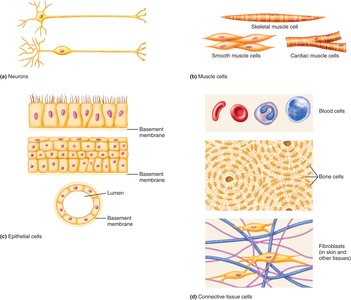
Additional info: Tissues are collections of similar cells performing a common function. The four basic tissue types are nervous, muscle, epithelial, and connective tissue.
Glands: Exocrine and Endocrine
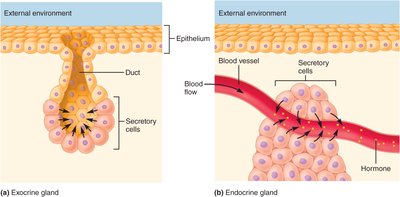
Some epithelial cells are specialized to form glands, which synthesize and secrete products.
Exocrine glands: Secrete products into ducts that lead to the external environment (e.g., sweat, salivary glands).
Endocrine glands: Secrete hormones directly into the bloodstream, allowing communication throughout the body (e.g., pituitary, adrenal glands).
Organs and Organ Systems
When two or more tissues combine to perform specific functions, they form organs. Organs are organized into organ systems, each responsible for major physiological processes.
Example: The heart (organ) is composed of muscle, nervous, epithelial, and connective tissues and is part of the cardiovascular system.
Organ systems may be physically connected (e.g., gastrointestinal tract) or functionally linked but anatomically separate (e.g., endocrine system).
System | Some organs/tissues within system | Function |
|---|---|---|
Endocrine | Hypothalamus, pituitary gland, adrenal gland, etc. | Communication via hormones |
Nervous | Brain, spinal cord, peripheral nerves | Electrical signaling and coordination |
Musculoskeletal | Skeletal muscle, bones, tendons, ligaments | Support and movement |
Cardiovascular | Heart, blood vessels, blood | Transport of molecules in blood |
Respiratory | Lungs, airways | Gas exchange |
Urinary | Kidneys, ureters, bladder, urethra | Filtration and excretion |
Gastrointestinal | Mouth, stomach, intestines, etc. | Digestion and absorption |
Reproductive | Gonads, reproductive tracts | Generation of offspring |
Immune | White blood cells, lymph nodes, etc. | Defense against pathogens |
Integumentary | Skin | Protection |
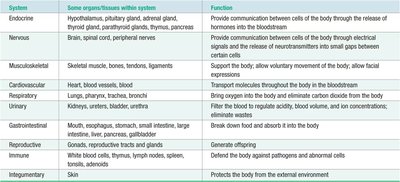
Additional info: Some organs, like the pancreas, belong to more than one system (digestive and endocrine).
The Overall Body Plan: Simplified View
Minimalist Model of the Human Body
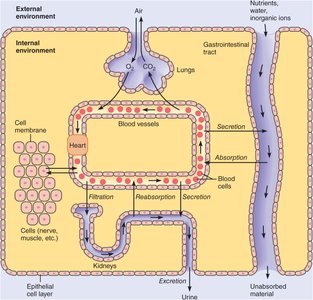
Physiologists often use simplified diagrams to highlight essential principles of body organization. In these models, the body is depicted as compartments separated by barriers, with arrows indicating the flow of materials such as gases, nutrients, and wastes.
The Body's External and Internal Environments
The external environment includes everything outside the epithelial barriers of the body, such as the skin surface, the lumen of the gastrointestinal tract, and the airways. Materials in these spaces are not considered inside the body until they cross the epithelial barrier.
The internal environment refers to the fluid that surrounds most cells (extracellular fluid) and the blood. Most cells do not directly contact the external environment but rely on the internal environment for exchange of materials.
Exchange of Materials
Material exchange between the internal and external environments occurs at specific sites:
Lungs: Oxygen enters and carbon dioxide exits the blood.
Gastrointestinal tract: Nutrients, water, and salts are absorbed; unabsorbed material is excreted as feces.
Kidneys: Filtration, reabsorption, and secretion processes regulate the composition of blood and produce urine for excretion.
Body Fluid Compartments
Distribution and Types of Body Fluids
Water is the most abundant substance in the body, distributed among several compartments separated by selectively permeable barriers.
Total body water (TBW): All fluid within the body (about 60% of body weight).
Intracellular fluid (ICF): Fluid inside cells (about two-thirds of TBW).
Extracellular fluid (ECF): Fluid outside cells (about one-third of TBW), including plasma and interstitial fluid.
Plasma: The liquid, noncellular part of blood (about 20% of ECF).
Interstitial fluid (ISF): Fluid surrounding cells, outside the blood (about 80% of ECF).
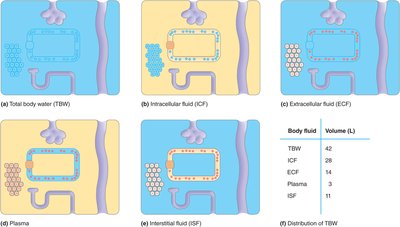
Additional info: Cell membranes and epithelial barriers are selectively permeable, allowing controlled exchange of substances between compartments. ICF is rich in potassium and proteins, while ECF is rich in sodium and has fewer proteins (except plasma).
Key Terms and Concepts
Absorption: Movement of substances from the external environment into the internal environment (e.g., nutrients from the gut to blood).
Reabsorption: Movement of substances from the kidney tubules back into the blood.
Secretion: Movement of substances from the blood into the lumen of an organ or outside the body.
Excretion: Elimination of waste products from the body (e.g., urine, feces).
