 Back
BackIntroduction to the Endocrine System: Structure, Function, and Hormone Pathways
Study Guide - Smart Notes
 Tailored notes based on your materials, expanded with key definitions, examples, and context.
Introduction to the Endocrine System
Overview of the Endocrine System
The endocrine system is a complex network of glands that secrete hormones directly into the bloodstream to regulate various physiological processes. These hormones act as long-distance chemical messengers, influencing metabolism, growth, development, reproduction, and homeostasis.
Endocrine glands are distributed throughout the body and include the pituitary, thyroid, parathyroid, adrenal glands, pancreas, gonads, and others.
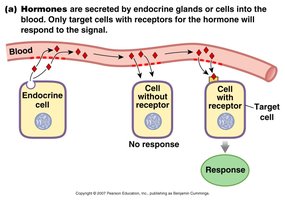
Hormones are secreted by specialized epithelial cells and act on distant target tissues with specific receptors.
Hormonal effects are exerted at very low concentrations and are terminated by enzymatic degradation.
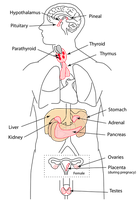
Comparative Endocrine Anatomy
While the basic principles of endocrine regulation are conserved across vertebrates, the location and function of endocrine glands can vary significantly among species such as fish, birds, and amphibians.
Conserved hormones (e.g., insulin, thyroid hormones) are found in many species, but some hormones and glands are species-specific.
Environmental influences and evolutionary adaptations shape endocrine system structure and function.
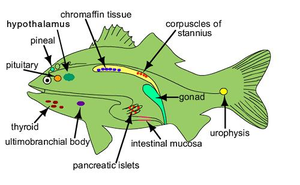
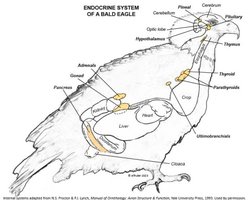
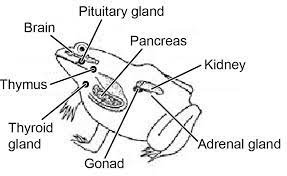
Hormones: Definition, Function, and Mechanisms
What are Hormones?
Hormones are chemical messengers that mediate long-distance cell-to-cell communication. They are secreted into the blood and act on target cells with specific receptors, triggering physiological responses such as metabolism regulation, water balance, growth, and reproduction.
Hormones act by controlling enzymatic reactions, membrane transport, and gene expression.
They exert effects at low concentrations, unlike cytokines or histamines, which act locally and at higher concentrations.
The half-life of a hormone is the time required to reduce its concentration by half, reflecting its duration of action.
Hormone Classification
Hormones can be classified by their source, stimulus for release, receptor type, and chemical structure. The main chemical classes are peptide/protein hormones, steroid hormones, and amine hormones.
Peptide/Protein hormones: Chains of amino acids, water-soluble, act via membrane receptors.
Steroid hormones: Derived from cholesterol, lipid-soluble, act via intracellular receptors.
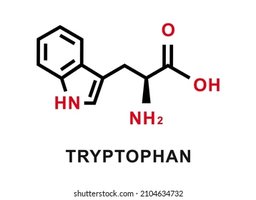
Amine hormones: Derived from single amino acids (tyrosine or tryptophan), include catecholamines and thyroid hormones.
Peptide Hormones: Synthesis and Action
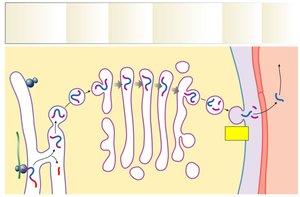
Most hormones are peptides or proteins, synthesized as large inactive precursors (preprohormones) that are processed to active forms. They are stored in secretory vesicles and released by exocytosis.
Peptide hormones bind to cell surface receptors and activate second messenger systems (e.g., cAMP, tyrosine kinase pathways).
They have short half-lives and rapid effects, often modifying existing proteins.
Steroid Hormones: Synthesis and Action
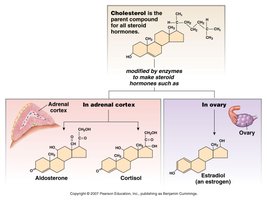
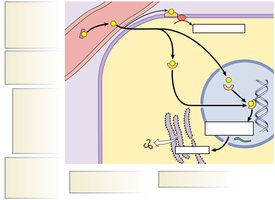
Steroid hormones are synthesized from cholesterol in the adrenal cortex, gonads, skin, and placenta. They are lipophilic, allowing them to diffuse through cell membranes and bind to cytoplasmic or nuclear receptors.
Transported in blood bound to carrier proteins.
Activate gene transcription, leading to new protein synthesis (slower but longer-lasting effects).
Examples: cortisol, estrogen, testosterone.
Amine Hormones: Features and Types
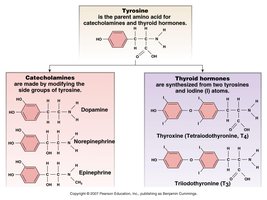
Amine hormones are derived from the amino acids tyrosine or tryptophan. They include catecholamines (epinephrine, norepinephrine, dopamine) and thyroid hormones (T3, T4).
Catecholamines act via membrane receptors and second messengers.
Thyroid hormones act via nuclear receptors to regulate gene expression.
Hormone Classification Table
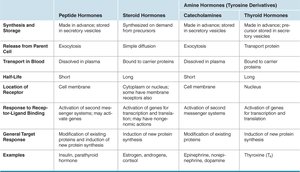
The following table summarizes the main features of peptide, steroid, and amine hormones:
Peptide Hormones | Steroid Hormones | Catecholamines | Thyroid Hormones | |
|---|---|---|---|---|
Synthesis & Storage | Made in advance; stored in vesicles | Synthesized on demand | Made in advance; stored in vesicles | Made in advance; stored in vesicles |
Release | Exocytosis | Simple diffusion | Exocytosis | Transport protein |
Transport in Blood | Dissolved in plasma | Bound to carrier proteins | Dissolved in plasma | Bound to carrier proteins |
Half-Life | Short | Long | Short | Long |
Receptor Location | Cell membrane | Cytoplasm or nucleus | Cell membrane | Nucleus |
Response to Receptor-Ligand Binding | Second messenger systems | Activation of genes | Second messenger systems | Activation of genes |
Examples | Insulin, parathyroid hormone | Estrogen, cortisol | Epinephrine, norepinephrine | Thyroxine (T4) |
Endocrine Reflex Pathways
General Pathway
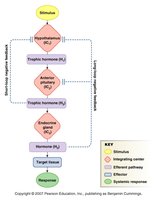
Endocrine reflexes involve a stimulus, afferent signal, integration, efferent signal (hormone), physiological action, and negative feedback. This ensures homeostatic regulation of hormone levels and physiological responses.
Negative feedback is a key feature, preventing overproduction of hormones.
Major Endocrine Glands and Hormones
Pineal Gland and Melatonin
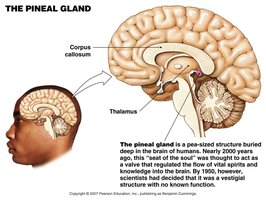
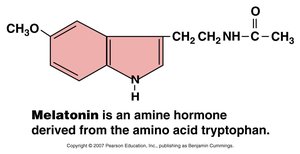
The pineal gland is a small structure in the brain that secretes melatonin, an amine hormone derived from tryptophan. Melatonin regulates circadian rhythms, sleep-wake cycles, and may influence puberty and antioxidant activity.
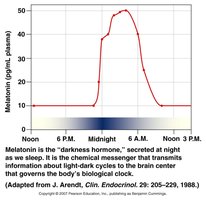
Melatonin secretion peaks at night and is influenced by light-dark cycles.
Hypothalamus and Pituitary Gland
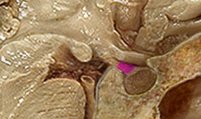
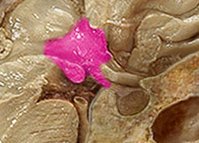
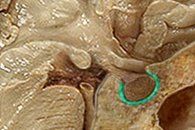
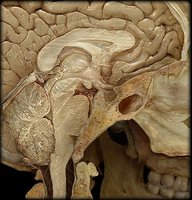
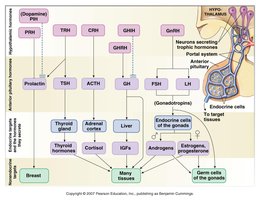
The hypothalamus and pituitary gland form the central regulatory axis of the endocrine system. The hypothalamus produces releasing and inhibiting hormones that control the anterior pituitary, which in turn secretes trophic hormones to regulate other endocrine glands.
The posterior pituitary releases neurohormones (oxytocin, vasopressin) produced in the hypothalamus.
The anterior pituitary secretes hormones such as growth hormone, ACTH, TSH, LH, FSH, and prolactin.
Endocrine Control Levels
Hormone secretion is regulated at three levels: hypothalamic stimulation (from the CNS), pituitary stimulation (from hypothalamic hormones), and endocrine gland stimulation (from pituitary hormones).
This hierarchical control allows for precise regulation and integration of physiological responses.
Hormone Interactions
Types of Hormone Interactions
Hormones can interact in several ways to regulate physiological processes:
Synergism: Multiple hormones produce a greater effect together than individually.
Permissiveness: One hormone is required for another to exert its full effect.
Antagonism: One hormone opposes the action of another (e.g., glucagon vs. insulin).
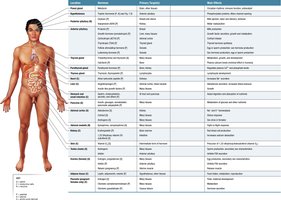
Summary Table: Major Human Endocrine Glands and Hormones
The following table summarizes the major endocrine glands, their hormones, and primary effects:
Gland | Hormone | Primary Targets | Main Effects |
|---|---|---|---|
Pineal | Melatonin | Brain, other tissues | Regulates circadian rhythms |
Hypothalamus | Releasing/inhibiting hormones | Anterior pituitary | Regulates pituitary hormone secretion |
Pituitary (anterior) | GH, ACTH, TSH, LH, FSH, PRL | Various | Growth, metabolism, stress, reproduction |
Pituitary (posterior) | Oxytocin, vasopressin | Uterus, kidneys | Labor, milk ejection, water balance |
Thyroid | T3, T4, calcitonin | Most cells, bone | Metabolism, calcium regulation |
Parathyroid | PTH | Bone, kidney, intestine | Increases blood calcium |
Adrenal cortex | Cortisol, aldosterone, androgens | Many tissues, kidney | Stress response, sodium balance, sex traits |
Adrenal medulla | Epinephrine, norepinephrine | Many tissues | Fight-or-flight response |
Pancreas | Insulin, glucagon | Liver, muscle, adipose | Blood glucose regulation |
Gonads | Estrogen, progesterone, testosterone | Reproductive organs | Sexual development, reproduction |
Additional info: This guide provides a foundational overview of endocrine system structure, hormone classification, and major regulatory pathways, suitable for introductory college-level physiology courses.
