 Back
BackIntroduction to the Peripheral Nervous System (PNS)
Study Guide - Smart Notes
 Tailored notes based on your materials, expanded with key definitions, examples, and context.
Introduction to the Peripheral Nervous System (PNS)
Overview of the Peripheral Nervous System
The Peripheral Nervous System (PNS) consists of all neural structures outside the Central Nervous System (CNS). It serves as the communication lines that link all parts of the body to the CNS, transmitting sensory information to the brain and spinal cord and carrying out motor commands to effectors such as muscles and glands.
Sensory receptors: Detect changes in the environment (stimuli) and relay this information to the CNS.
Afferent (sensory) nerves: Carry sensory signals to the CNS.
Efferent (motor) nerves: Carry motor commands from the CNS to effectors.
Associated ganglia: Collections of neuron cell bodies located outside the CNS.
Motor endings: Structures that activate effectors (muscles or glands).
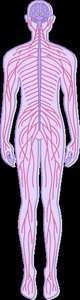
Example: Feeling the warmth from a cup of coffee involves sensory receptors in the skin, afferent nerves transmitting the signal to the CNS, and efferent nerves potentially triggering a motor response.
Divisions of the Nervous System
The nervous system is divided into two main parts:
Central Nervous System (CNS): Brain and spinal cord; processes information and determines responses.
Peripheral Nervous System (PNS): All neural structures outside the CNS; connects the CNS to limbs and organs.
Functional Organization of the PNS
The PNS is functionally divided into two main divisions:
Afferent (Sensory) Division: Transmits sensory information from receptors to the CNS.
Efferent (Motor) Division: Transmits motor commands from the CNS to effectors (muscles and glands).
Practice Question: Which of the following structures can be found in the afferent division of the PNS?
Sensory receptors.
Motor endings.
Motor neurons.
Skeletal muscles.
Correct answer: a) Sensory receptors.
Example of PNS Function
The PNS is essential for both voluntary and involuntary actions. For example, when you touch a hot object, sensory receptors in your skin detect the heat and send a signal via afferent nerves to the CNS. The CNS processes this information and sends a command via efferent nerves to move your hand away.

Lesson Map: Organization of the Peripheral Nervous System
The PNS can be further organized into sensory and motor pathways, each with specialized structures and functions. The following diagram summarizes the main components and their relationships:
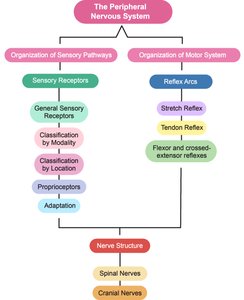
Sensory Pathways: Include sensory receptors, classification by modality and location, proprioceptors, and adaptation mechanisms.
Motor System: Includes reflex arcs, stretch and tendon reflexes, and flexor/crossed-extensor reflexes.
Nerve Structure: Composed of spinal and cranial nerves.
Key Terms and Definitions
Sensory receptor: Specialized cell or structure that detects changes in the environment.
Afferent nerve: Nerve fiber that carries sensory information to the CNS.
Efferent nerve: Nerve fiber that carries motor commands from the CNS to effectors.
Ganglion (plural: ganglia): Cluster of neuron cell bodies in the PNS.
Effector: Muscle or gland that responds to motor commands.
Summary Table: Comparison of Afferent and Efferent Nerves
Feature | Afferent (Sensory) Nerves | Efferent (Motor) Nerves |
|---|---|---|
Direction of Signal | Toward CNS | Away from CNS |
Function | Transmit sensory information | Transmit motor commands |
Example | Touch, pain, temperature | Muscle contraction, gland secretion |
Additional info:
The PNS is critical for both voluntary actions (like moving your hand) and involuntary reflexes (like pulling away from heat).
Damage to the PNS can result in loss of sensation, muscle weakness, or paralysis.
