 Back
BackIon Channels and Transporters: Structure, Function, and Measurement
Study Guide - Smart Notes
 Tailored notes based on your materials, expanded with key definitions, examples, and context.
Ion Channels and Transporters
Introduction
Ion channels and transporters are essential for the regulation of ionic gradients and electrical signaling in cells, particularly neurons. This study guide covers the measurement of ionic currents, the diversity and structure of ion channels, and the mechanisms of active transporters.
Measuring Ionic Currents
Voltage-Clamp Technique
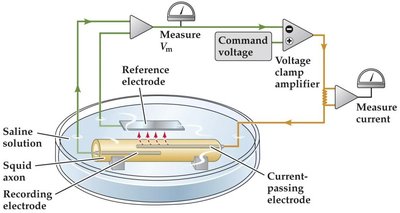
The voltage-clamp technique is a foundational method for studying ionic currents in excitable cells. It allows researchers to control the membrane potential and measure the resulting ionic currents.
Key Point: The voltage-clamp setup uses electrodes to measure and control the voltage across a cell membrane, isolating ionic currents for analysis.
Example: The squid giant axon is a classic preparation for voltage-clamp studies due to its large size.
Patch-Clamp Method
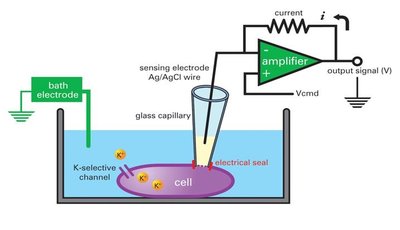
The patch-clamp method revolutionized electrophysiology by enabling the recording of currents from single ion channels or whole cells.
Key Point: A glass micropipette forms a tight seal with a small patch of membrane, allowing precise measurement of ionic currents.
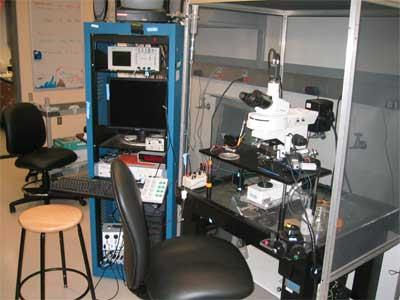
Advantages: Can record from single channels or the entire cell; allows manipulation of intracellular contents.
Disadvantages: Requires specialized equipment and expertise.
Cell-Attached and Whole-Cell Recording
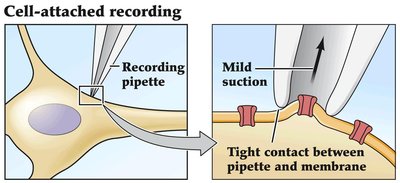
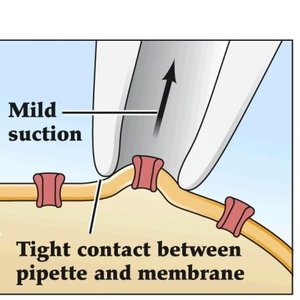
Cell-Attached Recording: Mild suction creates a tight seal between the pipette and membrane, enabling single-channel recordings.
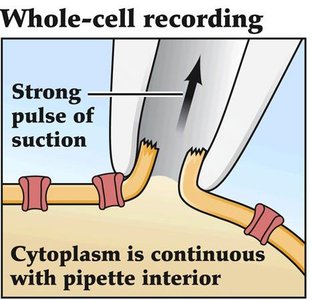
Whole-Cell Recording: Strong suction breaks the membrane patch, allowing access to the cell's interior and recording of whole-cell currents.
Microscopic vs. Macroscopic Ionic Currents
Definitions and Relationships
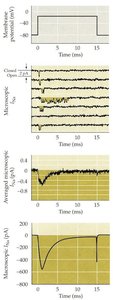
Microscopic Currents: Currents through individual or a few ion channels in a small patch of membrane.
Macroscopic Currents: The sum of microscopic currents across a large area or the entire cell membrane.
Relationship: Macroscopic currents reflect the collective behavior of many microscopic channels.
Ion Channel Diversity
Major Classes of Ion Channels
Ion channels are classified based on their gating mechanisms and ion selectivity.
Voltage-Gated Channels: Open in response to changes in membrane potential.
Ligand-Gated Channels: Open in response to binding of specific molecules (ligands) such as neurotransmitters.
Other Specialized Channels: Gated by temperature, protons, or other ligands.
Experimental Distinction
Ion Selectivity: Channels are distinguished by which ions they allow to pass.
Gating Mechanisms: Voltage or ligand sensitivity can be tested experimentally.
Pharmacological Properties: Specific blockers or activators can identify channel types.
Ion Channel Structure and Function
Molecular Structure of Ion Channels
Ion channels are integral membrane proteins with multiple subunits and domains.
Pore Domain: The pathway through which ions permeate.
Voltage Sensor: Detects changes in membrane potential and triggers channel opening.
Auxiliary Subunits: Modulate channel function.
Channel States: Closed, Open, Inactivated
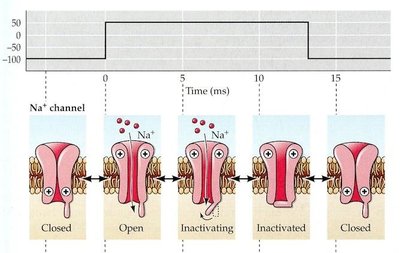
Closed State: Channel is not conducting ions.
Open State: Channel allows ion flow.
Inactivated State: Channel is non-conducting but cannot be immediately reopened.
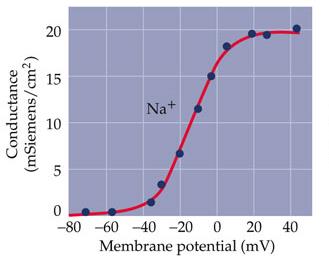
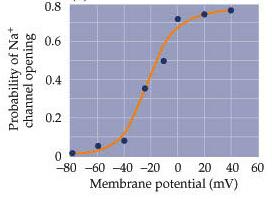
Conductance and Open Probability
Conductance: The ability of a channel to allow ion flow, measured as a function of membrane potential.
Open Probability: The likelihood that a channel is open at a given membrane potential.
Ion Pumps and Transporters
Active Transport Mechanisms
Active transporters move ions against their concentration gradients, establishing and maintaining ionic gradients essential for cell function.
ATPase Pumps: Use ATP hydrolysis to drive ion transport (e.g., Na+/K+ ATPase, Ca2+ ATPase).
Ion Exchangers: Use the gradient of one ion to drive the transport of another ion in the opposite direction.
Co-Transporters: Use the gradient of one ion to drive the transport of another ion in the same direction.
Electrogenic Nature of Na+/K+ ATPase
Key Point: The Na+/K+ ATPase pump generates an electrical current by moving three Na+ ions out and two K+ ions in per ATP hydrolyzed.
Equation:
Summary Table: Comparison of Ion Channel Types
Channel Type | Gating Mechanism | Ion Selectivity | Example |
|---|---|---|---|
Voltage-Gated | Membrane potential | Na+, K+, Ca2+ | Na+ channel |
Ligand-Gated | Ligand binding | Cl-, Na+, K+ | GABA receptor |
Other Specialized | Temperature, protons | Varies | TRP channels |
Conclusion
Understanding ion channels and transporters is fundamental to neurophysiology and cell biology. The patch-clamp and voltage-clamp techniques provide powerful tools for studying these proteins, revealing their diversity, structure, and function.
Additional info:
Some details about channel structure and gating mechanisms were inferred from standard academic sources to ensure completeness.
