 Back
BackIonic Basis of the Action Potential: Voltage-Clamp Analysis in the Squid Giant Axon
Study Guide - Smart Notes
 Tailored notes based on your materials, expanded with key definitions, examples, and context.
Ionic Basis of the Action Potential
Overview of Action Potential Generation
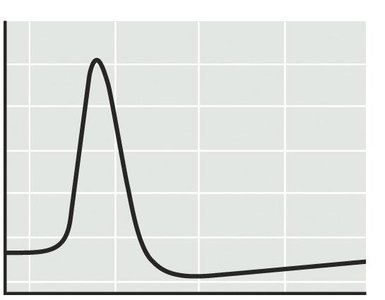
The action potential is a rapid, transient change in membrane potential that is fundamental to neuronal signaling. Its waveform is shaped by the coordinated activity of voltage-gated ion channels, primarily sodium (Na+) and potassium (K+) channels.
Key ions: Na+ and K+ are the principal ions involved in generating the action potential.
Phases: The action potential consists of depolarization, repolarization, and a brief hyperpolarization (undershoot).
Squid giant axon: Classic experiments by Hodgkin and Huxley used this model to elucidate the ionic mechanisms underlying action potentials.
The Voltage-Clamp Method
Principles and Experimental Setup
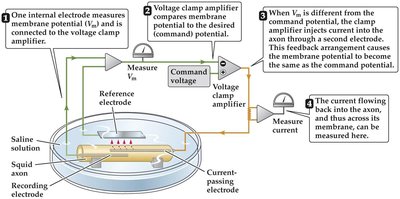
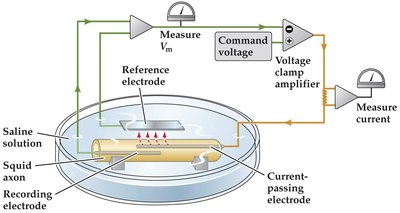
The voltage-clamp technique allows researchers to control the membrane potential (Vm) of a neuron and measure the resulting ionic currents. This method was pioneered by Kenneth Cole and applied by Hodgkin and Huxley.
Set parameter: Membrane potential (Vm) is held at a desired value.
Measured parameter: Ionic current (I) flowing across the membrane.
Calculated parameter: Conductance (g), using Ohm's Law.
Feedback circuit: Ensures Vm remains constant by injecting current as needed.
Ionic Composition of Neurons
Intracellular vs. Extracellular Ion Concentrations
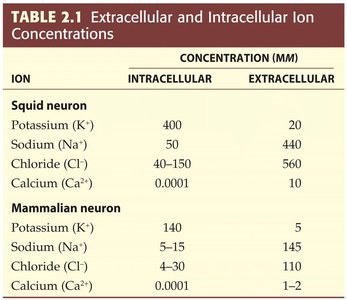
The distribution of ions across the neuronal membrane is crucial for establishing the resting membrane potential and for action potential generation.
Squid neuron: High intracellular K+, high extracellular Na+.
Mammalian neuron: Similar trends, but with different absolute concentrations.
Ion | Squid Neuron (Intracellular) | Squid Neuron (Extracellular) | Mammalian Neuron (Intracellular) | Mammalian Neuron (Extracellular) |
|---|---|---|---|---|
Potassium (K+) | 400 | 20 | 140 | 5 |
Sodium (Na+) | 50 | 440 | 5–15 | 145 |
Chloride (Cl–) | 40–150 | 560 | 4–30 | 110 |
Calcium (Ca2+) | 0.0001 | 10 | 0.0001 | 1–2 |
Voltage-Clamp Experiments: Membrane Current Responses
Hyperpolarization and Depolarization
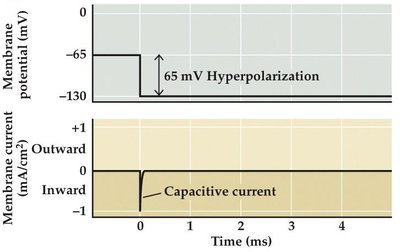
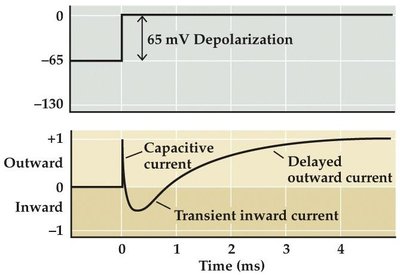
Voltage-clamp experiments reveal distinct current responses when the membrane is hyperpolarized or depolarized.
Hyperpolarization: Produces a capacitive current due to charge redistribution.
Depolarization: Reveals a transient inward current (Na+) followed by a delayed outward current (K+).
Characterization of Ionic Currents
Early Inward and Late Outward Currents
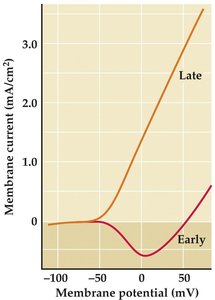
Hodgkin and Huxley identified two main components of ionic current during depolarization:
Early inward current: Carried by Na+, transient, disappears at positive potentials.
Late outward current: Carried by K+, increases with depolarization, persists.
Separating Ionic Currents: Ion Substitution and Pharmacology
Ion Substitution Experiments
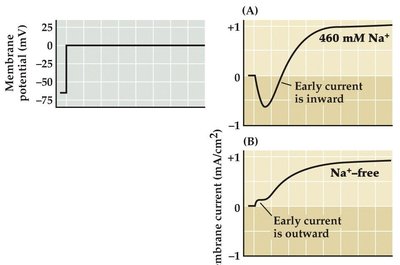
By altering extracellular ion concentrations, researchers can identify which ions carry specific currents.
Removing Na+: Early inward current disappears, confirming Na+ as its carrier.
Late outward current: Remains, indicating it is not carried by Na+.
Pharmacological Blockers
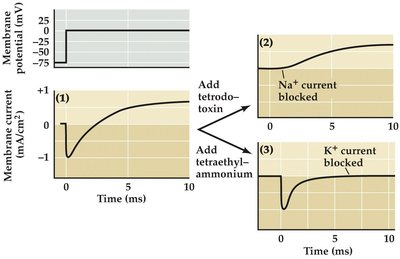
Specific drugs can block individual ionic currents:
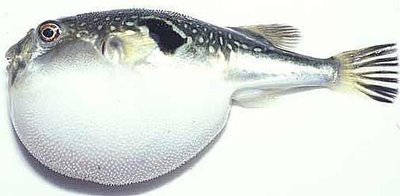
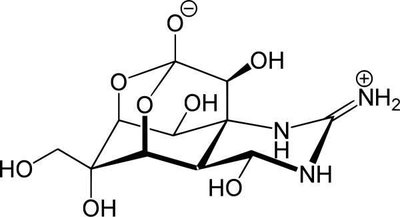
Tetrodotoxin (TTX): Blocks Na+ channels, eliminating the early inward current.
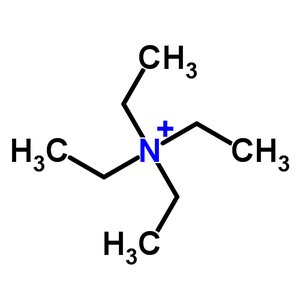
Tetraethylammonium (TEA): Blocks K+ channels, eliminating the late outward current.
Quantitative Analysis: Ohm's Law and Conductance
Calculating Conductance
Ohm's Law relates membrane current, voltage, and conductance:
Equation:
Conductance:
Driving force: The difference between membrane potential and equilibrium potential for each ion.
Voltage-Dependent Conductance of Na+ and K+
Key Features and g-V Curves
Na+ and K+ conductances exhibit distinct voltage-dependent behaviors:
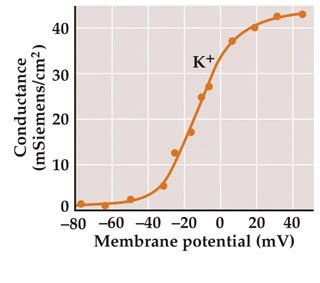
K+ conductance: Activation is delayed, reaches steady-state, does not inactivate.
Na+ conductance: Activation is rapid, exhibits inactivation after peak.
g-V curves: Show how conductance changes with membrane potential.

Time-Course of the Action Potential
Sequence of Ionic Events
The action potential is generated by a sequence of voltage-dependent processes:
At rest, permeability to K+ is high.
Increase in gNa leads to Na+ influx and depolarization.
At threshold, regenerative increase in gNa propels Vm toward ENa.
At AP peak, gNa inactivates and gK increases, causing repolarization.
gK dominates, leading to hyperpolarization (undershoot).
Voltage-dependent processes shut off, Vm returns to rest.
Refractory Periods
Absolute vs. Relative Refractory Period
After an action potential, the neuron cannot immediately fire another AP due to inactivation of Na+ channels.
Absolute refractory period: No new AP can be triggered; Na+ channels are inactivated.
Relative refractory period: A stronger stimulus is required; some Na+ channels have recovered.
Summary Table: Comparison of Na+ and K+ Conductances
Feature | Na+ Conductance (gNa) | K+ Conductance (gK) |
|---|---|---|
Activation | Rapid | Delayed |
Inactivation | Yes | No |
Peak Conductance | Function of Vm | Function of Vm |
Role in AP | Depolarization | Repolarization/Hyperpolarization |
Additional info: The Hodgkin-Huxley mathematical model, based on these voltage-clamp findings, accurately predicts the time-course and refractory periods of action potentials in neurons.
