 Back
BackIonic Basis of the Resting Membrane Potential: Study Guide
Study Guide - Smart Notes
 Tailored notes based on your materials, expanded with key definitions, examples, and context.
Ionic Basis of the Resting Membrane Potential
Introduction
The resting membrane potential is a fundamental property of all cells, especially neurons, and arises from the unequal distribution of ions across the cell membrane. This study guide explores the ionic gradients, membrane permeability, and the mathematical equations used to predict and explain membrane potentials.
Ions in Solution and Electrochemical Gradients
Water as the Solvent of Life
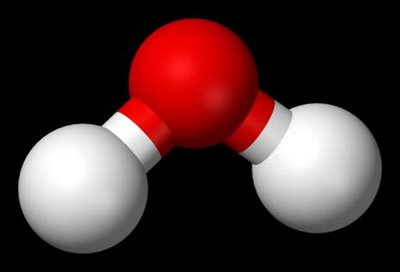
Water is the most abundant molecule in biological systems, serving as the medium for ion movement and biochemical reactions.
Molecular Weight: 18 g/mol
Density: ~1 kg/L
Concentration: ~55 mol/L (much higher than any other solute)
Role: Facilitates ion dissociation and transport
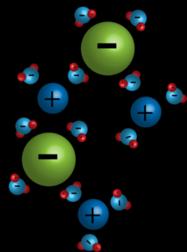
Ions in Water
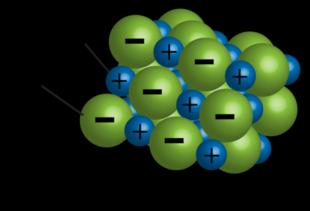
Ions are atoms or molecules with a net electrical charge. Common biological ions include sodium (Na+), potassium (K+), chloride (Cl-), and calcium (Ca2+).
Cations: Positively charged (e.g., Na+, K+)
Anions: Negatively charged (e.g., Cl-)
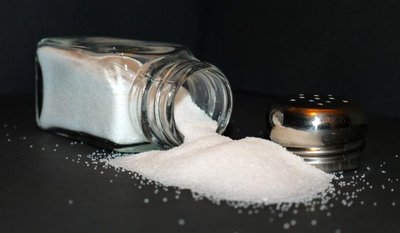
Dissociation: Ionic compounds like NaCl dissociate in water, allowing ions to move freely
Phospholipid Membranes and Ion Distribution
Phospholipid Bilayer Structure
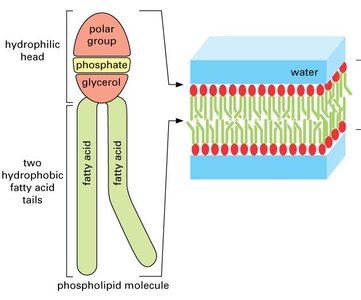
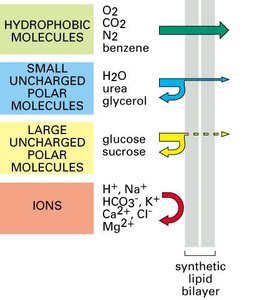
Cell membranes are composed of a phospholipid bilayer, which acts as a barrier to most ions and polar molecules.
Hydrophilic head: Faces water
Hydrophobic tails: Face inward, away from water
Function: Creates compartments and restricts ion movement
Selective Permeability
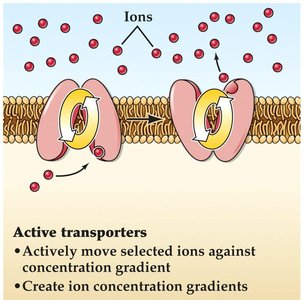
Membranes are selectively permeable, allowing certain ions to pass through via specific channels and transporters.
Transporters and Pumps: Actively move ions against concentration gradients
Ion Channels: Allow passive diffusion of ions down their concentration gradients
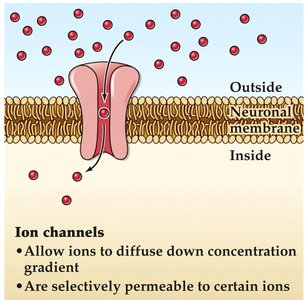
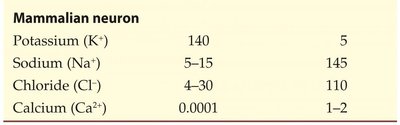
Ion Concentrations Inside and Outside Cells
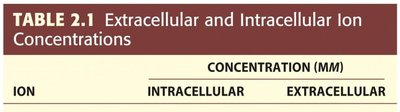
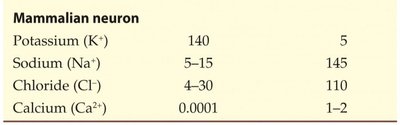
Ions are unequally distributed across cell membranes, creating concentration gradients that drive passive diffusion.
Ion | Intracellular (mM) | Extracellular (mM) |
|---|---|---|
Potassium (K+) | 140 | 5 |
Sodium (Na+) | 5–15 | 145 |
Chloride (Cl-) | 4–30 | 110 |
Calcium (Ca2+) | 0.0001 | 1–2 |
Membrane Potential and Electrical Signaling
Generation of Membrane Potential
The movement of ions across cell membranes generates electrical signals. Pumps and transporters maintain ionic gradients, resulting in a potential difference (membrane potential, Vm).
Current (I): Flow of ions through open channels
Membrane Potential (V): Difference in charge across the membrane
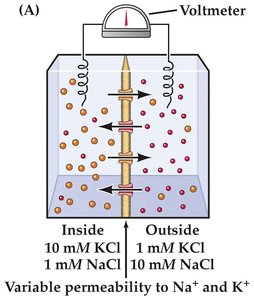
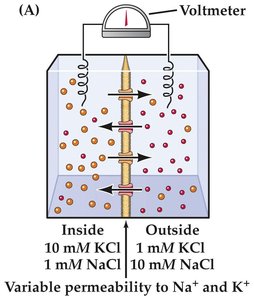
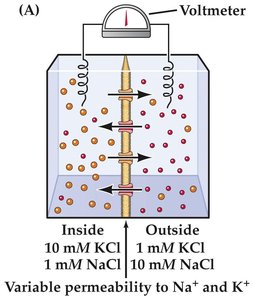
Two-Compartment Model
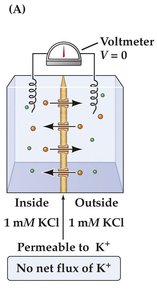
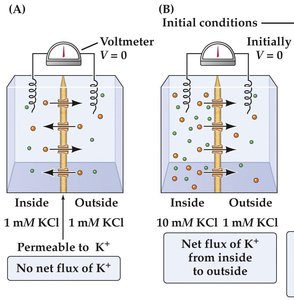
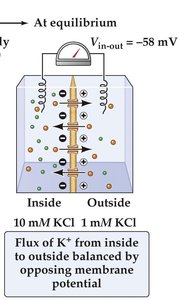
A simplified model illustrates how selective permeability and concentration gradients generate membrane potential.
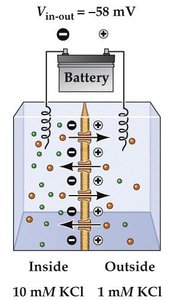
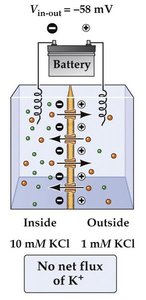
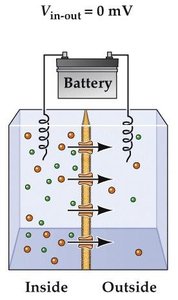
Equal KCl concentrations: No net flux, V = 0
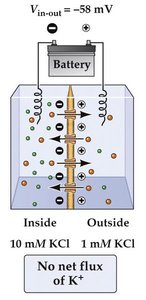
Higher KCl inside: K+ diffuses out, creating a positive charge outside
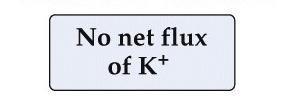
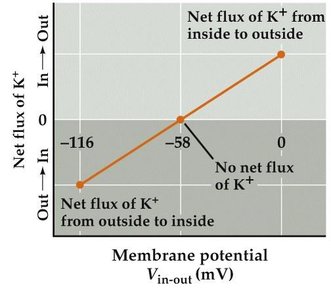
Electrochemical equilibrium: Electrical gradient opposes further K+ movement
The Nernst Equation and Equilibrium Potential
Definition and Calculation
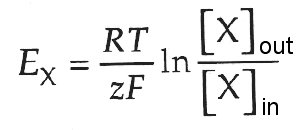
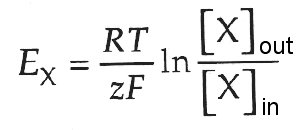
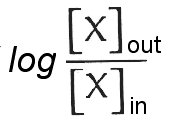
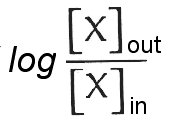
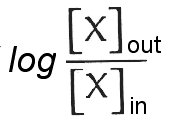
The equilibrium potential (EX) is the membrane potential at which the electrical and concentration gradients for a single ion are balanced. The Nernst equation calculates this potential.
Variables: R (gas constant), T (temperature), F (Faraday's constant), z (valence), [X]out, [X]in
Equation:
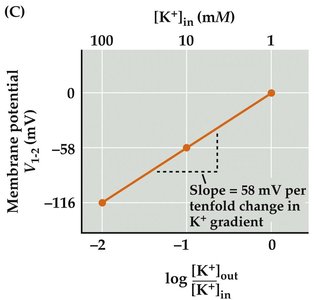
Simplified Nernst Equation for Monovalent Cations
At 18°C (291 K), for z = +1:
Example Calculation
For K+ with [K]in = 10 mM, [K]out = 1 mM:
Driving Force and Ionic Flux
Electrochemical Equilibrium and Ion Flux
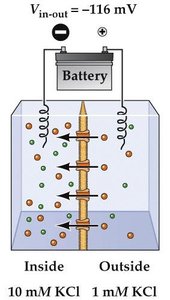
At equilibrium, the net movement of ions stops. Changing the membrane potential alters the direction and magnitude of ion flux.
Driving Force: Difference between membrane potential (Vm) and equilibrium potential (EX)
Equation:
Current-Voltage (IV) Relationship
IV Relationship for Cations and Anions
The IV relationship describes how current changes as a function of voltage. For cations, inward current is negative; for anions, current is opposite to ion flux.
Cations: Negative current = inward flux, positive current = outward flux
Anions: Current direction is opposite to ion flux
Typical Equilibrium Potentials in Neurons
Values for Major Ions
EK: ~ -90 mV
ECl: ~ -70 mV
ENa: ~ +60 mV
ECa: ~ +125 mV
Ohm’s Law and Driving Force
Ohm’s Law in Membrane Physiology
Ohm’s Law relates current, voltage, and resistance. In biological membranes, conductance (g) is the reciprocal of resistance (R).
Equation:
Driving Force:
Resting Membrane Potential and the Goldman Equation
Goldman-Hodgkin-Katz (GHK) Equation
The Goldman equation extends the Nernst equation to account for multiple ions and their relative permeabilities.
PX: Permeability coefficient for each ion
Vm: Determined by the weighted contributions of all permeant ions
Scenarios with Multiple Ions
Membrane only permeable to K+: Vm = EK
Membrane only permeable to Na+: Vm = ENa
Membrane equally permeable to both: Vm = 0 mV
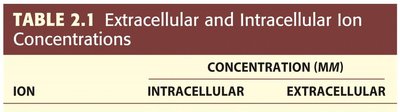

Summary Table: Extracellular and Intracellular Ion Concentrations
Ion | Intracellular (mM) | Extracellular (mM) |
|---|---|---|
Potassium (K+) | 140 | 5 |
Sodium (Na+) | 5–15 | 145 |
Chloride (Cl-) | 4–30 | 110 |
Calcium (Ca2+) | 0.0001 | 1–2 |
Key Concepts and Applications
Electrochemical equilibrium: Balance of electrical and concentration gradients
Nernst equation: Predicts equilibrium potential for a single ion
Goldman equation: Predicts membrane potential with multiple ions
Driving force: Determines direction and magnitude of ion flux
Resting membrane potential: Primarily determined by K+ permeability, but influenced by other ions
Example:
In a neuron, the resting membrane potential is typically around -70 mV, reflecting high permeability to K+ and lower permeability to Na+ and Cl-.
Additional info:
These notes expand on the original lecture content by providing definitions, equations, and context for the ionic basis of membrane potentials, suitable for exam preparation in anatomy and physiology courses.
