 Back
Ch 8 Joints (Articulations): Structure, Classification, and Features
Study Guide - Smart Notes
 Tailored notes based on your materials, expanded with key definitions, examples, and context.
Joints (Articulations)
Introduction to Joints
Joints, also known as articulations, are the sites where two or more bones meet. They play a crucial role in providing mobility and stability to the skeletal system. The structure and function of joints are essential topics in anatomy and physiology, particularly in understanding movement and support in the human body.
Articulation: The point of contact between bones, cartilage, or bones and teeth.
Functions of joints: Enable movement, provide stability, and connect bones.
Classification of Joints
Joints are classified in two main ways: functionally (by movement) and structurally (by material and cavity presence).
Functional classification: Based on the amount of movement allowed.
Structural classification: Based on the material binding bones and the presence or absence of a joint cavity.
Functional Classification of Joints
Types of Functional Joints
The functional classification describes joints according to their mobility.
Synarthroses: Immovable joints (e.g., sutures in the skull).
Amphiarthroses: Slightly movable joints (e.g., intervertebral discs).
Diarthroses: Freely movable joints (e.g., most limb joints).
Structural Classification of Joints
Types of Structural Joints
Structural classification is based on the material connecting the bones and the presence of a joint cavity.
Fibrous joints: Bones joined by dense fibrous connective tissue; no joint cavity.
Cartilaginous joints: Bones united by cartilage; no joint cavity.
Synovial joints: Bones separated by a fluid-filled joint cavity; most are freely movable.
Fibrous Joints
General Features
Fibrous joints are connected by dense fibrous connective tissue and lack a joint cavity. They are generally immovable or allow very limited movement.
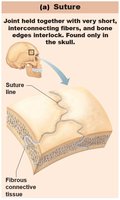
Suture: Found only in the skull; bones are held together by very short, interconnecting fibers, and bone edges interlock.
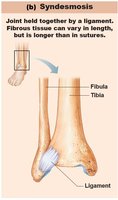
Syndesmosis: Bones are connected by a ligament; the amount of movement depends on the length of the ligament.
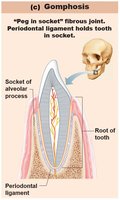
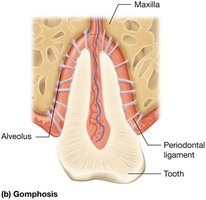
Gomphosis: A peg-in-socket joint; the tooth is held in its socket by the periodontal ligament.
Suture
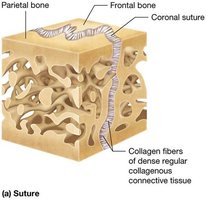
Sutures are immovable joints found exclusively in the skull, where short fibers tightly bind bones together.
Location: Skull
Structure: Interlocking bone edges with fibrous connective tissue
Syndesmosis
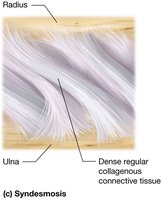
Syndesmoses are joints where bones are connected by ligaments, allowing more movement than sutures but still limited.
Examples: Distal tibiofibular joint, interosseous membrane between radius and ulna
Structure: Dense regular collagenous connective tissue
Gomphosis
Gomphoses are specialized fibrous joints where a peg-like structure fits into a socket, such as a tooth in its alveolus.
Location: Teeth and alveolar sockets
Structure: Periodontal ligament holds the tooth in place
Cartilaginous Joints
General Features
Cartilaginous joints are connected by cartilage and lack a joint cavity. They allow limited movement and are classified into two types: synchondroses and symphyses.
Synchondroses: Bones united by hyaline cartilage; typically immovable.
Symphyses: Bones united by fibrocartilage; allow limited movement.
Synchondroses
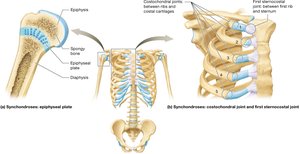
Synchondroses are joints where bones are joined by hyaline cartilage.
Examples: Epiphyseal plates in growing bones, first sternocostal joint
Structure: Hyaline cartilage
Symphyses
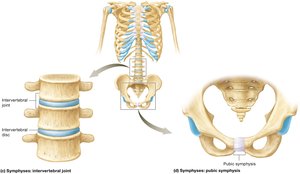
Symphyses are joints where bones are joined by fibrocartilage, providing strength and flexibility.
Examples: Intervertebral discs, pubic symphysis
Structure: Fibrocartilage
Synovial Joints
General Features
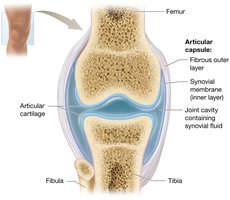
Synovial joints are the most common and most movable type of joint in the body. They are characterized by a fluid-filled joint cavity and are always diarthrotic (freely movable).
Articular cartilage: Covers bone surfaces to reduce friction.
Joint (synovial) cavity: Space containing synovial fluid.
Articular (joint) capsule: Encloses the joint cavity; consists of fibrous and synovial layers.
Synovial fluid: Lubricates and nourishes the joint.
Other Features of Some Synovial Joints
Some synovial joints have additional structures for improved function and protection.
Fatty pads: Cushioning between fibrous layer and synovial membrane or bone.
Articular discs (menisci): Fibrocartilage pads that improve the fit of bone ends, stabilize the joint, and reduce wear and tear.
Structures Associated with Synovial Joints
Bursae: Sacs lined with synovial membrane that reduce friction between moving structures.
Tendon sheaths: Elongated bursae wrapped around tendons subjected to friction.
Examples of Synovial Joints
Shoulder Joint
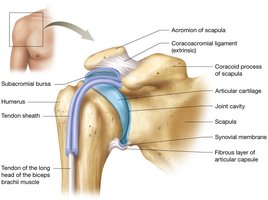
The shoulder joint is a synovial joint with a wide range of motion, stabilized by ligaments, tendons, and bursae.
Components: Articular cartilage, joint cavity, synovial membrane, fibrous capsule, ligaments, bursae, tendon sheaths
Knee Joint
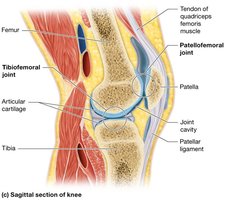
The knee joint is a complex synovial joint, including articular cartilage, menisci, ligaments, and bursae. It is essential for weight-bearing and movement.
Components: Tibiofemoral joint, patellofemoral joint, articular cartilage, joint cavity, patellar ligament, menisci
Summary Table: Structural and Functional Classification of Joints
Structural Classification | Functional Classification | Examples |
|---|---|---|
Fibrous | Synarthroses (immovable) | Sutures, syndesmoses, gomphoses |
Cartilaginous | Amphiarthroses (slightly movable) | Synchondroses, symphyses |
Synovial | Diarthroses (freely movable) | Shoulder, knee, hip, elbow |
Key Terms and Definitions
Articulation: The site where two bones meet.
Synarthrosis: An immovable joint.
Amphiarthrosis: A slightly movable joint.
Diarthrosis: A freely movable joint.
Fibrous joint: Joint connected by fibrous tissue.
Cartilaginous joint: Joint connected by cartilage.
Synovial joint: Joint with a fluid-filled cavity.
Equations and Formulas
Joint Classification Formula
The classification of joints can be summarized as:
Conclusion
Understanding the structure and classification of joints is fundamental in anatomy and physiology, as it provides insight into how the body moves and maintains stability. The various types of joints, their features, and associated structures are essential for both normal function and clinical assessment.
