 Back
BackJoints, Bone Development, and Movement: Study Notes for Anatomy & Physiology
Study Guide - Smart Notes
 Tailored notes based on your materials, expanded with key definitions, examples, and context.
Joints (Articulations)
Definition and Function
Joints, also known as articulations, are the sites where two or more bones meet. They are the weakest parts of the skeleton but serve essential functions:
Mobility: Allow movement of the skeleton.
Stability: Hold the skeleton together.
Classification of Joints
Structural Classification: Based on the material binding bones and presence of a joint cavity.
Fibrous Joints: Bones joined by fibrous tissue; no joint cavity; mostly immovable (e.g., sutures, syndesmoses, gomphoses).
Cartilaginous Joints: Bones united by cartilage; lack a joint cavity; can be immovable or slightly movable (e.g., synchondroses, symphyses).
Synovial Joints: Bones separated by a fluid-filled joint cavity; all are freely movable (diarthroses).
Functional Classification: Based on movement allowed.
Synarthroses: Immovable joints.
Amphiarthroses: Slightly movable joints.
Diarthroses: Freely movable joints.
Synovial Joints
General Structure
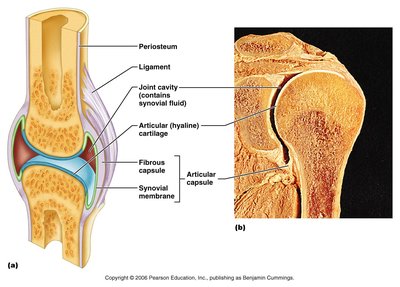
Synovial joints are characterized by the presence of a joint cavity containing synovial fluid. They are the most common and most movable type of joint in the body.
Articular cartilage: Hyaline cartilage covering bone surfaces.
Joint (synovial) cavity: Space containing synovial fluid.
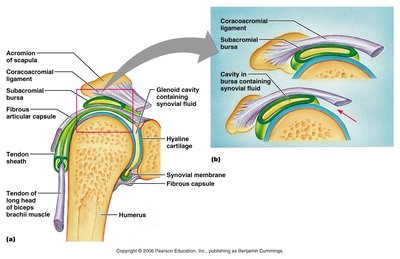
Articular capsule: Double-layered capsule surrounding the joint.
Synovial fluid: Lubricates and nourishes the joint.
Reinforcing ligaments: Strengthen and stabilize the joint.
Friction-Reducing Structures
Bursae: Flattened sacs lined with synovial membrane, reduce friction where ligaments, tendons, or bones rub together.
Tendon sheath: Elongated bursa wrapping around a tendon, especially in the digits.
Stability and Range of Motion
Articular surfaces: Shape determines possible movements.
Ligaments: Unite bones and prevent excessive motion.
Muscle tendons: Cross joints and help stabilize them.
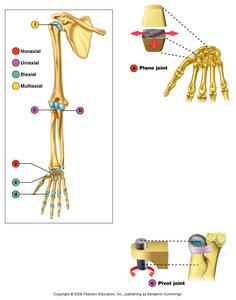
Range of Motion: Nonaxial (slipping), uniaxial (one plane), biaxial (two planes), multiaxial (all three planes).
Types of Synovial Joints
Plane Joint
Articular surfaces are flat, allowing only slipping or gliding movements. These are nonaxial joints, such as intercarpal and intertarsal joints.
Hinge Joint
Cylindrical projection of one bone fits into a trough-shaped surface of another. Uniaxial, permitting flexion and extension (e.g., elbow, interphalangeal joints).
Pivot Joint
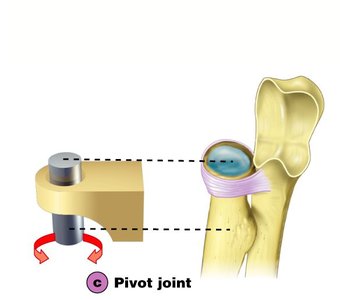
Rounded end of one bone protrudes into a ring formed by another bone or ligament. Allows uniaxial rotation (e.g., proximal radioulnar joint, joint between atlas and dens).
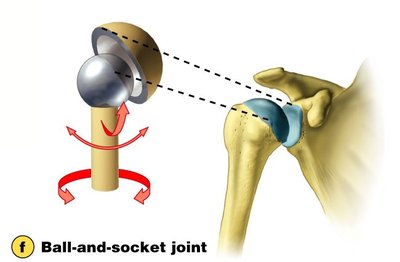
Ball-and-Socket Joint
Spherical head of one bone fits into a cuplike socket of another. Multiaxial, permitting the most freely moving synovial joints (e.g., shoulder, hip).
Movements at Synovial Joints
Angular Movements
Flexion: Decreases the angle of the joint.
Extension: Increases the angle of the joint.
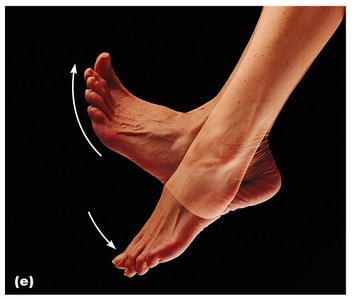
Dorsiflexion and Plantar Flexion: Up and down movement of the foot.
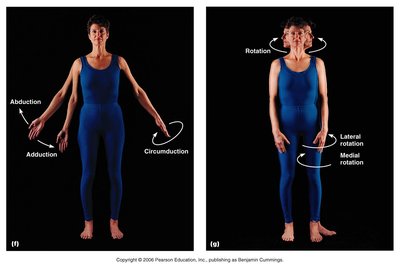
Abduction: Movement away from the midline.
Adduction: Movement toward the midline.
Circumduction: Movement describes a cone in space, combining flexion, abduction, extension, and adduction.
Rotation
Turning of a bone around its own long axis (e.g., between first two vertebrae, hip, and shoulder joints).
Special Movements
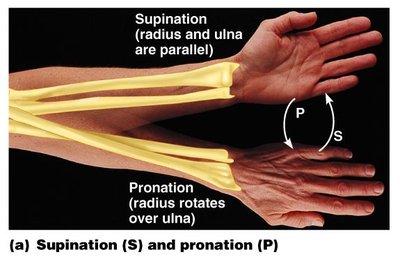
Supination and Pronation: Rotation of the forearm so the palm faces up (supination) or down (pronation).
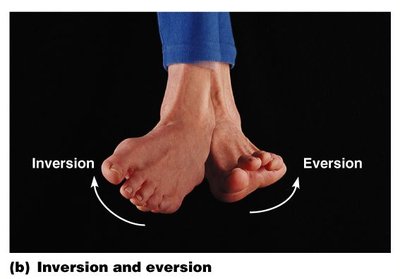
Inversion and Eversion: Turning the sole of the foot inward (inversion) or outward (eversion).
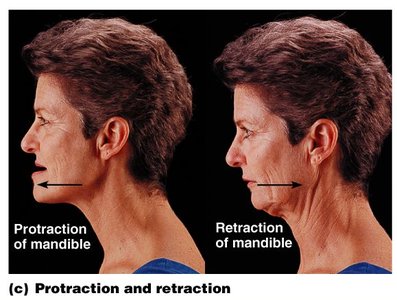
Protraction and Retraction: Moving a body part forward (protraction) or backward (retraction).
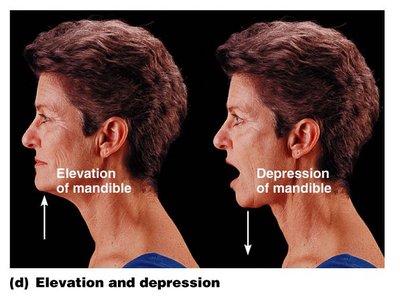
Elevation and Depression: Raising (elevation) or lowering (depression) a body part.
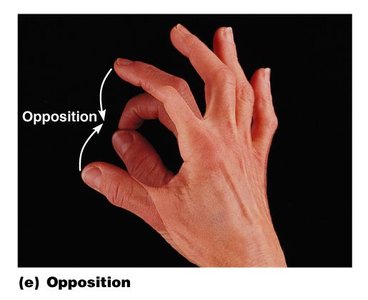
Opposition: Movement of the thumb to touch the tips of other fingers.
Bone Development and Growth
Osteogenesis and Ossification
Bone tissue formation and calcification occur through two main processes:
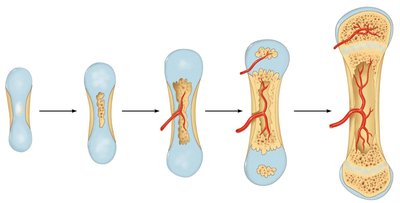
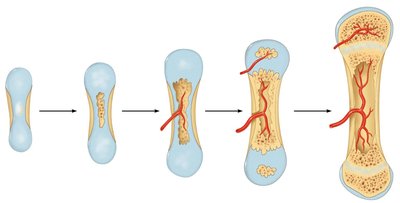
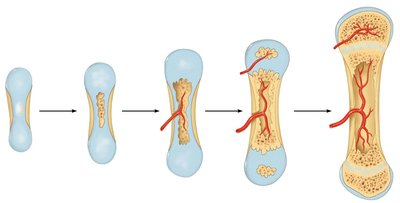
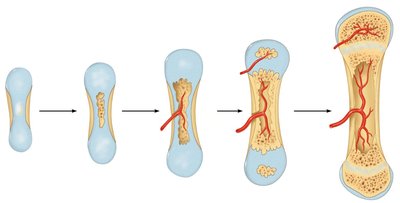
Intramembranous Ossification: Bone develops from a fibrous membrane, forming most flat bones of the skull and clavicles.
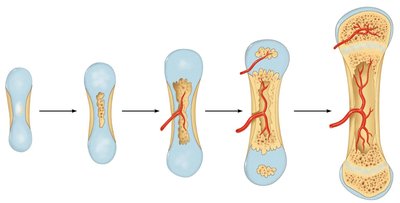
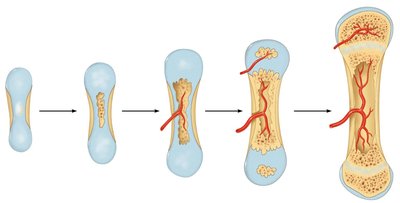
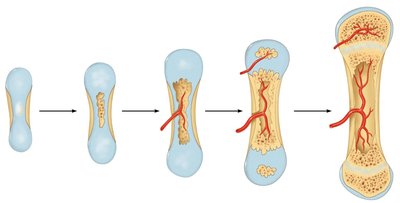
Endochondral Ossification: Bone forms by replacing hyaline cartilage, responsible for most bones in the body.
Stages of Endochondral Ossification
Formation of bone collar around hyaline cartilage model.
Cavitation of the hyaline cartilage within the cartilage model.
Invasion of internal cavities by the periosteal bud and spongy bone formation.
Formation of the medullary cavity; appearance of secondary ossification centers in the epiphyses.
Ossification of the epiphyses; hyaline cartilage remains only in the epiphyseal plates and articular cartilages.
Postnatal Bone Growth
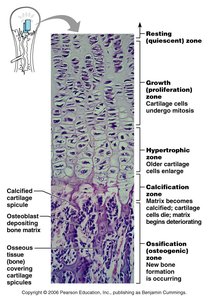
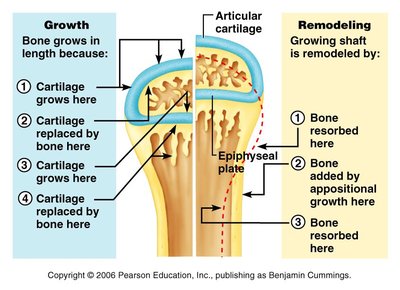
Long bones grow in length at the epiphyseal plate, which consists of several functional zones:
Resting (quiescent) zone: Relatively inactive cartilage.
Growth (proliferation) zone: Cartilage cells undergo mitosis.
Hypertrophic zone: Older cartilage cells enlarge.
Calcification zone: Matrix becomes calcified, cartilage cells die.
Osteogenic (ossification) zone: New bone formation occurs.
Long Bone Growth and Remodeling
Bone grows in length by the continuous growth and replacement of cartilage at the epiphyseal plate. Remodeling occurs by bone resorption and appositional growth.
Hormonal Regulation of Bone Growth and Calcium Homeostasis
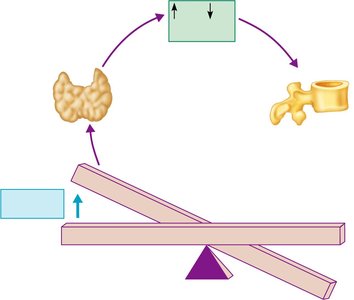
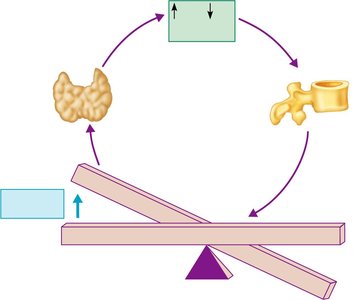
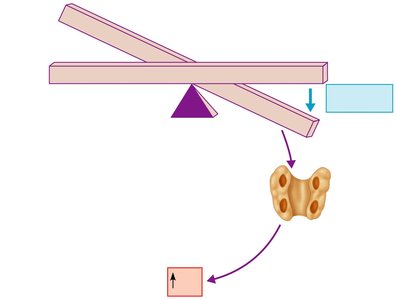
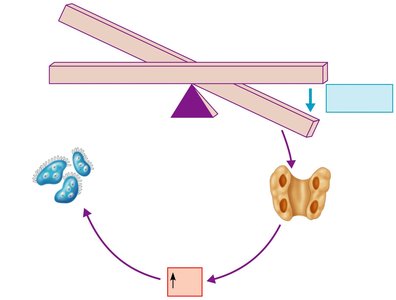
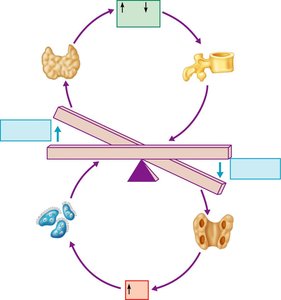
Hormonal Control of Blood Calcium
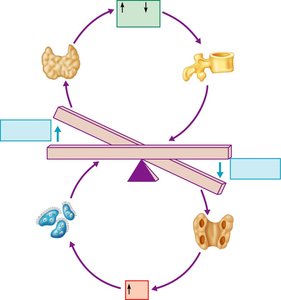
Calcium homeostasis is maintained by two main hormones:
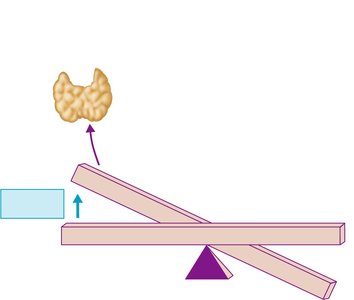
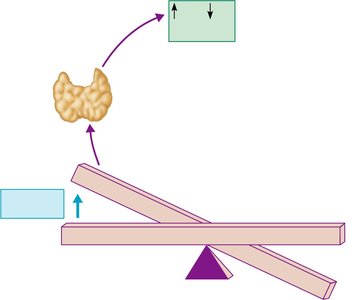
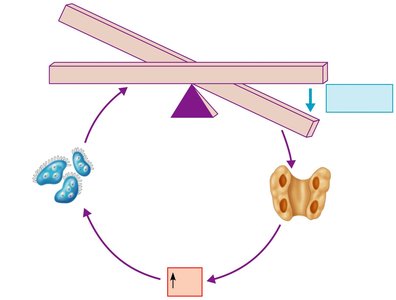
Calcitonin: Released by the thyroid gland when blood calcium levels rise; stimulates calcium salt deposition in bone.
Parathyroid Hormone (PTH): Released by the parathyroid glands when blood calcium levels fall; stimulates osteoclasts to degrade bone matrix and release calcium into the blood.
Normal blood calcium levels: 9–11 mg/100 ml.
Summary Table: Types of Synovial Joints
Joint Type | Movement | Example |
|---|---|---|
Plane | Nonaxial, gliding | Intercarpal joints |
Hinge | Uniaxial, flexion/extension | Elbow |
Pivot | Uniaxial, rotation | Proximal radioulnar joint |
Condyloid | Biaxial, angular | Wrist |
Saddle | Biaxial, greater movement | Thumb |
Ball-and-Socket | Multiaxial, most movement | Shoulder, hip |
Key Terms and Definitions
Articulation: Site where two or more bones meet.
Synovial fluid: Lubricating fluid in synovial joints.
Osteogenesis: Formation of bone tissue.
Epiphyseal plate: Growth plate in long bones.
Osteoclast: Bone-resorbing cell.
Osteoblast: Bone-forming cell.
Calcitonin: Hormone lowering blood calcium.
PTH: Hormone raising blood calcium.
Equations
Calcium homeostasis equation:
Hormonal regulation:
