 Back
Kidney Anatomy, Blood Flow, and Nephron Structure Study Guide
Study Guide - Smart Notes
 Tailored notes based on your materials, expanded with key definitions, examples, and context.
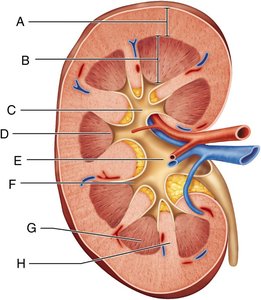
Q1. Assign the letters (A–H) to their corresponding regions and structures shown in the figure of the internal anatomy of the kidney.
Background
Topic: Kidney Anatomy
This question tests your knowledge of the gross anatomical regions and structures of the kidney, which is essential for understanding renal physiology and urine formation.
Key Terms:
Renal cortex: The outer region of the kidney.
Renal medulla: The inner region, containing renal pyramids.
Renal pyramid: Cone-shaped tissue masses in the medulla.
Renal column: Extensions of cortex between pyramids.
Renal pelvis: Funnel-shaped tube that collects urine.
Major and minor calyces: Chambers that collect urine from pyramids.
Papilla of pyramid: Tip of the renal pyramid.
Step-by-Step Guidance
Examine the labeled diagram and identify the outermost region (usually labeled as the cortex).
Locate the inner region with the cone-shaped structures (renal pyramids) and the areas between them (renal columns).
Identify the funnel-shaped structure in the center (renal pelvis) and the branching chambers (major and minor calyces).
Match each label (A–H) to the correct anatomical structure based on its location and description.
Try solving on your own before revealing the answer!
Final Answer:
A: Renal cortex
B: Renal medulla
C: Major calyx
D: Papilla of pyramid
E: Renal pelvis
F: Minor calyx
G: Renal pyramid
H: Renal column
Each label corresponds to a distinct region or structure within the kidney, which is important for understanding how urine is formed and transported.
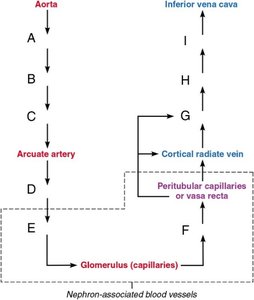
Q2. Assign the letters (A–I) to the missing blood vessels in the path of blood flow through the kidney.
Background
Topic: Renal Blood Flow
This question tests your understanding of the sequence of blood vessels that supply and drain the kidney, which is crucial for renal function and filtration.
Key Terms:
Renal artery: Supplies blood to the kidney.
Segmental artery, interlobar artery, arcuate artery, cortical radiate artery: Branches of the renal artery.
Afferent arteriole: Brings blood to the glomerulus.
Efferent arteriole: Drains blood from the glomerulus.
Renal vein: Drains blood from the kidney.
Step-by-Step Guidance
Start at the aorta and follow the sequence of arteries as they branch into the kidney.
Identify the afferent and efferent arterioles associated with the glomerulus.
Trace the path of blood as it leaves the glomerulus and moves through the veins.
Match each letter (A–I) to the correct vessel based on its position in the diagram.
Try solving on your own before revealing the answer!
Final Answer:
A: Renal artery
B: Segmental artery
C: Interlobar artery
D: Cortical radiate artery
E: Afferent arteriole
F: Efferent arteriole
G: Arcuate vein
H: Interlobar vein
I: Renal vein
Understanding the sequence of blood vessels is essential for grasping how the kidney filters blood and maintains homeostasis.
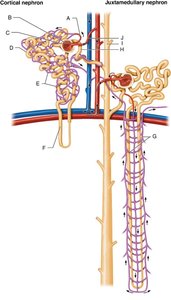
Q3. Assign the letters (A–J) to the corresponding parts of a nephron and associated structures.
Background
Topic: Nephron Anatomy
This question tests your ability to identify the structural components of a nephron, the functional unit of the kidney, and their associated blood vessels.
Key Terms:
Renal corpuscle: Includes the glomerulus and glomerular capsule.
Renal tubule: Includes proximal convoluted tubule, nephron loop, distal convoluted tubule.
Associated blood vessels: Afferent arteriole, efferent arteriole, peritubular capillaries, vasa recta.
Collecting duct: Receives filtrate from multiple nephrons.
Step-by-Step Guidance
Examine the diagram and locate the renal corpuscle and its two main parts.
Identify the three major segments of the renal tubule.
Find the associated blood vessels and the collecting duct.
Match each label (A–J) to the correct structure based on its location and function.
Try solving on your own before revealing the answer!
Final Answer:
A: Efferent arteriole
B: Glomerulus
C: Glomerular capsule
D: Proximal convoluted tubule
E: Peritubular capillaries
F: Nephron loop
G: Vasa recta
H: Distal convoluted tubule
I: Collecting duct
J: Afferent arteriole
Each part of the nephron plays a specific role in filtration, reabsorption, and secretion, which are key processes in urine formation.
