 Back
Lab 6: Culture Media & Aseptic Techniques – Study Notes
Study Guide - Smart Notes
 Tailored notes based on your materials, expanded with key definitions, examples, and context.
Culture Media & Aseptic Techniques
Introduction
This section covers the fundamentals of culture media and aseptic techniques, which are essential for cultivating and studying microorganisms in the laboratory. Understanding the types, composition, and uses of culture media, as well as the importance of aseptic and sterilization methods, is foundational for microbiology and related biomedical sciences.
Types of Culture Media
Chemically Defined Media
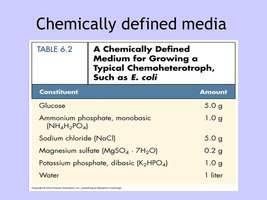
Chemically defined media are prepared from pure chemical substances, and their exact chemical composition is known. These media are used for culturing microbes with well-characterized nutritional requirements, such as Escherichia coli in research settings.
Definition: Media with precisely known quantities of all ingredients.
Application: Used for experiments requiring reproducibility and for growing fastidious organisms.
Example: A typical medium for chemoheterotrophs like E. coli contains glucose, ammonium phosphate, sodium chloride, magnesium sulfate, potassium phosphate, and water.
Complex Media
Complex media contain extracts and digests of yeast, meat, or plants. The exact chemical composition is not known, making them suitable for growing a wide variety of microorganisms, especially when their nutritional requirements are not fully understood.
Definition: Media with at least one ingredient of unknown composition (e.g., beef extract).
Application: Used for routine cultivation and maintenance of microbial cultures.
Forms of Culture Media
Broth Media
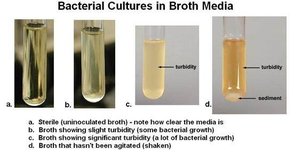
Broth is a liquid medium that supports the growth of bacteria in suspension. It is useful for producing large numbers of cells in a small volume.
Advantages: Efficient for growing many bacteria; easy to transport.
Limitation: Purity must be checked periodically, as contamination is not always visible.
Growth Indication: Turbidity (cloudiness) indicates bacterial growth.
Agar Media
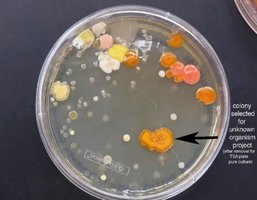
Agar is a solidifying agent derived from seaweed, added to liquid media to create a solid surface for microbial growth. It is not digested by most bacteria, making it ideal for culturing and isolating colonies.
Properties of Agar:
Solidifies at ~40°C, liquefies at ~100°C
Not digested by most microbes
Allows for observation of colony morphology
Agar Plates
Petri dishes containing a thin layer of agar provide a large surface area for the isolation and observation of colonies.
Advantage: Enables isolation of pure colonies from mixed populations.
Limitation: Not suitable for long-term maintenance of cultures.

Agar Slants
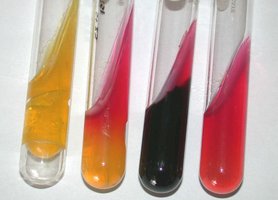
Test tubes with agar solidified at an angle provide a small surface area and a deep butt, which helps maintain cultures for extended periods.
Advantage: Good for storage and maintenance of stock cultures.
Structure: Slanted surface for aerobic growth, deep butt for anaerobic growth or nutrient reserve.
Semi-Solid Deeps
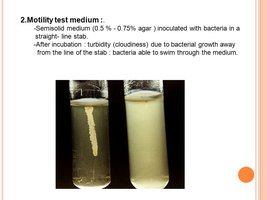
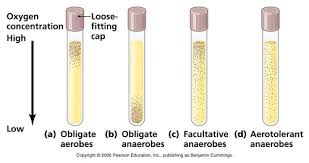
Semi-solid media contain less agar (0.05–0.5%) and are used for motility assays and to grow bacteria with different oxygen requirements.
Application: Used to test bacterial motility and oxygen preferences.
Observation: Motile bacteria spread from the line of inoculation, causing turbidity.
Aseptic Techniques
Definition and Importance
Aseptic techniques are procedures used to prevent contamination of cultures, media, and the laboratory environment by unwanted microorganisms. These techniques are essential for obtaining reliable experimental results and ensuring safety.
Examples: Washing hands, wearing gloves, sterilizing equipment.


Sterilization Methods
Sterilization is the complete elimination of all living organisms from an object or environment. Common methods include:
Moist Heat: Autoclaving uses pressurized steam to sterilize media and equipment.
Dry Heat: Flaming inoculating loops and needles.


Streak Plating
Purpose and Method
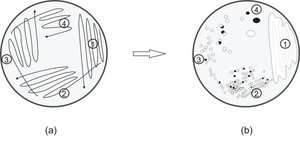
Streak plating is a technique used to isolate pure cultures from mixed microbial populations. By sequentially diluting a sample across the surface of an agar plate, individual cells are separated and grow into distinct colonies.
Purpose: To obtain pure cultures for further study and testing.
Process: Involves streaking a loopful of sample over different sections of the plate, followed by incubation.


Summary Table: Types of Culture Media
Type | Composition | Form | Application |
|---|---|---|---|
Chemically Defined | Known chemicals | Broth, Agar | Research, fastidious microbes |
Complex | Extracts/digests | Broth, Agar | Routine cultivation |
Semi-solid | Low agar | Deep | Motility, oxygen requirements |
Additional info: Mastery of these techniques is foundational for all laboratory work in microbiology, clinical diagnostics, and research involving microorganisms.
