 Back
Lymphatic System: Structure, Function, and Immune Role
Study Guide - Smart Notes
 Tailored notes based on your materials, expanded with key definitions, examples, and context.
Lymphatic System
Structure and Distribution of Lymphatic Vessels
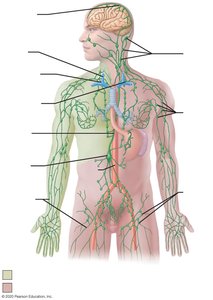
The lymphatic system is a network of vessels and nodes that plays a crucial role in fluid balance and immune defense. Lymphatic vessels are distributed throughout the body, collecting excess interstitial fluid and returning it to the bloodstream.
Lymphatic Capillaries: Small, thin-walled vessels located near blood capillaries; absorb interstitial fluid.
Collecting Lymphatic Vessels: Larger vessels that transport lymph toward lymph nodes and eventually to the venous system.
Regional Lymph Nodes: Clustered in key areas such as the cervical, axillary, and inguinal regions.
Example: Lymphatic vessels in the arm drain lymph toward axillary lymph nodes, which filter pathogens before lymph re-enters circulation.
Formation and Transport of Lymph
Lymph is formed when interstitial fluid enters lymphatic capillaries. The transport of lymph relies on several mechanisms:
Pressure Gradients: Created by skeletal muscle contraction and respiratory movements.
Valves: Prevent backflow, ensuring unidirectional movement toward the heart.
Additional info: Lymph flow is slower than blood flow, allowing time for immune surveillance.
Functions of Lymphatic Vessels
Lymphatic vessels serve several important functions:
Fluid Balance: Return excess interstitial fluid to the bloodstream.
Absorption of Fats: Specialized lymphatic vessels (lacteals) in the intestine absorb dietary fats.
Immune Defense: Transport lymphocytes and filter pathogens through lymph nodes.
Lymph Nodes as Lymphatic Organs
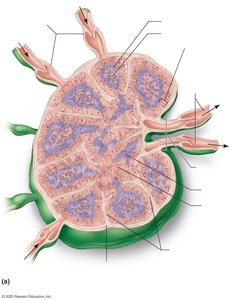
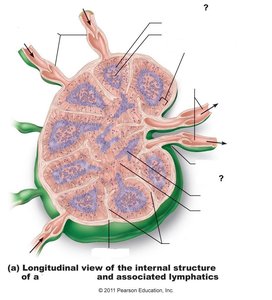
Lymph nodes are small, bean-shaped structures that filter lymph and house immune cells. They are key sites for immune activation.
Structure: Encapsulated with an outer cortex and inner medulla.
Function: Trap pathogens and present them to lymphocytes for immune response.
Example: Swollen lymph nodes often indicate infection as immune cells proliferate.
Lymphocytes: Function, Recirculation, and Activation
Lymphocytes are white blood cells central to adaptive immunity. They circulate between blood, lymph, and lymphoid tissues.
B Lymphocytes: Produce antibodies; mature in bone marrow.
T Lymphocytes: Attack infected cells; mature in thymus.
Activation: Occurs when lymphocytes encounter antigens in lymph nodes or other lymphoid organs.
Structure of Lymphoid Tissue and Infection-Fighting Function
Lymphoid tissue is specialized for immune defense, containing dense populations of lymphocytes and macrophages.
Reticular Connective Tissue: Forms the structural framework of lymphoid organs.
Follicles: Sites of B cell activation and proliferation.
Locations, Histological Structure, and Immune Functions of Lymphoid Organs
The lymphatic system includes several organs, each with distinct structure and immune functions:
Thymus: Site of T cell maturation; located in the mediastinum.
Lymph Nodes: Filter lymph; clustered in cervical, axillary, and inguinal regions.
Spleen: Filters blood, removes old erythrocytes, and mounts immune responses.
Tonsils: Guard the entrance to the pharynx; trap pathogens from food and air.
Aggregated Lymphoid Nodules (Peyer’s Patches): Located in the intestine; monitor gut pathogens.
Appendix: Contains lymphoid tissue; contributes to gut immunity.
Summary Table: Major Lymphoid Organs and Their Functions
Organ | Location | Main Function |
|---|---|---|
Thymus | Mediastinum | T cell maturation |
Lymph Nodes | Cervical, axillary, inguinal regions | Filter lymph, immune activation |
Spleen | Left upper abdomen | Filter blood, immune response |
Tonsils | Pharynx | Trap pathogens from food/air |
Peyer’s Patches | Intestine | Monitor gut pathogens |
Appendix | Lower right abdomen | Gut immunity |
Key Terms and Definitions
Lymph: Clear fluid derived from interstitial fluid, transported by lymphatic vessels.
Lymphocyte: White blood cell involved in adaptive immunity.
Lymph Node: Organ that filters lymph and houses immune cells.
Lymphoid Tissue: Tissue rich in lymphocytes and macrophages, specialized for immune defense.
Relevant Equations
Fluid movement in capillaries and lymphatic vessels is governed by Starling’s Law:
Additional info: This equation explains how fluid leaves capillaries and enters lymphatic vessels.
