 Back
Major Arteries and Veins of the Human Body
Study Guide - Smart Notes
 Tailored notes based on your materials, expanded with key definitions, examples, and context.
Major Vessels of the Arterial System
Overview of the Arterial System
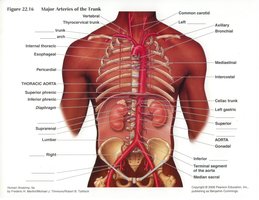
The arterial system is responsible for transporting oxygenated blood from the heart to various tissues throughout the body. The major arteries branch from the aorta and supply blood to the head, neck, trunk, and limbs.
Aorta: The largest artery in the body, originating from the left ventricle of the heart and branching into the thoracic and abdominal aorta.
Brachiocephalic artery: Supplies blood to the right arm and the head and neck.
Subclavian arteries: Supply blood to the arms and part of the thorax.
Common carotid arteries: Supply blood to the head and neck.
Renal arteries: Supply blood to the kidneys.
Common iliac arteries: Branch from the abdominal aorta to supply the pelvis and lower limbs.
External and internal iliac arteries: The external iliac continues into the leg as the femoral artery, while the internal iliac supplies the pelvic organs.
Mesenteric arteries (superior and inferior): Supply blood to the intestines.
Splenic artery: Supplies blood to the spleen.
Common hepatic artery: Supplies blood to the liver.
Major Veins of the Systemic Circulation
Overview of the Venous System
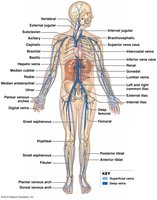
The venous system returns deoxygenated blood from the body back to the heart. Major veins often run parallel to arteries and are named similarly.
Superior and inferior vena cava: The largest veins, returning blood from the upper and lower body to the right atrium of the heart.
Jugular veins: Drain blood from the head and neck.
Subclavian veins: Drain blood from the arms.
Renal veins: Drain blood from the kidneys.
Common iliac veins: Drain blood from the pelvis and lower limbs.
Femoral vein: Major vein of the thigh, continuing as the external iliac vein.
Great saphenous vein: The longest vein in the body, running along the length of the lower limb.
Arteries and Veins of the Lower Limb
Major Arteries of the Lower Limb
The lower limb receives blood from branches of the external iliac artery, which becomes the femoral artery as it passes into the thigh. The femoral artery gives rise to several important branches that supply the leg and foot.
Femoral artery: Main artery of the thigh.
Popliteal artery: Continuation of the femoral artery behind the knee.
Anterior and posterior tibial arteries: Supply the anterior and posterior compartments of the leg, respectively.
Fibular (peroneal) artery: Supplies the lateral compartment of the leg.
Dorsalis pedis artery: Continuation of the anterior tibial artery on the dorsum of the foot.

Major Veins of the Lower Limb
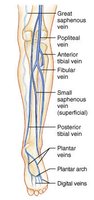
The veins of the lower limb are divided into superficial and deep veins. The great saphenous vein is the main superficial vein, while the femoral and popliteal veins are the main deep veins.
Great saphenous vein: Runs along the medial aspect of the leg and thigh, draining into the femoral vein.
Small saphenous vein: Runs along the posterior aspect of the leg, draining into the popliteal vein.
Femoral vein: Main deep vein of the thigh.
Popliteal vein: Deep vein behind the knee.
Anterior and posterior tibial veins: Deep veins of the leg.
Summary Table: Major Arteries and Veins
Region | Major Artery | Major Vein |
|---|---|---|
Head & Neck | Common carotid | Jugular |
Upper Limb | Subclavian, Brachial | Subclavian, Cephalic, Basilic |
Abdomen | Aorta, Renal, Mesenteric | Inferior vena cava, Renal |
Pelvis & Lower Limb | Common iliac, Femoral, Popliteal, Tibial | Common iliac, Femoral, Great saphenous |
Clinical Relevance
Importance of Vascular Anatomy
Understanding the major arteries and veins is crucial for clinical procedures such as blood draws, intravenous access, and the management of trauma or vascular diseases. Injuries to major vessels can lead to life-threatening hemorrhage and require immediate medical attention.
