 Back
BackMajor Brain Regions and Their Functions
Study Guide - Smart Notes
 Tailored notes based on your materials, expanded with key definitions, examples, and context.
Major Brain Regions
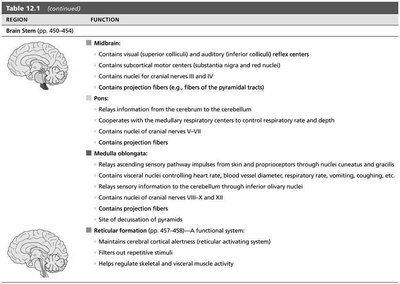
Anatomy of the Brain
The human brain is a complex organ composed of several distinct regions, each with specialized functions. Understanding the structure and function of these regions is essential for studying the central nervous system.
Cerebral Hemispheres: The largest part of the brain, responsible for higher cognitive functions.
Diencephalon: Includes the thalamus, hypothalamus, and epithalamus, which regulate sensory processing and homeostasis.
Brain Stem: Composed of the midbrain, pons, and medulla oblongata, it controls vital functions and relays information.
Cerebellum: Coordinates movement and maintains balance.
Functions of Major Brain Regions
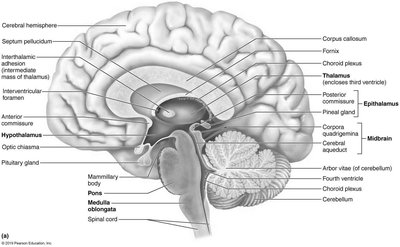
Cerebral Hemispheres
The cerebral hemispheres are involved in sensory interpretation, voluntary movement, and higher intellectual functions.
Cortical gray matter:
Localizes and interprets sensory inputs
Controls voluntary and skilled skeletal muscle activity
Functions in intellectual and emotional processing
Basal nuclei (ganglia):
Subcortical motor centers
Help control skeletal muscle movements
Diencephalon
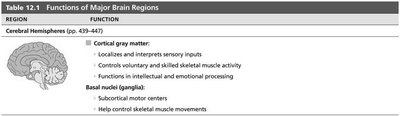
The diencephalon is a central relay and regulatory center, consisting of the thalamus, hypothalamus, and limbic system.
Thalamus:
Relays sensory impulses to cerebral cortex for interpretation
Relays impulses between cerebral motor cortex and lower motor centers, including cerebellum
Involved in memory processing
Hypothalamus:
Chief integration center of autonomic (involuntary) nervous system
Regulates body temperature, food intake, water balance, thirst, and biological rhythms and drives
Regulates hormonal output of anterior pituitary gland
Acts as an endocrine organ, producing posterior pituitary hormones ADH and oxytocin
Limbic system:
Includes cerebral and diencephalon structures (e.g., hypothalamus and anterior thalamic nuclei)
Mediates emotional response
Involved in memory processing
Brain Stem
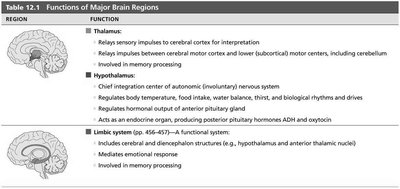
The brain stem is responsible for basic life functions and acts as a conduit for information between the brain and spinal cord.
Midbrain:
Contains visual (superior colliculi) and auditory (inferior colliculi) reflex centers
Contains subcortical motor centers (substantia nigra and red nucleus)
Relays information for cranial nerves III and IV
Contains projection fibers (e.g., fibers of the pyramidal tract)
Pons:
Relays information from the cerebrum to the cerebellum
Cooperates with the medullary respiratory centers to control respiratory rate and depth
Contains nuclei of cranial nerves V-VII
Contains projection fibers
Medulla oblongata:
Relays ascending sensory pathway impulses from skin and proprioceptors through nuclei cuneatus and gracilis
Contains nuclei controlling heart rate, blood vessel diameter, respiratory rate, vomiting, coughing, etc.
Relays information to the cerebellum through inferior olivary nuclei
Contains nuclei of cranial nerves VIII-XII
Contains projection fibers
Site of decussation of pyramids
Reticular formation:
Maintains cerebral cortical alertness (reticular activating system)
Filters out repetitive stimuli
Helps regulate skeletal and visceral muscle activity
Cerebellum
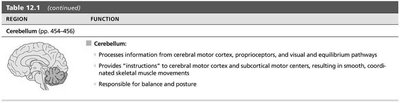
The cerebellum is essential for motor coordination, balance, and posture.
Processes information from cerebral motor cortex, proprioceptors, and visual and equilibrium pathways
Provides "instructions" to cerebral motor cortex and subcortical motor centers, resulting in smooth, coordinated skeletal muscle movements
Responsible for balance and posture
Summary Table: Functions of Major Brain Regions
Region | Main Functions |
|---|---|
Cerebral Hemispheres | Sensory interpretation, voluntary movement, intellectual and emotional processing |
Thalamus | Sensory relay, motor coordination, memory processing |
Hypothalamus | Autonomic regulation, hormone production, homeostasis |
Limbic System | Emotion mediation, memory processing |
Midbrain | Visual and auditory reflexes, motor control |
Pons | Relay between cerebrum and cerebellum, respiratory control |
Medulla Oblongata | Vital functions (heart rate, respiration), sensory relay |
Cerebellum | Motor coordination, balance, posture |
Additional info: The notes above expand on the brief points in the original tables, providing definitions and context for each brain region and its function. This guide is suitable for exam preparation in college-level anatomy and physiology courses.
