 Back
BackMajor Endocrine Organs Identification and Endocrine System Study Guide
Study Guide - Smart Notes
 Tailored notes based on your materials, expanded with key definitions, examples, and context.
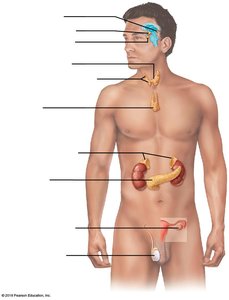
Q17. Identify the Major Endocrine Organs on the Diagram
Background
Topic: Endocrine System Anatomy
This question tests your ability to recognize and label the major endocrine glands in the human body. Understanding the location and function of these glands is foundational for studying hormone regulation and endocrine disorders.
Key Terms:
Endocrine glands: Ductless glands that secrete hormones directly into the bloodstream.
Hormones: Chemical messengers that regulate physiological processes.
Major glands to identify: Pituitary, Pineal, Thyroid, Parathyroid, Thymus, Adrenal, Pancreas, Ovaries (female), Testes (male).
Step-by-Step Guidance
Start at the top of the diagram and work your way down. The gland located at the base of the brain is the pituitary gland, often called the "master gland." It is just below the hypothalamus.
Just above the pituitary, in the brain, is the pineal gland. It is small and involved in regulating sleep cycles.
In the neck region, you will find the thyroid gland (anterior to the trachea) and the parathyroid glands (typically on the posterior side of the thyroid).
Below the neck, in the upper chest behind the sternum, is the thymus gland (more prominent in children).
On top of each kidney are the adrenal glands. The pancreas is located behind the stomach, extending toward the left side of the abdomen.
In males, the testes are located in the scrotal sac. In females (not shown in this diagram), the ovaries are in the pelvic cavity.
Try solving on your own before revealing the answer!
Final Answer: Major Endocrine Organs Labeled
Pineal gland (brain, superior and posterior)
Pituitary gland (base of brain, below hypothalamus)
Thyroid gland (anterior neck)
Parathyroid glands (posterior to thyroid)
Thymus gland (upper chest, behind sternum)
Adrenal glands (on top of kidneys)
Pancreas (behind stomach, across abdomen)
Testes (scrotal sac, male)
Correct identification of these glands is essential for understanding hormone production and regulation in the body.
