 Back
Male Accessory Glands and Semen: Structure, Function, and Clinical Relevance
Study Guide - Smart Notes
 Tailored notes based on your materials, expanded with key definitions, examples, and context.
Male Accessory Glands
Overview of Male Accessory Glands
The male accessory glands are essential components of the male reproductive system, producing the majority of the fluid that constitutes semen. The main accessory glands include the paired seminal glands (seminal vesicles), the prostate, and the paired bulbo-urethral glands. Each gland contributes unique secretions that support sperm function and reproductive success.
Seminal glands: Located on the posterior bladder surface, these glands contribute a significant portion of semen volume.
Prostate: A single, doughnut-shaped gland encircling the urethra just below the bladder.
Bulbo-urethral glands: Small, pea-sized glands situated inferior to the prostate within the deep perineal muscles.
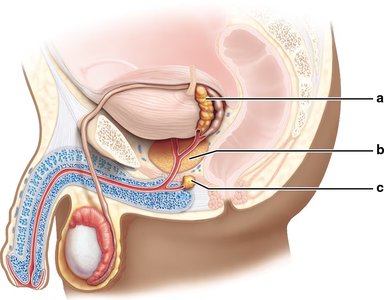
Seminal Glands (Seminal Vesicles)
The seminal glands are large, hollow, and highly coiled structures. Their secretions account for a substantial fraction of semen volume and are released during ejaculation.
Location: Posterior to the bladder.
Structure: Pouched, coiled, and folded; uncoiled length is much greater than apparent size.
Secretions: Yellowish, viscous, alkaline fluid containing fructose, citric acid, coagulating enzyme, prostaglandins, and other substances that enhance sperm motility and fertilizing ability.
Function: Provides nutrients and increases sperm motility; yellow pigment fluoresces under UV light, aiding forensic investigations.
Connection: Duct of each seminal gland joins the ductus deferens to form the ejaculatory duct.
Prostate
The prostate is a single gland that surrounds the urethra just below the bladder. It contributes a milky, slightly acidic fluid to semen, which is important for sperm activation.
Location: Inferior to the bladder, encircling the urethra.
Structure: Compound tubuloalveolar glands within a stroma of smooth muscle and dense connective tissue.
Secretions: Milky, slightly acidic fluid containing citrate, enzymes (including prostate-specific antigen (PSA)).
Function: Activates sperm; accounts for up to one-third of semen volume.
Clinical Relevance: Prostate Disorders
Benign Prostatic Hyperplasia (BPH): Non-cancerous enlargement of the prostate, common in older males. Causes constriction of the prostatic urethra, leading to difficulty urinating, incomplete bladder emptying, frequent urinary tract infections, and potential kidney damage. Treatment includes muscle relaxants, hormone inhibitors, and surgical procedures (transurethral resection).
Prostatitis: Inflammation of the prostate, a frequent reason for urological consultation.
Prostate Cancer: Third most common cause of cancer death in males. Often slow-growing and symptomless in early stages. Diagnosis may involve digital rectal exam and PSA blood test (though routine PSA screening is not recommended due to false positives). Treatment options include watchful waiting, surgery, radiation, and hormone therapy.
Bulbo-Urethral Glands
The bulbo-urethral glands are small, paired glands located inferior to the prostate. They secrete a clear mucus that serves important protective and lubricating functions.
Location: Deep perineal muscles, inferior to the prostate.
Secretions: Thick, clear mucus.
Function: Neutralizes acidic urine in the urethra and lubricates the glans penis during sexual excitement.
Semen
Composition and Function of Semen
Semen is a milky white, sticky mixture of sperm and accessory gland secretions. It provides a transport medium, nutrients, and protective chemicals for sperm.
Transport medium: Facilitates sperm movement.
Nutrients: Fructose from seminal glands fuels sperm ATP synthesis.
Protective chemicals: Prostaglandins decrease cervical mucus viscosity and stimulate uterine contractions; relaxin and enzymes enhance sperm motility; ATP provides energy; immune suppressors protect sperm; antibiotics destroy bacteria; clotting factors cause semen coagulation, aiding sperm retention in the vagina.
Alkalinity: Semen is alkaline, neutralizing acidic environments in the male urethra and female vagina, which enhances sperm motility.
Volume and concentration: Ejaculated semen volume is small, but contains millions of sperm per milliliter.
Key Substances in Semen
Prostaglandins: Facilitate sperm movement through the female reproductive tract.
Relaxin: Hormone that enhances sperm motility.
ATP: Provides energy for sperm.
Immune suppressors: Protect sperm from female immune response.
Antibiotics: Destroy bacteria.
Clotting factors: Coagulate semen after ejaculation, then enzymes liquefy it for sperm movement.
Summary Table: Male Accessory Glands
Gland | Location | Main Secretion | Function |
|---|---|---|---|
Seminal Glands | Posterior to bladder | Alkaline fluid with fructose, prostaglandins | Nutrient supply, sperm motility, coagulation |
Prostate | Inferior to bladder, encircling urethra | Milky, slightly acidic fluid with PSA | Sperm activation, nutrient supply |
Bulbo-Urethral Glands | Deep perineal muscles, inferior to prostate | Clear mucus | Neutralizes urine, lubricates glans penis |
Check Your Understanding
Which gland produces primarily mucus? Bulbo-urethral glands.
Which gland produces the largest fraction of semen volume? Seminal glands.
Which gland is located at the junction of the ejaculatory duct and urethra? Prostate.
What is semen? A mixture of sperm and accessory gland secretions, providing transport, nutrients, and protection for sperm.
PREDICT: An older male with trouble urinating most likely has benign prostatic hyperplasia (BPH).
