 Back
Male Reproductive Duct System: Structure and Function
Study Guide - Smart Notes
 Tailored notes based on your materials, expanded with key definitions, examples, and context.
Male Reproductive Duct System
Overview of Sperm Transport
The male reproductive system includes a series of ducts that transport sperm from the testes to the exterior of the body. These ducts play essential roles in sperm maturation, storage, and ejaculation.
Main ducts (proximal to distal):
The epididymis
The ductus deferens (vas deferens)
The ejaculatory duct
The urethra
The Epididymis
The epididymis is a comma-shaped organ that arches over the posterior and lateral side of the testis. It is the site where sperm mature and are stored temporarily.
Structure: The head contains efferent ductules that empty into the highly coiled duct of the epididymis, which forms the body and tail of the organ.
Epithelium: The duct mucosa contains pseudostratified columnar epithelial cells with long, nonmotile microvilli called stereocilia.
Functions of stereocilia:
Absorb excess testicular fluid
Pass nutrients to stored sperm
Sperm maturation: Sperm gain motility as they move through the epididymis, a process that takes several days.
Storage: Sperm can be stored for several months; if not ejaculated, they are phagocytized by epithelial cells.
Ejaculation: Sperm are expelled from the epididymis by smooth muscle contraction during ejaculation.
The Ductus Deferens and Ejaculatory Duct
The ductus deferens (vas deferens) transports sperm during ejaculation. It ascends from the epididymis as part of the spermatic cord, passes through the inguinal canal, and enters the pelvic cavity.
Course: Runs upward from the scrotum, loops over the ureter, and descends along the posterior bladder wall.
Ampulla: The end of the ductus deferens expands to form the ampulla, which joins the duct of the seminal gland to form the ejaculatory duct.
Histology: The mucosa is pseudostratified columnar epithelium; the muscular layer is thick, allowing strong peristaltic contractions during ejaculation.
Vasectomy: A surgical procedure for male sterilization where the ductus deferens is cut and sealed, preventing sperm from reaching the exterior.
The Urethra
The urethra is the terminal portion of the male duct system, serving both the urinary and reproductive systems by transporting urine and semen (at different times).
Regions of the male urethra:
Prostatic urethra: Surrounded by the prostate gland.
Intermediate (membranous) urethra: Passes through the deep perineal muscles.
Spongy urethra: Runs through the penis and opens at the external urethral orifice; accounts for most of the urethral length.
Glands: The mucosa contains urethral glands that secrete lubricating mucus before ejaculation.
Summary Table: Male Duct System
Organ | Main Function | Key Features |
|---|---|---|
Epididymis | Sperm maturation and storage | Highly coiled duct, stereocilia, smooth muscle |
Ductus deferens | Sperm transport during ejaculation | Thick muscular wall, peristalsis, palpable |
Ejaculatory duct | Joins sperm with seminal fluid | Short duct, formed by ampulla and seminal gland duct |
Urethra | Transports semen and urine | Three regions, urethral glands, external opening |
Check Your Understanding
Name the organs of the male duct system in order, from the epididymis to the body exterior. Which of these organs runs from the scrotum into the pelvic cavity?
What are two functions of the stereocilia on the epididymal epithelium?
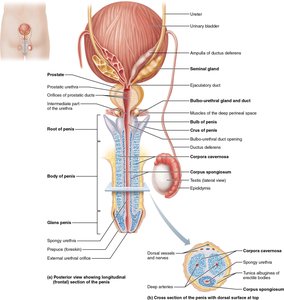
Additional info: The image above provides a detailed anatomical view of the male reproductive duct system, including the epididymis, ductus deferens, ejaculatory duct, and urethra, as well as their spatial relationships to the testes, penis, and accessory glands.
