 Back
BackMechanics of Skeletal Muscle Contraction: Force, Twitch, and Recruitment
Study Guide - Smart Notes
 Tailored notes based on your materials, expanded with key definitions, examples, and context.
Mechanics of Skeletal Muscle Contraction
The Muscle Twitch
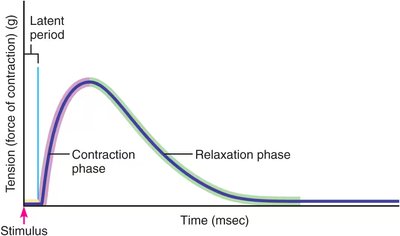
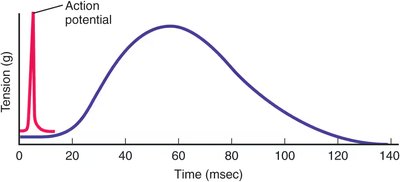
The basic unit of muscle contraction is the twitch, which is the mechanical response of a muscle cell, motor unit, or whole muscle to a single action potential. A twitch is an all-or-nothing event, meaning that each stimulus produces a response of the same magnitude and duration under identical conditions.
Latent Period: The brief delay between the action potential and the onset of contraction, during which excitation-contraction coupling occurs.
Contraction Phase: The period when muscle tension increases as cytosolic calcium rises and crossbridge cycling occurs.
Relaxation Phase: The period when muscle tension decreases as calcium is re-sequestered into the sarcoplasmic reticulum and crossbridges detach.
Isometric and Isotonic Contractions
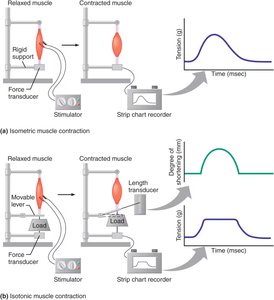
Muscle contractions can be classified based on whether the muscle changes length during contraction:
Isometric Contraction: The muscle generates tension without changing length because the load is greater than the force generated. Example: trying to lift an immovable object.
Isotonic Contraction: The muscle changes length while the tension remains constant. Two types:
Concentric: Muscle shortens while generating force (e.g., lifting a weight).
Eccentric: Muscle lengthens while generating force (e.g., lowering a weight).
Effect of Load on Muscle Contraction
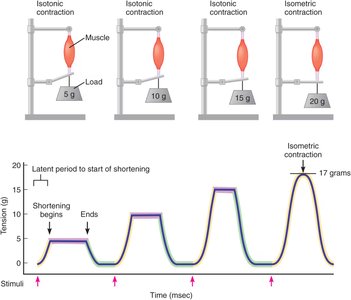
The response of a muscle to a stimulus depends on the load it must move:
With increasing load, the muscle requires more tension to initiate shortening, increasing the latent period.
If the load exceeds the muscle's maximum force, the contraction is isometric.
During isotonic contractions, the force plateaus at the value of the load while the muscle shortens.
Physics of Skeletal Muscle Contraction: Lever Systems
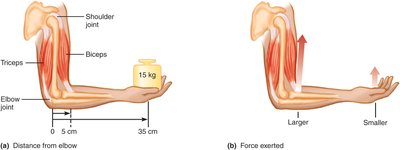
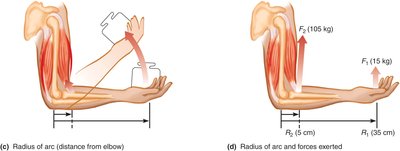
Bones act as levers, and muscles apply force to move loads. The force a muscle must generate is often much greater than the load due to the relative positions of muscle insertion and the load with respect to the joint (pivot point).
Work Equation:
Lever Arm Principle: , where is the force at the hand, is the distance from the elbow to the hand, is the force exerted by the biceps, and is the distance from the elbow to the biceps insertion.
Muscles are at a mechanical disadvantage for force but can move limbs quickly due to the lever system.
Frequency of Stimulation: Treppe, Summation, and Tetanus
The force generated by a muscle fiber increases with the frequency of stimulation due to increased cytosolic calcium:
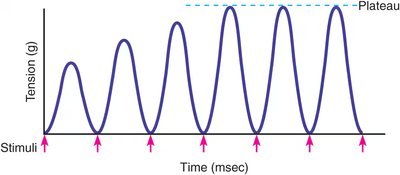
Treppe: Stepwise increase in tension with repeated stimulation at low frequency.
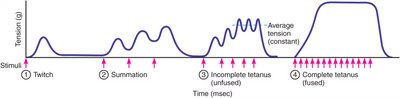
Summation: Increased tension when stimuli arrive before the muscle fully relaxes, causing twitches to overlap.
Tetanus: Sustained maximal contraction. Unfused (incomplete) tetanus shows small oscillations; fused (complete) tetanus is a smooth, sustained plateau.
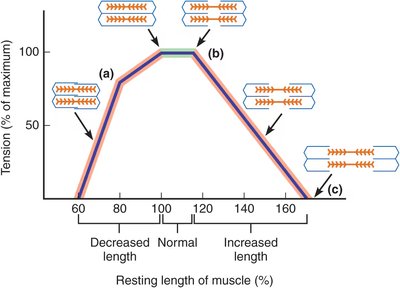
Length-Tension Relationship
The force a muscle fiber can generate depends on its length at the onset of contraction:
There is an optimal length where maximum force is generated due to optimal overlap of thick and thin filaments.
If the fiber is stretched or shortened beyond this range, force generation decreases due to reduced crossbridge formation or filament interference.
Regulation of Force in Whole Muscles: Recruitment and the Size Principle
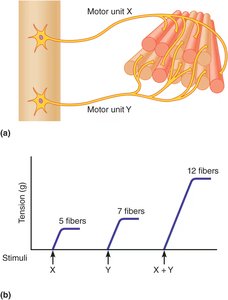
The total force generated by a muscle depends on both the force generated by individual fibers and the number of fibers (motor units) activated:
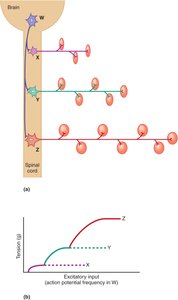
Recruitment: Increasing the number of active motor units increases total muscle force.
Size Principle: Smaller motor units are recruited first for fine control; larger units are recruited as more force is needed.
Motor units differ in size and strength, allowing for graded control of muscle force.
Velocity of Muscle Shortening
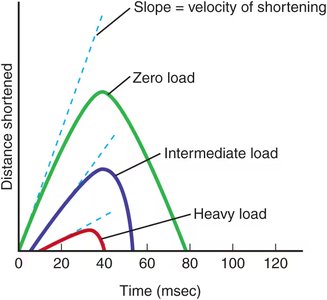
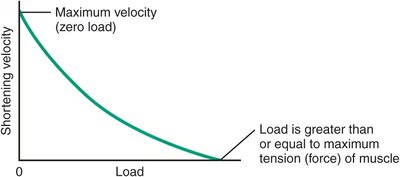
The speed at which a muscle shortens during contraction depends on the load:
As load increases, the velocity of shortening decreases.
When the load equals or exceeds the muscle's maximum force, shortening velocity is zero (isometric contraction).
Velocity is greatest when there is no load.
Summary Table: Types of Muscle Contraction
Type | Muscle Length | Tension | Example |
|---|---|---|---|
Isometric | No change | Increases | Holding a heavy object steady |
Isotonic (Concentric) | Shortens | Constant | Lifting a weight |
Isotonic (Eccentric) | Lengthens | Constant | Lowering a weight |
Key Equations
Work:
Lever Arm:
