 Back
Mechanisms of Disease: Pathophysiology, Pathogens, and Cancer
Study Guide - Smart Notes
 Tailored notes based on your materials, expanded with key definitions, examples, and context.
Mechanisms of Disease
Disease Terminology
Understanding disease requires familiarity with key terms that describe health, disease, and their progression.
Health: A state of complete physical, mental, and social well-being, not merely the absence of disease.
Disease: An abnormality in body function that threatens health.
Etiology: The study of the factors that cause a disease.
Pathogenesis: The pattern of a disease’s development, including stages such as latent (incubation), convalescence (recovery), and remission (temporary or permanent recovery).
Pathology: The study of disease.
Idiopathic: Refers to a disease with an unknown cause.
Signs: Objective abnormalities that can be seen or measured by someone other than the patient.
Symptoms: Subjective abnormalities felt only by the patient.
Syndrome: A collection of different signs and symptoms, usually with a common cause, presenting a distinct picture of a pathological condition.
Disease Progression
Diseases can be classified by their duration and transmission characteristics.
Acute: Signs and symptoms appear suddenly, persist for a short time, then disappear.
Chronic: Diseases that develop slowly and last for a long time, possibly for life.
Subacute: Diseases with characteristics between acute and chronic.
Communicable (Infectious): Diseases that can be transmitted from one individual to another.
Patterns of Disease
Epidemiology studies the occurrence, distribution, and transmission of diseases in populations.
Endemic: Diseases native to a local region.
Epidemic: Diseases that affect many people at the same time.
Pandemic: Widespread, often global, epidemics.
Many factors affect disease transmission, including nutrition, age, gender, sanitation, and socioeconomic conditions. Distinguishing causal from coincidental relationships is essential for disease control.
Pathophysiology
Mechanisms of Disease
Pathophysiology is the study of the underlying physiological aspects of disease, often involving disturbances of homeostasis.
Genetic mechanisms: Diseases caused by altered or mutated genes.
Infectious mechanisms: Diseases caused by pathogenic organisms and particles (e.g., viruses, bacteria, fungi, protozoa, animals).
Neoplastic mechanisms: Abnormal tissue growths or neoplasms (tumors and cancer).
Traumatic mechanisms: Physical and chemical agents causing injury.
Metabolic mechanisms: Disruption of the body’s ability to use nutrients for energy (e.g., endocrine imbalances, malnutrition).
Inflammatory mechanisms: Immune system reactions, including autoimmunity and inflammation.
Degeneration: Breaking apart of tissues, often associated with aging or disease.
Risk Factors
Genetics: Inherited traits can predispose individuals to certain diseases.
Age: Different life stages carry different risks.
Lifestyle: Habits and behaviors can increase disease risk.
Stress: Can contribute to diseases such as hypertension, depression, and heart disease.
Environment: Climate and pollution can increase risk.
Preexisting conditions: One disease can predispose to another.
Pathogenic Organisms
Viruses
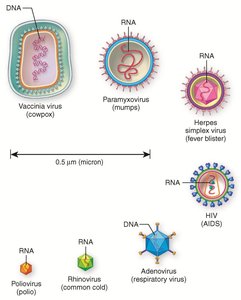
Viruses are microscopic, intracellular parasites consisting of a nucleic acid core (DNA or RNA) surrounded by a protein coat, sometimes with a lipoprotein envelope. They invade host cells and use the host’s machinery for replication. Viruses are classified by shape, nucleic acid type, and method of reproduction.
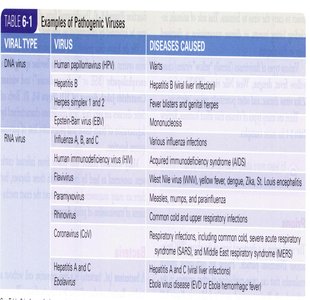
Viral Type | Virus | Diseases Caused |
|---|---|---|
DNA virus | Human papillomavirus (HPV) | Warts |
DNA virus | Hepatitis B | Hepatitis B liver infection |
RNA virus | Influenza A & B | Various influenza infections |
RNA virus | HIV | Acquired immunodeficiency syndrome (AIDS) |
RNA virus | Rhinovirus | Common cold and upper respiratory infections |
RNA virus | Coronavirus (CoV) | Respiratory infections, including COVID-19 |
Prions
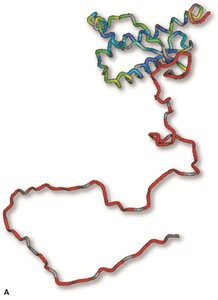
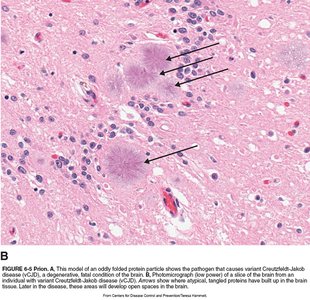
Prions are infectious protein molecules that cause normal proteins to misfold, resulting in degenerative nervous system disorders such as bovine spongiform encephalopathy (BSE) and variant Creutzfeldt-Jakob disease (vCJD).
Bacteria
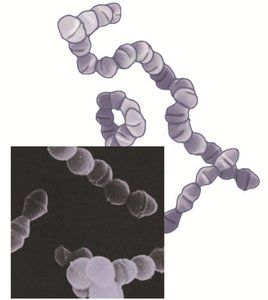
Bacteria are tiny cells without nuclei that may secrete toxins, parasitize host cells, or form colonies. They are classified by growth requirements, staining properties, and shape/size.
Growth requirements: Aerobic (require oxygen) or anaerobic (do not require oxygen).
Staining properties: Gram-positive (stain purple) or Gram-negative (do not stain purple).
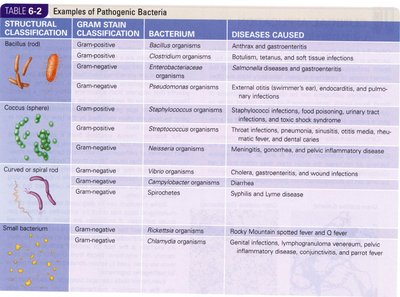
Shape and size: Bacilli (rod-shaped), cocci (spherical), curved/spiral rods, small bacteria (e.g., Rickettsia, Chlamydia), and spores (resistant forms).
Structural Classification | Gram Stain | Bacterium | Diseases Caused |
|---|---|---|---|
Bacillus (rod) | Gram-positive | Bacillus organisms | Anthrax, gastroenteritis |
Coccus (sphere) | Gram-positive | Staphylococcus organisms | Staph infections, food poisoning |
Curved/spiral rod | Gram-negative | Vibrio organisms | Cholera, wound infections |
Small bacterium | Gram-negative | Rickettsia organisms | Rocky Mountain spotted fever |
Fungi
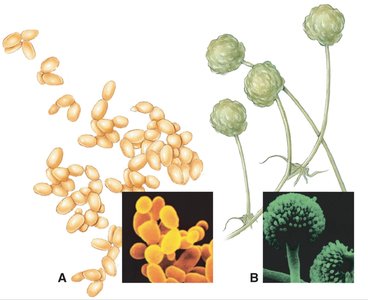
Fungi are simple organisms similar to plants but lacking chlorophyll. Pathogenic fungi must parasitize other organisms. They include yeasts (single-celled) and molds (multicellular). Mycotic infections often resist treatment.
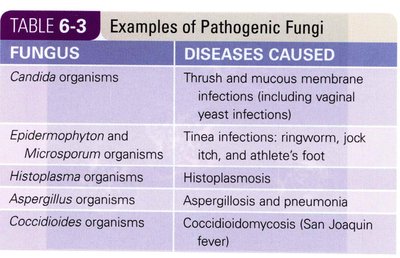
Fungus | Diseases Caused |
|---|---|
Candida | Thrush, mucous membrane infections |
Epidermophyton, Microsporum | Tinea infections (ringworm, athlete's foot) |
Histoplasma | Histoplasmosis |
Aspergillus | Aspergillosis, pneumonia |
Coccidioides | Coccidioidomycosis (San Joaquin fever) |
Protozoa
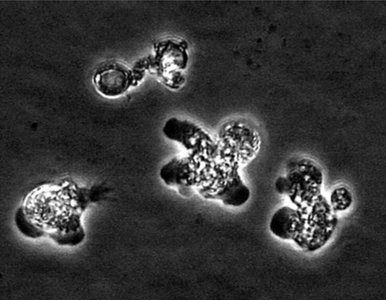
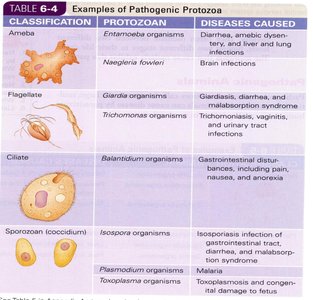
Protozoa are large, single-celled organisms with organized nuclei. They may infest human fluids and destroy cells. Major groups include amebas, flagellates, ciliates, and sporozoa (coccidia).
Amebas: Move by extending pseudopodia.
Flagellates: Move by wiggling flagella.
Ciliates: Move by means of cilia.
Sporozoa (coccidia): Enter cells during one phase, use vectors during another.
Classification | Protozoan | Diseases Caused |
|---|---|---|
Ameba | Entamoeba | Diarrhea, dysentery, liver/lung infections |
Flagellate | Giardia | Giardiasis, malabsorption syndrome |
Ciliate | Balantidium | Gastrointestinal disturbances |
Sporozoan | Plasmodium | Malaria |
Pathogenic Animals (Metazoa)
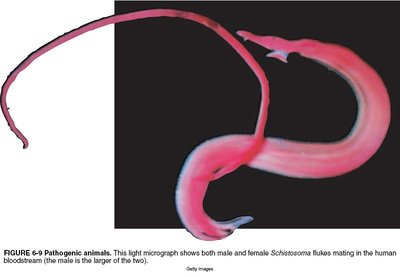
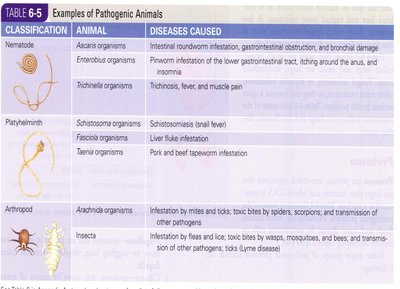
Pathogenic animals are large, multicellular organisms that parasitize or damage human tissues. Major groups include nematodes (roundworms), platyhelminths (flatworms/flukes), and arthropods (mites, ticks, lice, fleas, mosquitoes, etc.). Arthropods often act as vectors for other pathogens.
Classification | Animal | Diseases Caused |
|---|---|---|
Nematode | Ascaris | Intestinal roundworm infestation |
Platyhelminth | Schistosoma | Schistosomiasis (snail fever) |
Arthropod | Arachnida | Infestation by mites, ticks, spiders, scorpions |
Arthropod | Insecta | Infestation by fleas, lice, mosquitoes, etc. |
Prevention and Control of Disease
Mechanisms of Transmission
Preventing disease involves understanding and disrupting the mechanisms by which pathogens spread.
Person-to-person contact: Prevented by education and aseptic technique.
Environmental contact: Prevented by avoiding contact and practicing safe sanitation.
Opportunistic invasion: Prevented by maintaining healthy skin/mucous membranes and cleansing wounds.
Vector transmission: Prevented by reducing vector populations and contact.
Prevention and Treatment Strategies
Vaccination: Stimulates immunity by exposing the body to killed or weakened pathogens.
Drug therapy: Includes antibiotics (for bacteria) and antiviral drugs (for viruses). Antibiotic resistance is a major concern.
Combination therapy: "Drug cocktails" may be used for viral infections to reduce severity and complications.
Tumors and Cancer
Neoplasms (Tumors)
Neoplasms are abnormal growths of cells. They can be benign (localized) or malignant (cancerous, capable of spreading and forming secondary tumors via metastasis).
Benign epithelial tumors: Papilloma (wart), adenoma (glandular), nevus (mole).
Benign connective tissue tumors: Lipoma (fat), osteoma (bone), chondroma (cartilage).
Malignant epithelial tumors (carcinomas): Melanoma (skin), adenocarcinoma (glandular).
Malignant connective tissue tumors (sarcomas): Lymphoma (lymphatic), osteosarcoma (bone), myeloma (bone marrow), fibrosarcoma (fibrous tissue).
Miscellaneous tumors: Adenofibroma (benign, mixed tissue), neuroblastoma (malignant, nerve tissue).
Causes of Cancer
Cancer involves uncontrolled cell division (hyperplasia) and loss of differentiation (anaplasia). Causes include:
Genetic factors: Oncogenes (cancer genes).
Carcinogens: Chemicals that alter genetic activity; some are mutagens (cause DNA mutations).
Age: Accumulated cell damage over time.
Environment: Chronic exposure to damaging substances.
Viruses: Can alter genetic machinery.
Detection and Warning Signs of Cancer
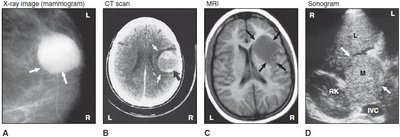
Early detection is crucial for effective treatment. Methods include self-examination, diagnostic imaging (X-ray, CT, MRI, ultrasonography), biopsy, and blood tests.
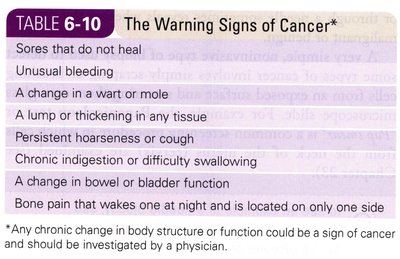
Warning Sign |
|---|
Sores that do not heal |
Unusual bleeding |
A change in a wart or mole |
A lump or thickening in any tissue |
Persistent hoarseness or cough |
Chronic indigestion or difficulty swallowing |
A change in bowel or bladder function |
Bone pain that wakes one at night and is located on only one side |
Staging, Grading, and Complications
Staging: Classifies tumors by size and extent of spread.
Grading: Assesses the likely pattern of tumor development based on cell abnormality; used for prognosis.
Cachexia: Syndrome including appetite loss, weight loss, and general weakness.
Causes of death: Secondary infections, organ failure, hemorrhage, and undetermined factors.
Cancer Treatment
Surgery: Removal of tumors.
Chemotherapy: Use of cytotoxic drugs to kill cancer cells.
Radiation therapy: Destructive x-ray or gamma radiation.
Laser therapy: Intense light beam destroys tumors.
Immunotherapy: Boosts the body's defenses against cancer.
Rational drugs: Target specific molecules, enzymes, or receptors unique to cancer cells.
Inflammation
Inflammatory Response
The inflammatory response reduces injury to tissues and helps maintain homeostasis. It may occur in response to mechanical injuries, chemicals, radiation, or toxins.
Signs: Redness, heat, swelling, and pain.
Inflammation mediators: Histamine, prostaglandins, and kinins cause blood vessels to dilate and increase permeability, attracting white blood cells to the site (chemotaxis).
Pus: Formed when exudate accumulates with white blood cells, dead tissue, and bacteria.
Phagocytosis: White blood cells consume damaged cells and pathogens.
Types of Inflammation
Local inflammation: Isolated to a limited area (e.g., infected cut).
Systemic inflammation: Spreads throughout the body, may cause fever.
Chronic inflammation: Can cause tissue damage and constitute disease itself.
