 Back
Mechanisms of Disease: Pathophysiology, Pathogens, and Cancer
Study Guide - Smart Notes
 Tailored notes based on your materials, expanded with key definitions, examples, and context.
Mechanisms of Disease
Disease Terminology
Understanding disease requires familiarity with key terms that describe health, disease, and their progression. Health is defined as physical, mental, and social well-being, not merely the absence of disease. Disease is an abnormality in body function that threatens health. Etiology is the study of the factors that cause a disease, while pathogenesis describes the pattern of a disease’s development, including stages such as latent (incubation), convalescence (recovery), and remission (temporary reversal of symptoms).
Pathology: The study of disease.
Idiopathic: Disease with unknown cause.
Signs: Objective abnormalities observable by others.
Symptoms: Subjective abnormalities felt only by the patient.
Syndrome: Collection of signs and symptoms with a common cause.
Disease Progression
Diseases can be classified by their progression and transmission.
Acute: Sudden onset, short duration.
Chronic: Slow development, long-lasting.
Subacute: Intermediate characteristics.
Communicable: Transmissible between individuals.
Patterns of Disease
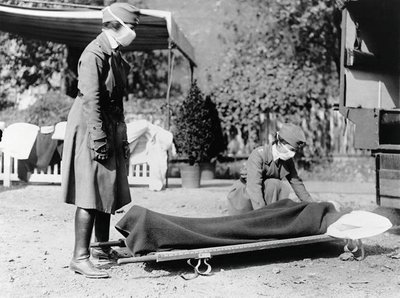
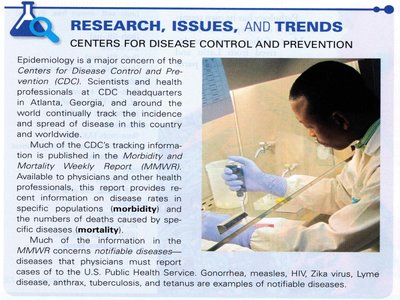
Epidemiology studies the occurrence, distribution, and transmission of diseases in populations. Diseases may be endemic (native to a region), epidemic (affecting many at once), or pandemic (global spread). Disease transmission is influenced by factors such as nutrition, age, gender, sanitation, and socioeconomic conditions. Prevention and therapy are key strategies in combating disease.
Pathophysiology
Mechanisms of Disease
Pathophysiology is the study of the physiological aspects of disease, often understood as disturbances of homeostasis. Mechanisms include:
Genetic: Altered or mutated genes.
Infectious: Pathogenic organisms and particles (e.g., parasites).
Neoplastic: Abnormal tissue growths or tumors.
Traumatic: Physical and chemical agents.
Metabolic: Disruption of nutrient use (e.g., endocrine imbalances, malnutrition).
Inflammatory: Immune system reactions, including autoimmunity and degeneration.
Risk Factors
Risk factors for disease include genetics, age, lifestyle, stress, environment, and preexisting conditions.
Pathogenic Organisms
Viruses
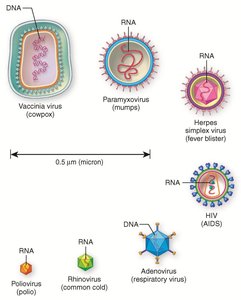
Viruses are microscopic, intracellular parasites consisting of a nucleic acid core (DNA or RNA) surrounded by a protein coat, sometimes with a lipoprotein envelope. They invade host cells and use cellular machinery for reproduction. Viruses are classified by shape, nucleic acid type, and method of reproduction.
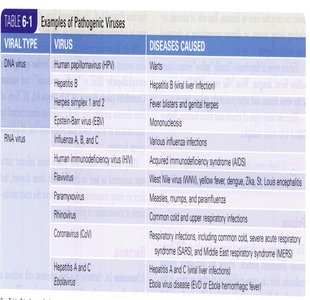
Viral Type | Virus | Diseases Caused |
|---|---|---|
DNA virus | Human papillomavirus (HPV) | Warts |
DNA virus | Hepatitis B | Hepatitis B liver infection |
RNA virus | Influenza A & B | Various influenza infections |
RNA virus | HIV | Acquired immunodeficiency syndrome (AIDS) |
RNA virus | Rhinovirus | Common cold and upper respiratory infections |
RNA virus | Coronavirus (CoV) | Respiratory infections, including SARS and MERS |
RNA virus | Ebola virus | Ebola virus disease |
Additional info: | See full table for more examples |
Prions
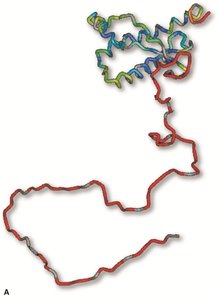
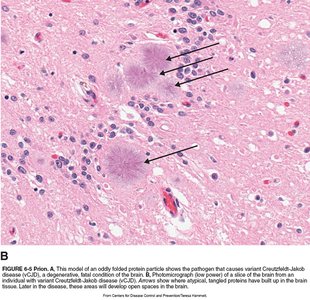
Prions are pathogenic protein molecules that cause disease by converting normal proteins to abnormal forms, leading to misfolding and dysfunction. Prion diseases include rare, degenerative disorders of the nervous system such as bovine spongiform encephalopathy (BSE) and variant Creutzfeldt-Jakob disease (vCJD).
Bacteria
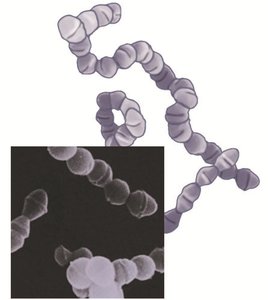
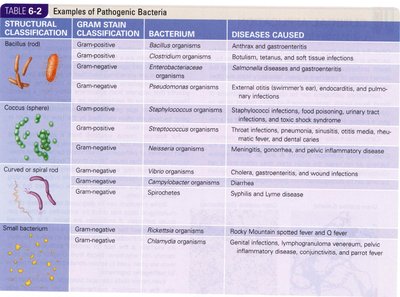
Bacteria are tiny cells without nuclei that secrete toxins, parasitize host cells, or form colonies. They are classified by growth requirements (aerobic or anaerobic), staining properties (Gram-positive or Gram-negative), and shape/size (bacilli, cocci, curved rods, small bacteria, spores).
Bacilli: Rod-shaped cells.
Cocci: Round cells, found singly, in pairs, strings, or clusters.
Curved/Spiral rods: Curved or spiral-shaped cells.
Small bacteria: Obligate intracellular parasites (e.g., Rickettsia, Chlamydia).
Spores: Resistant, nonreproducing forms.
Structural Classification | Gram Stain | Bacterium | Diseases Caused |
|---|---|---|---|
Bacillus (rod) | Gram-positive | Bacillus organisms | Anthrax, gastroenteritis |
Coccus (sphere) | Gram-positive | Staphylococcus organisms | Staph infections, food poisoning |
Curved rod | Gram-negative | Vibrio organisms | Cholera, gastroenteritis |
Small bacterium | Gram-negative | Rickettsia organisms | Rocky Mountain spotted fever |
Additional info: | See full table for more examples |
Fungi
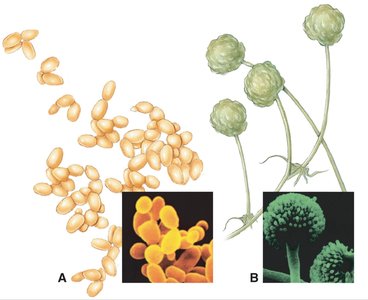
Fungi are simple organisms similar to plants but lacking chlorophyll. Pathogenic fungi must parasitize other organisms for nutrients. Types include yeasts (single-celled) and molds (multicellular). Mycotic infections often resist treatment.
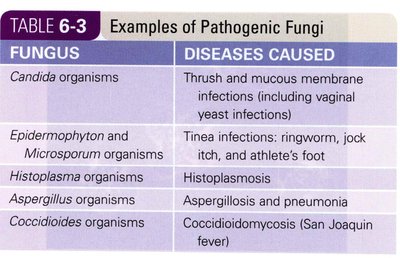
Fungus | Diseases Caused |
|---|---|
Candida | Thrush, mucous membrane infections |
Epidermophyton, Microsporum | Tinea infections: ringworm, jock itch, athlete's foot |
Histoplasma | Histoplasmosis |
Aspergillus | Aspergillosis, pneumonia |
Coccidioides | Coccidioidomycosis (San Joaquin fever) |
Protozoa
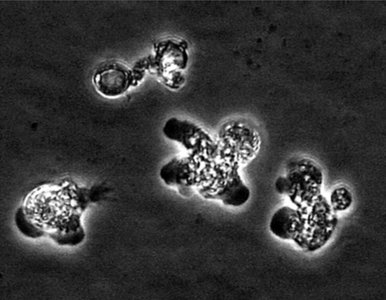
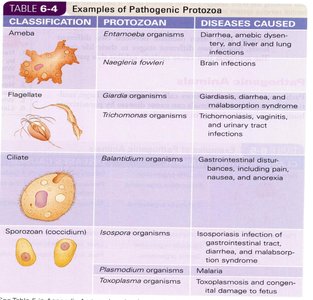
Protozoa are large, one-celled organisms with organized nuclei. They may infest human fluids and destroy cells. Major groups include amebas (pseudopodia), flagellates (flagella), ciliates (cilia), and sporozoa (coccidia, borne by vectors).
Classification | Protozoan | Diseases Caused |
|---|---|---|
Ameba | Entamoeba | Diarrhea, dysentery, liver/lung infections |
Flagellate | Giardia | Giardiasis, diarrhea |
Ciliate | Balantidium | Gastrointestinal disturbances |
Sporozoan | Plasmodium | Malaria |
Additional info: | See full table for more examples |
Pathogenic Animals
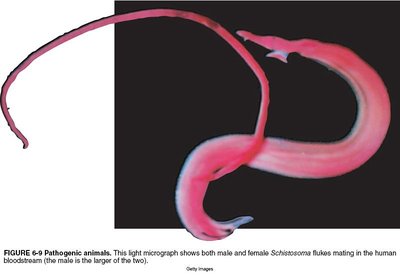
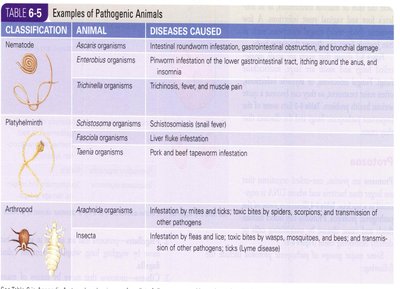
Pathogenic animals (metazoans) are large, complex multicellular organisms that parasitize or damage human tissues. Major groups include nematodes (roundworms), platyhelminths (flatworms/flukes), and arthropods (mites, ticks, lice, fleas, vectors).
Classification | Animal | Diseases Caused |
|---|---|---|
Nematode | Ascaris | Intestinal roundworm infestation |
Platyhelminth | Schistosoma | Schistosomiasis (snail fever) |
Arthropod | Insecta | Infestation by fleas, lice, ticks; transmission of pathogens |
Additional info: | See full table for more examples |
Prevention and Control
Mechanisms of Transmission
Preventing disease involves stopping pathogens from entering the body. Transmission mechanisms include person-to-person contact, environmental contact, opportunistic invasion, and vector transmission. Strategies include education, aseptic technique, sanitation, wound cleansing, and vector control.
Prevention and Treatment Strategies
Vaccination: Stimulates immunity by exposing the body to killed or attenuated pathogens.
Drug therapy: Includes antibiotics (for bacteria) and antiviral drugs (for viruses). Antibiotic resistance is a major concern.
Tumors and Cancer
Neoplasms (Tumors)
Neoplasms are abnormal growths of cells, classified as benign (localized) or malignant (spread, cancer). Malignant tumors may replace vital organs with undifferentiated tissue and metastasize to new locations.
Benign epithelial tumors: Papilloma, adenoma, nevus.
Benign connective tissue tumors: Lipoma, osteoma, chondroma.
Malignant epithelial tumors (carcinomas): Melanoma, adenocarcinoma.
Malignant connective tissue tumors (sarcomas): Lymphoma, osteosarcoma, myeloma, fibrosarcoma.
Miscellaneous tumors: Adenofibroma, neuroblastoma.
Causes of Cancer
Cancer involves uncontrolled cell division (hyperplasia) and undifferentiated cell development (anaplasia). Factors include genetics (oncogenes), carcinogens (mutagens), age, environment, and viruses.
Warning Signs and Detection
Sores that do not heal
Unusual bleeding
Change in a wart or mole
Lump or thickening in tissue
Persistent hoarseness or cough
Chronic indigestion or difficulty swallowing
Change in bowel or bladder function
Bone pain at night, on one side
Methods of Detecting Cancer
Self-examination
Diagnostic imaging (X-ray, CT, MRI, ultrasonography)
Biopsy (e.g., Pap smear)
Blood tests
Staging, Grading, and Complications
Staging: Classifies tumors by size and spread.
Grading: Assesses cell abnormality and predicts prognosis.
Cachexia: Syndrome of appetite loss, weight loss, and weakness.
Causes of death: Secondary infections, organ failure, hemorrhage.
Cancer Treatment
Surgery
Chemotherapy (cytotoxic drugs)
Radiation therapy
Laser therapy
Immunotherapy
Rational drugs (target specific molecules)
Inflammation
Inflammatory Response
Inflammation reduces injury to tissues and maintains homeostasis. It may occur in response to mechanical injuries, chemicals, radiation, or toxins. Signs include redness, heat, swelling, and pain. Inflammation mediators (histamine, prostaglandins, kinins) cause blood vessel dilation and increased permeability, attracting white blood cells to the injury site.
Inflammatory Disease
Local inflammation: Isolated to a limited area.
Systemic inflammation: Spreads throughout the body, may cause fever.
Chronic inflammation: Can cause tissue damage and constitute disease.
Review Questions
When signs and symptoms of a disease appear suddenly, persist for a short time, then disappear, the disease is referred to as: D. Acute
An organism that lives in or on another organism to obtain its nutrients is called a(n): C. Parasite
Which of the following is a result of a pathogenic virus? A. Influenza
Liver fluke infestation is a result of a pathogenic: D. Animal
In an attempt to prevent the spread of many diseases, which strategy involves killing or disabling pathogens on surfaces before they can spread to other people? A. Aseptic technique
Identify the type of malignant tumor that arises from epithelial tissue. C. Melanoma
Histamine, prostaglandins, and kinins are released from damaged tissue. Collectively, they are referred to as: B. Inflammation mediators
