 Back
BackMembrane Dynamics: Osmosis, Tonicity, and Transport Mechanisms
Study Guide - Smart Notes
 Tailored notes based on your materials, expanded with key definitions, examples, and context.
Membrane Dynamics
Introduction to Membrane Dynamics
Membrane dynamics refers to the movement of water, ions, and molecules across cell membranes, which is essential for maintaining homeostasis in the body. The cell membrane acts as a selective barrier, regulating the internal environment of the cell and facilitating communication between the intracellular and extracellular compartments.
Body Fluid Compartments and Homeostasis
Fluid Compartments
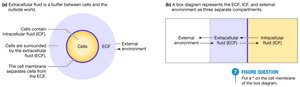
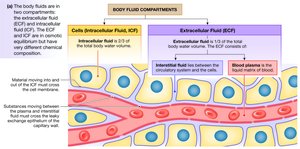
The body contains two main fluid compartments: the intracellular fluid (ICF), which is the fluid inside cells, and the extracellular fluid (ECF), which surrounds the cells. The ECF acts as a buffer zone between cells and the external environment, and most substances entering or leaving cells must pass through the ECF.
ICF: Makes up about two-thirds of total body water.
ECF: Composed of interstitial fluid (between cells) and plasma (in blood vessels).
Homeostasis and Disequilibrium
Homeostasis maintains three dynamic steady states:
Osmotic equilibrium: Water moves freely between compartments, so total solute concentrations are equal.
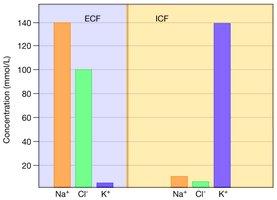
Chemical disequilibrium: Some solutes are more concentrated in one compartment than the other.
Electrical disequilibrium: Ions are distributed unequally, creating a charge difference across the membrane.
Osmosis and Tonicity
Osmosis
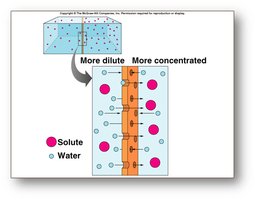
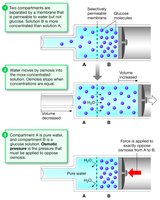
Osmosis is the movement of water across a semi-permeable membrane in response to a solute concentration gradient. Water moves to dilute the more concentrated solution, and this process is fundamental to cell volume regulation and IV therapy.
For osmosis to occur, the membrane must be permeable to water but impermeable to at least one solute.
Water moves through aquaporin channels and water-filled ion channels.
Osmotic Pressure
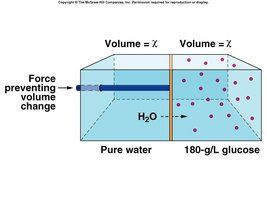
Osmotic pressure is the pressure required to prevent the movement of water across a membrane due to osmosis. It is a measure of how strongly a solution draws water into itself. Higher solute concentration means higher osmotic pressure.
Osmolarity and Osmolality
Osmolarity is the number of osmotically active particles per liter of solution (osmoles/L), while osmolality is the number per kilogram of water (osmoles/kg). In physiology, these terms are often used interchangeably because 1 L of water weighs approximately 1 kg.
Molarity (M): Moles of solute per liter of solution.
Osmolarity (OsM): Osmoles of solute per liter of solution.
Comparing Osmolarities
When comparing two solutions:
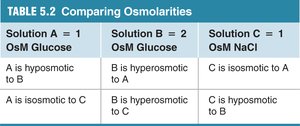
Isosmotic: Equal number of solute particles per unit volume.
Hyperosmotic: More solute particles per unit volume.
Hyposmotic: Fewer solute particles per unit volume.
Solution | Osmolarity | Comparison |
|---|---|---|
A = 1 OsM Glucose | 1 OsM | Hyposmotic to B |
B = 2 OsM Glucose | 2 OsM | Hyperosmotic to A |
C = 1 OsM NaCl | 1 OsM | Isosmotic to A |
Tonicity
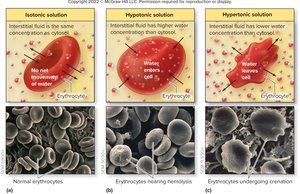
Tonicity describes how a solution affects cell volume when a cell is placed in it:
Hypotonic: Cell swells (gains water).
Isotonic: Cell volume does not change.
Hypertonic: Cell shrinks (loses water).
Tonicity vs. Osmolarity
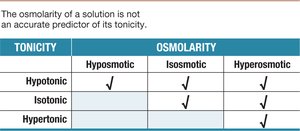
Osmolarity measures the total concentration of solute particles, while tonicity describes the effect of a solution on cell volume. Tonicity depends on the concentration of nonpenetrating solutes only.
Tonicity | Hyposmotic | Isosmotic | Hyperosmotic |
|---|---|---|---|
Hypotonic | ✓ | ✓ | ✓ |
Isotonic | ✓ | ✓ | |
Hypertonic | ✓ |
Clinical Application: Intravenous Solutions
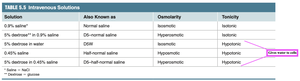
Understanding osmolarity and tonicity is crucial for selecting appropriate IV fluids in clinical practice. For example, isotonic solutions are used to replace ECF volume, while hypotonic solutions are used to rehydrate cells.
Solution | Also Known As | Osmolarity | Tonicity |
|---|---|---|---|
0.9% saline | Normal saline | Isosmotic | Isotonic |
5% dextrose in water | D5W | Isosmotic | Hypotonic |
0.45% saline | Half-normal saline | Hyposmotic | Hypotonic |
Transport Processes Across Membranes
Bulk Flow and Membrane Permeability
Bulk flow refers to the movement of fluids (liquids or gases) from regions of higher pressure to lower pressure. Cell membranes are selectively permeable, allowing some molecules to cross while restricting others.
Passive transport: Does not require energy (e.g., diffusion).
Active transport: Requires energy input (e.g., ATP).
Diffusion
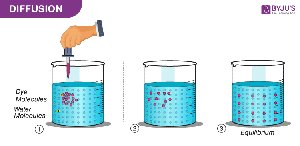
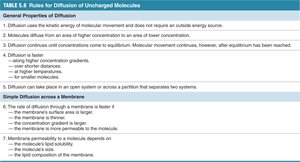
Diffusion is the passive movement of molecules from an area of higher concentration to an area of lower concentration. It is driven by the kinetic energy of molecules and continues until equilibrium is reached.
Rapid over short distances, slower over long distances.
Rate increases with temperature and concentration gradient.
Smaller molecules diffuse faster than larger ones.
Factors Affecting Diffusion Rate
Concentration gradient (higher gradient = faster rate).
Membrane permeability (more permeable = faster rate).
Temperature (higher temperature = faster rate).
Surface area (greater area = faster rate).
Simple Diffusion vs. Facilitated Diffusion
Simple diffusion occurs directly through the lipid bilayer and is limited to lipophilic molecules. Most molecules require protein-mediated transport to cross the membrane.
Facilitated diffusion: Passive, uses carrier proteins, moves substances down their concentration gradient.
Active transport: Uses carrier proteins and energy to move substances against their gradient.
Protein-Mediated Transport
Channel Proteins
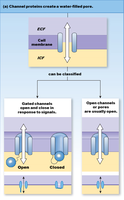
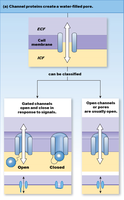
Channel proteins form water-filled passageways that allow specific ions or water to move across the membrane. They can be open (leak channels) or gated (regulated by signals).
Carrier Proteins
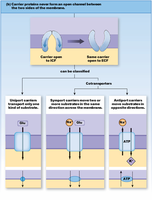
Carrier proteins bind specific substrates and undergo conformational changes to transport them across the membrane. Types include:
Uniport: Transports one type of molecule.
Symport: Transports two or more molecules in the same direction.
Antiport: Transports molecules in opposite directions.
Active Transport
Active transport moves substances against their concentration gradients and requires energy. It can be:
Primary active transport: Directly uses ATP (e.g., sodium-potassium pump).
Secondary active transport: Uses energy stored in concentration gradients created by primary active transport.
Carrier-Mediated Transport Properties
Specificity: Each transporter moves only certain molecules.
Competition: Related molecules compete for transport.
Saturation: Transport rate reaches a maximum when all carriers are occupied.
Vesicular and Epithelial Transport
Vesicular Transport
Large molecules enter or leave cells via vesicles formed from the cell membrane. Types include:
Phagocytosis: Engulfing large particles.
Endocytosis: Taking in small molecules or fluids.
Exocytosis: Releasing substances to the ECF.
Epithelial Transport
Epithelial cells regulate movement between the lumen and ECF via:
Paracellular transport: Through junctions between cells.
Transcellular transport: Through the cell, involving crossing two membranes.
Resting Membrane Potential
Establishing Membrane Potential
Cells maintain an electrical gradient across their membranes, known as the resting membrane potential. This is mainly due to the movement of potassium ions (K+) through leak channels, creating a negative charge inside the cell relative to the outside.
Electrochemical gradient: Combination of chemical and electrical gradients.
Nernst equation: Calculates equilibrium potential for a single ion.
Goldman equation: Considers multiple ions and their permeabilities.
Changes in Membrane Potential
Depolarization: Membrane potential becomes less negative (towards zero).
Repolarization: Return to resting potential.
Hyperpolarization: Membrane potential becomes more negative than resting.
Integration Example: Insulin Secretion
Beta cells in the pancreas integrate membrane processes to secrete insulin in response to increased blood glucose. This involves glucose uptake, ATP production, closure of K+ channels, depolarization, opening of Ca2+ channels, and exocytosis of insulin.
Additional info: The above notes integrate textbook content, figures, and tables to provide a comprehensive overview of membrane dynamics, suitable for ANP college students preparing for exams.
