 Back
BackMembrane Dynamics: Structure, Function, and Transport Mechanisms
Study Guide - Smart Notes
 Tailored notes based on your materials, expanded with key definitions, examples, and context.
Membrane Dynamics
Body Fluid Compartments
The human body contains two main fluid compartments: the intracellular fluid (ICF) and the extracellular fluid (ECF). These compartments are in osmotic equilibrium but differ in chemical composition.
ICF: Makes up 2/3 of total body water volume; located within cells.
ECF: Makes up 1/3 of total body water volume; consists of interstitial fluid (between cells and circulatory system) and blood plasma (liquid matrix of blood).
Material moving into/out of ICF must cross the cell membrane; movement between plasma and interstitial fluid crosses the capillary wall.
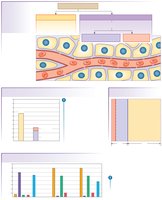
Example: For a standard 70-kg man, total body water is 42 L (ICF: 28 L, ECF: 14 L; plasma is 25% of ECF, interstitial fluid is 75% of ECF).
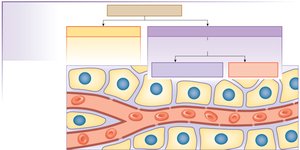
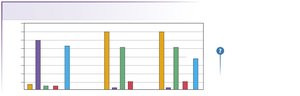
Additional info: The cell membrane is selectively permeable, creating chemical disequilibrium between compartments. Ion concentrations differ: Na+ and Cl- are high in ECF, K+ is high in ICF.
Osmosis and Osmotic Pressure
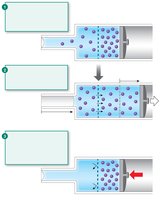
Osmosis is the movement of water across a selectively permeable membrane from a region of lower solute concentration to higher solute concentration. Osmotic pressure is the pressure required to oppose osmosis.
Water moves freely through membranes permeable to water but not solutes.
Osmosis stops when solute concentrations are equal on both sides.
Osmotic pressure can be calculated and is important in clinical settings (e.g., IV solutions).
Osmolarity and Tonicity
Osmolarity is the concentration of osmotically active particles in a solution (osmoles/L). Tonicity describes the effect of a solution on cell volume at equilibrium.
Osmolarity compares any two solutions; tonicity always compares a cell and a solution.
Cells swell in hypotonic solutions, shrink in hypertonic solutions, and remain unchanged in isotonic solutions.
Osmolarity cannot predict tonicity; only nonpenetrating solutes affect tonicity.
Formula:
Transport Across Membranes
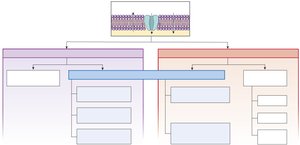
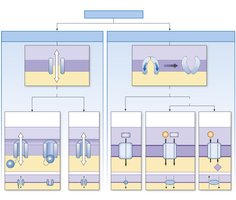
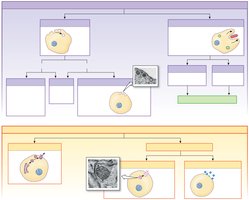
Substances cross cell membranes via simple diffusion, protein-mediated transport, or vesicular transport. Transport can be classified by energy requirements and physical pathway.
Passive transport: No energy required; includes simple diffusion, facilitated diffusion, and osmosis.
Active transport: Requires energy (ATP); includes primary and secondary active transport, and vesicular transport (endocytosis, exocytosis).
Transporters include channel proteins (water-filled pores) and carrier proteins (never form open channels).
Diffusion and Fick's Law
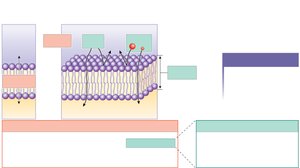
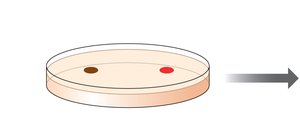
Diffusion is the passive movement of molecules from high to low concentration. Fick's Law describes the rate of diffusion:
Rate of diffusion is proportional to surface area, concentration gradient, and membrane permeability.
Membrane permeability depends on lipid solubility, molecular size, and composition of the lipid layer.
Formula:
Membrane Proteins
Membrane proteins serve various functions: transporters, structural proteins, enzymes, and receptors.
Transporters: Move substances across membranes (carrier and channel proteins).
Structural proteins: Maintain cell shape and form junctions.
Enzymes: Catalyze reactions and transfer signals.
Receptors: Bind ligands and trigger intracellular responses.
Facilitated Diffusion and Active Transport
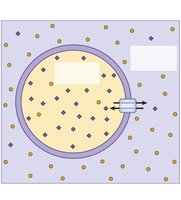
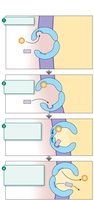
Facilitated diffusion uses carrier proteins to move substances down their concentration gradient. Active transport moves substances against their gradient using energy.
Na+-K+-ATPase: Pumps Na+ out and K+ into the cell, maintaining gradients.
Secondary active transport: Uses energy from one gradient (e.g., Na+) to move another substance (e.g., glucose).
Vesicular Transport
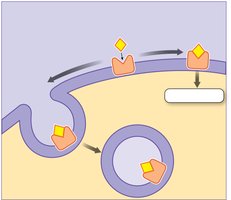
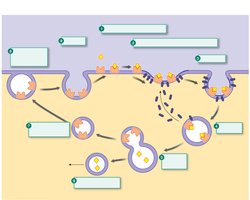
Vesicular transport includes endocytosis, exocytosis, and transcytosis. These processes move large molecules and particles across membranes.
Endocytosis: Cell takes in material by engulfing it.
Exocytosis: Cell releases material by fusing vesicles with the membrane.
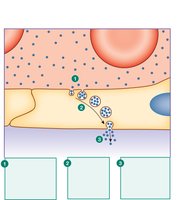
Transcytosis: Moves substances across cells using vesicles.
Transepithelial Transport
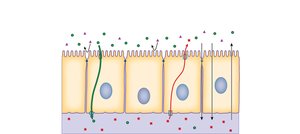
Transporting epithelial cells are polarized, with different proteins on apical and basolateral membranes. This allows selective directional transport.
Absorption: Movement from lumen to ECF.
Secretion: Movement from ECF to lumen.
Transport may be transcellular (through cells) or paracellular (between cells).
Membrane Potential
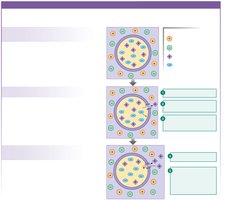
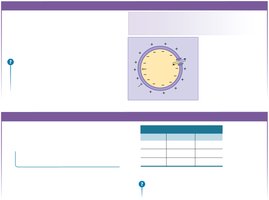
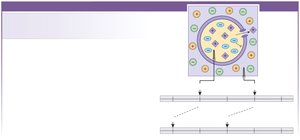
The membrane potential difference (Vm) is the electrical disequilibrium between ECF and ICF, resulting from uneven ion distribution.
Created by ion concentration gradients and selectively permeable membranes.
Resting membrane potential is mainly due to K+ leak out of the cell.
Na+-K+-ATPase maintains the potential by pumping Na+ out and K+ in.
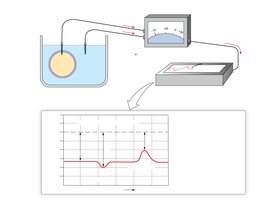
Measured using electrodes; ECF is set at 0 mV by convention.
Formula:
Clinical Application: Cystic Fibrosis
Cystic fibrosis is caused by a defect in the CFTR channel protein, which transports chloride ions across epithelial membranes. This defect leads to thick mucus in airways and digestive problems.
CFTR is a chemically gated channel, activated by ATP binding.
Impaired chloride transport results in dehydrated mucus and high salt concentration in sweat.
Without functioning CFTR, salt is not reabsorbed in sweat glands, leading to diagnostic sweat tests.
Thick mucus in pancreatic ducts blocks enzyme secretion, causing malnutrition unless treated with artificial enzymes.
Additional info: CFTR is located on the apical surface of epithelial cells in sweat glands, lungs, and pancreas.
Summary Tables
Body Fluid Compartment Volumes
Compartment | Volume (L) | % Total Body Water |
|---|---|---|
ICF | 28 | 67% |
ECF | 14 | 33% |
Plasma | 3.5 | 8% |
Interstitial Fluid | 10.5 | 25% |
Ion Concentrations in Compartments
Ion | ICF (mM) | ECF (mM) |
|---|---|---|
K+ | 150 | 5 |
Na+ | 15 | 145 |
Cl- | 10 | 108 |
Transport Mechanisms
Type | Energy Requirement | Pathway |
|---|---|---|
Simple Diffusion | None | Through membrane |
Facilitated Diffusion | None | Through protein |
Primary Active Transport | ATP | Through protein |
Secondary Active Transport | Gradient (ATP indirect) | Through protein |
Vesicular Transport | ATP | In vesicle |
