 Back
BackMembrane Potentials and Ion Channels in Neurons
Study Guide - Smart Notes
 Tailored notes based on your materials, expanded with key definitions, examples, and context.
Electrical Signals in Neurons
Resting Membrane Potential
The resting membrane potential is the electrical potential difference across the cell membrane of neurons when they are not actively sending signals. In most neurons, this value is approximately -70 mV. The resting potential is mainly determined by the distribution and permeability of ions across the membrane.
Potassium (K+) is the primary ion responsible for the resting membrane potential due to its high membrane permeability.
Sodium (Na+) contributes slightly, as there are very few Na+ leak channels.
Chloride (Cl-) has minimal effect, as its equilibrium potential is close to the resting membrane potential.
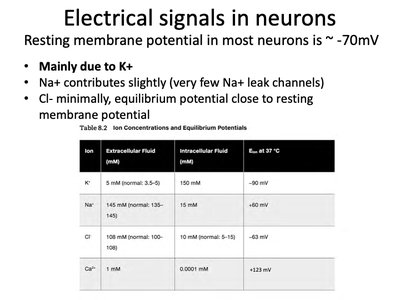
Table Purpose: The table compares the concentrations of major ions inside and outside the cell and their equilibrium potentials, illustrating the basis for the resting membrane potential.
Factors Influencing Membrane Potential
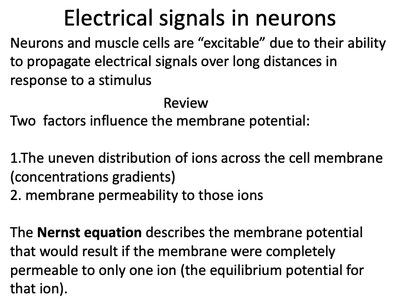
Two main factors determine the membrane potential in neurons:
The uneven distribution of ions across the cell membrane (concentration gradients).
Membrane permeability to those ions.
The Nernst equation calculates the equilibrium potential for a single ion, assuming the membrane is only permeable to that ion.
Goldman-Hodgkin-Katz (GHK) Equation
Predicting Membrane Potential
The Goldman-Hodgkin-Katz (GHK) equation predicts the membrane potential by considering the combined contributions of all permeant ions (mainly K+, Na+, and Cl-) and their relative permeabilities. This is more physiologically accurate than the Nernst equation, which only considers one ion at a time.
The GHK equation incorporates both the concentration and permeability of each ion.
At body temperature (37°C), the constant in the equation is 61.
GHK Equation:
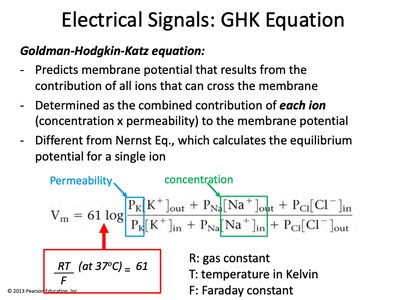
Key Terms: P = permeability, [Ion]out = extracellular concentration, [Ion]in = intracellular concentration.
Ion Channels and Gated Channels
Types of Gated Channels
Ion channels are proteins that allow specific ions to cross the cell membrane. Their opening and closing are regulated by various mechanisms, making them "gated." The main types of gated channels are:
Mechanically gated channels: Open in response to physical forces such as pressure or stretch, commonly found in sensory neurons.
Chemically gated channels: Open in response to binding of ligands such as neurotransmitters or intracellular signaling molecules.
Voltage-gated channels: Open or close in response to changes in the cell's membrane potential.
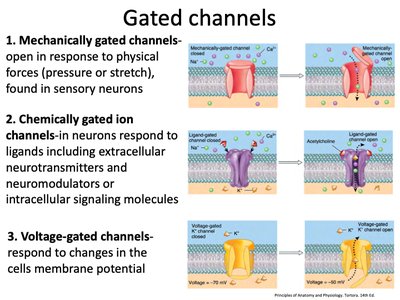
Example: Voltage-gated Na+ and K+ channels are essential for action potential generation in neurons.
Ion Channel Permeability and Conductance
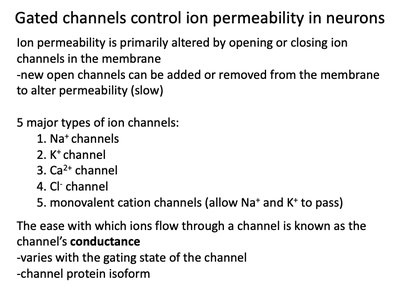
Ion permeability is primarily altered by opening or closing ion channels. The ease with which ions flow through a channel is called conductance, which varies with the gating state and the channel protein isoform.
Major types of ion channels in neurons: Na+, K+, Ca2+, Cl-, and monovalent cation channels.
New channels can be inserted or removed from the membrane to alter permeability (a slow process).
Ion Movements and Membrane Potential Changes
Depolarization and Hyperpolarization
Changes in ion movement across the membrane alter the membrane potential:
Depolarization: Membrane potential becomes more positive (e.g., Na+ influx).
Hyperpolarization: Membrane potential becomes more negative (e.g., Cl- influx or K+ efflux).
Even small movements of ions can cause significant changes in membrane potential, but the overall concentration gradients remain relatively constant.
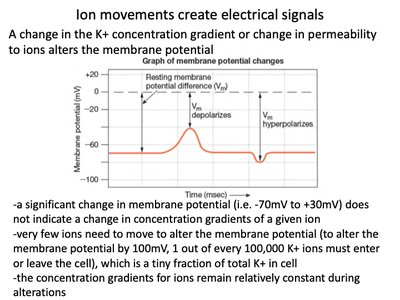
Example: Opening more K+ channels hyperpolarizes the cell, while opening Na+ channels depolarizes it.
Current Flow and Ohm's Law
Electrical Current in Neurons
The flow of ions (current) in neurons follows Ohm's law:
Current (I): Flow of electrical charge (ions).
Voltage (V): Electrical potential difference across the membrane.
Resistance (R): Opposition to current flow, with two main sources in cells:
Membrane resistance (Rm): Resistance of the phospholipid bilayer.
Internal resistance (Ri): Resistance of the cytoplasm, depending on cell size and composition.
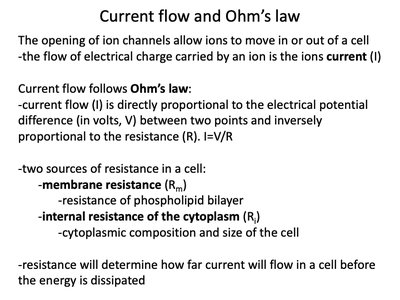
Application: Resistance determines how far current will flow in a neuron before dissipating.
Channelopathies
Ion Channel Disorders
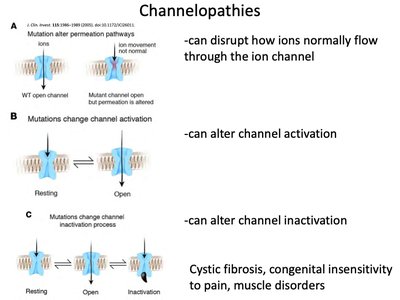
Channelopathies are diseases caused by dysfunctional ion channels, often due to genetic mutations. These can affect how ions flow, how channels activate, or how they inactivate.
Disruption of normal ion flow through the channel.
Altered channel activation or inactivation.
Examples include cystic fibrosis, congenital insensitivity to pain, and certain muscle disorders.
Variation in Gated Channels
Properties of Gated Channels
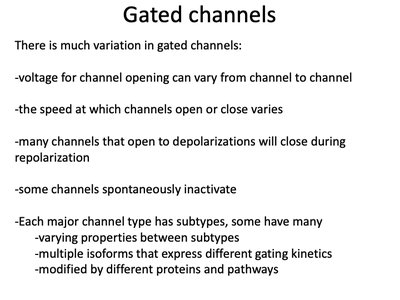
Gated channels exhibit significant variation:
The voltage required for opening can differ between channels.
The speed of opening and closing varies.
Some channels inactivate spontaneously or during repolarization.
Each channel type has multiple subtypes with different properties, gating kinetics, and regulatory mechanisms.
Additional info: Channel diversity allows for fine-tuned regulation of neuronal excitability and signaling.
