 Back
Membrane Transport Mechanisms & Signal Transduction Study Guide
Study Guide - Smart Notes
 Tailored notes based on your materials, expanded with key definitions, examples, and context.
Q1. Evaluate the solute concentration gradients between the ICF and ECF of Na+, K+, Ca2+, and glucose.
Background
Topic: Solute Gradients Across Cell Membranes
This question tests your understanding of how different ions and molecules are distributed between the intracellular fluid (ICF) and extracellular fluid (ECF), which is fundamental for membrane transport and cell function.
Key Terms:
ICF: Intracellular fluid (inside the cell)
ECF: Extracellular fluid (outside the cell)
Concentration gradient: Difference in concentration of a solute across a membrane
Step-by-Step Guidance
Identify the typical concentrations of Na+, K+, Ca2+, and glucose in the ICF and ECF.
Compare the concentrations to determine which direction each solute tends to move.
Consider how these gradients drive passive and active transport mechanisms.
Think about the physiological importance of maintaining these gradients.
Try solving on your own before revealing the answer!
Q2. Describe in your own words: a) passive transport b) active transport
Background
Topic: Membrane Transport Mechanisms
This question is about distinguishing between passive and active transport processes across cell membranes.
Key Terms:
Passive transport: Movement of substances without energy input
Active transport: Movement of substances against a gradient, requiring energy (usually ATP)
Step-by-Step Guidance
Define passive transport and give examples (e.g., diffusion, osmosis).
Define active transport and explain how it uses energy.
Contrast the direction of movement relative to concentration gradients for each.
Consider the role of membrane proteins in each process.
Try solving on your own before revealing the answer!
Q3. Name 4 naturally occurring nonpolar solutes.
Background
Topic: Solute Properties and Membrane Permeability
This question tests your knowledge of which molecules can easily cross the lipid bilayer due to their nonpolar nature.
Key Terms:
Nonpolar solute: Molecule without a charge, often hydrophobic
Lipid bilayer: Double layer of phospholipids forming the cell membrane
Step-by-Step Guidance
Recall examples of nonpolar molecules found in the body.
Think about gases and lipids that can diffuse through membranes.
List four examples, considering their biological relevance.
Try solving on your own before revealing the answer!
Q4. Define the following types of passive transport: a) simple diffusion b) channel-mediated diffusion c) carrier-mediated diffusion (facilitated diffusion)
Background
Topic: Types of Passive Transport
This question is about understanding the different ways substances can move across membranes without energy input.
Key Terms and Formulas:
Simple diffusion: Direct movement through the lipid bilayer
Channel-mediated diffusion: Movement through protein channels
Carrier-mediated diffusion: Movement via protein carriers (facilitated diffusion)
Step-by-Step Guidance
Define each type of passive transport.
Describe the role of membrane proteins in channel- and carrier-mediated diffusion.
Compare the types based on the solutes they transport.
Consider the direction of movement relative to concentration gradients.
Try solving on your own before revealing the answer!
Q5. Compare and contrast passive transport mechanisms of nonpolar molecules, ions, and nutrients.
Background
Topic: Membrane Transport Specificity
This question asks you to analyze how different types of molecules use different passive transport mechanisms.
Key Terms:
Nonpolar molecules: Often use simple diffusion
Ions: Often use channel-mediated diffusion
Nutrients: Often use carrier-mediated diffusion
Step-by-Step Guidance
Identify which transport mechanism each type of molecule uses.
Explain why nonpolar molecules can cross the membrane easily.
Discuss the need for channels or carriers for ions and nutrients.
Compare the speed and specificity of each mechanism.
Try solving on your own before revealing the answer!
Q6. List and describe four general factors that influence the rate of passive transport.
Background
Topic: Factors Affecting Passive Transport
This question is about understanding what determines how quickly substances move across membranes passively.
Key Terms:
Concentration gradient
Membrane permeability
Surface area
Temperature
Step-by-Step Guidance
List four factors that affect passive transport rate.
Describe how each factor influences movement.
Provide examples for each factor.
Consider how these factors interact in real biological systems.
Try solving on your own before revealing the answer!
Q7. List and describe two general factors that influence the rate of active transport across a membrane.
Background
Topic: Factors Affecting Active Transport
This question tests your understanding of what determines the efficiency of active transport processes.
Key Terms:
ATP availability
Number of transport proteins
Step-by-Step Guidance
List two factors that affect active transport rate.
Describe how each factor influences movement.
Provide examples for each factor.
Try solving on your own before revealing the answer!
Q8. In your own words, describe the process of active transport of Na+/K+.
Background
Topic: Sodium-Potassium Pump
This question is about the mechanism by which cells maintain Na+ and K+ gradients using ATP.
Key Terms and Formula:
Na+/K+ ATPase: Enzyme that pumps Na+ out and K+ in
ATP: Energy source for active transport
Step-by-Step Guidance
Describe the role of Na+/K+ ATPase in maintaining gradients.
Explain how ATP is used to drive the pump.
Discuss the direction of Na+ and K+ movement.
Consider the importance of this process for cell function.
Try solving on your own before revealing the answer!
Q9. Define osmosis.
Background
Topic: Water Movement Across Membranes
This question is about the process by which water moves across membranes in response to solute concentration differences.
Key Terms:
Osmosis: Movement of water across a semipermeable membrane
Semipermeable membrane: Allows water but not solutes to pass
Step-by-Step Guidance
Define osmosis in your own words.
Explain the role of solute concentration in driving osmosis.
Consider the direction of water movement relative to solute concentration.
Try solving on your own before revealing the answer!
Q10. Define: a) Hypotonic b) Isotonic c) Hypertonic
Background
Topic: Solution Tonicity
This question is about understanding how different types of solutions affect cells based on their solute concentrations.
Key Terms:
Hypotonic: Lower solute concentration than the cell
Isotonic: Equal solute concentration as the cell
Hypertonic: Higher solute concentration than the cell
Step-by-Step Guidance
Define each term clearly.
Explain how each solution affects water movement in and out of cells.
Consider the physiological consequences for cells in each solution.
Try solving on your own before revealing the answer!
Q15. Relate the direction of osmosis to solute concentration.
Background
Topic: Osmosis and Solute Gradients
This question is about predicting the direction of water movement based on solute concentrations inside and outside the cell.
Key Terms:
Osmosis
Solute concentration
Step-by-Step Guidance
Recall that water moves toward higher solute concentration.
Apply this principle to different scenarios (e.g., hypotonic, hypertonic solutions).
Explain the effect on cell volume.
Try solving on your own before revealing the answer!
Q16. Predict the outcome of placing human blood cells in the following solutions: a) Hypotonic b) Isotonic c) Hypertonic
Background
Topic: Effects of Solution Tonicity on Cells
This question tests your ability to predict cellular responses to different external environments.
Key Terms:
Hypotonic: Cells may swell
Isotonic: Cells remain unchanged
Hypertonic: Cells may shrink
Step-by-Step Guidance
Describe what happens to cells in each type of solution.
Explain the direction of water movement for each scenario.
Consider the physiological consequences for blood cells.
Try solving on your own before revealing the answer!
Q18. Contrast endocytosis and exocytosis.
Background
Topic: Bulk Transport Across Membranes
This question is about understanding how cells move large quantities of substances in and out.
Key Terms:
Endocytosis: Uptake of substances into the cell
Exocytosis: Release of substances from the cell
Step-by-Step Guidance
Define endocytosis and exocytosis.
Describe the mechanisms involved in each process.
Compare the direction and purpose of each process.
Try solving on your own before revealing the answer!
Q19. Analyze each box (A—D) in the diagram in terms of: a) ATPase, carrier mediated diffusion, channel mediated diffusion, simple diffusion b) possible solutes (O2, CO2, steroids, fatty acids, nutrient Ca+2,Cl-, K+ Na+) c) polar or nonpolar solute d) passive or active transport
Background
Topic: Membrane Transport Mechanisms Illustrated
This question asks you to interpret a diagram showing different types of membrane transport and relate them to solute properties and transport mechanisms.
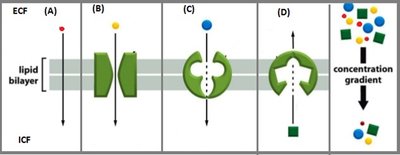
Key Terms:
ATPase: Enzyme for active transport
Carrier-mediated diffusion: Facilitated diffusion
Channel-mediated diffusion: Passive transport via channels
Simple diffusion: Passive transport of nonpolar molecules
Step-by-Step Guidance
Examine each box (A–D) and identify the type of transport depicted.
Match each transport type to possible solutes (e.g., O2 for simple diffusion, Na+ for channel-mediated diffusion).
Determine whether the solute is polar or nonpolar.
Classify each transport as passive or active.
Consider the role of concentration gradients in each mechanism.
Try solving on your own before revealing the answer!
Q1. Define receptor.
Background
Topic: Signal Transduction
This question is about understanding what a receptor is and its role in cell communication.
Key Terms:
Receptor: Protein that binds a signaling molecule
Signal transduction: Process of converting a signal to a cellular response
Step-by-Step Guidance
Define what a receptor is.
Explain its role in cell signaling.
Consider examples of receptors in the body.
Try solving on your own before revealing the answer!
Q2. Contrast the cellular location of receptors of lipid-soluble and lipid-insoluble messengers.
Background
Topic: Receptor Location and Messenger Type
This question is about understanding where receptors are found depending on the type of signaling molecule.
Key Terms:
Lipid-soluble messenger: Can cross the membrane, receptor inside cell
Lipid-insoluble messenger: Cannot cross, receptor on cell surface
Step-by-Step Guidance
Identify the location of receptors for each messenger type.
Explain why lipid-soluble messengers can use intracellular receptors.
Discuss the implications for signal transduction pathways.
Try solving on your own before revealing the answer!
Q3. Describe how receptors act as an "on/off" switch.
Background
Topic: Receptor Function in Signal Transduction
This question is about how receptors regulate cellular responses to signals.
Key Terms:
On/off switch: Activation or inhibition of cellular processes
Step-by-Step Guidance
Describe how binding of a messenger activates or deactivates a receptor.
Explain the downstream effects on cellular activity.
Consider examples of receptor-mediated signaling.
Try solving on your own before revealing the answer!
Q4. Explain how a chemical messenger can produce different responses in various effectors.
Background
Topic: Signal Specificity and Diversity
This question is about understanding how the same signal can have different effects in different cells.
Key Terms:
Effector: Cell or organ that responds to a signal
Signal transduction pathway
Step-by-Step Guidance
Explain how different effectors have different receptors or pathways.
Describe how the same messenger can trigger diverse responses.
Consider examples from hormones or neurotransmitters.
Try solving on your own before revealing the answer!
Q5. Describe down-regulation and its effect on the cell.
Background
Topic: Receptor Regulation
This question is about how cells decrease their sensitivity to signals.
Key Terms:
Down-regulation: Decrease in receptor number or sensitivity
Step-by-Step Guidance
Define down-regulation.
Explain how it affects cell responsiveness.
Consider physiological examples.
Try solving on your own before revealing the answer!
Q6. Describe up-regulation and its effect on the cell.
Background
Topic: Receptor Regulation
This question is about how cells increase their sensitivity to signals.
Key Terms:
Up-regulation: Increase in receptor number or sensitivity
Step-by-Step Guidance
Define up-regulation.
Explain how it affects cell responsiveness.
Consider physiological examples.
Try solving on your own before revealing the answer!
