 Back
Membrane Transport, Membrane Potential, and Bioelectricity: Study Notes for Human Anatomy & Physiology I
Study Guide - Smart Notes
 Tailored notes based on your materials, expanded with key definitions, examples, and context.
Membrane Structure and Function
Cell Membrane as a Barrier
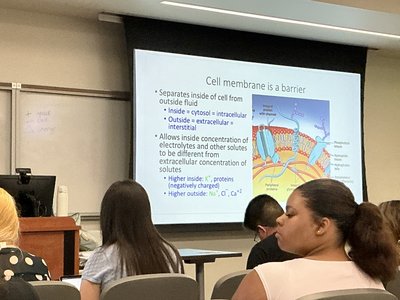
The cell membrane separates the inside of the cell from the outside environment, maintaining distinct internal conditions essential for cellular function.
Intracellular fluid (cytosol): Fluid inside the cell.
Extracellular fluid: Fluid outside the cell, including interstitial fluid and plasma.
Selective permeability: The membrane allows some substances to pass while restricting others, enabling the cell to control its internal environment.
Electrolyte concentration: The cell membrane maintains different concentrations of ions and solutes inside versus outside the cell.
Key ions: Higher inside: K+, proteins (negatively charged); Higher outside: Na+, Cl-, Ca2+.
Membrane Permeability and Diffusion
Permeability
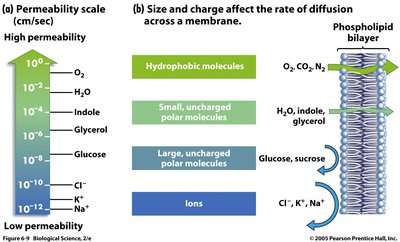
Permeability describes how easily substances cross the cell membrane. Cell membranes are selectively permeable, allowing some molecules to pass more readily than others.
Freely permeable: Allows all substances to pass.
Impermeable: Allows no substances to pass.
Selectively permeable: Allows some substances to pass based on size, charge, and solubility.
Diffusion
Diffusion is the passive movement of molecules from an area of high concentration to an area of low concentration. For uncharged molecules, movement is along the chemical concentration gradient. For ions, both chemical and electrical gradients (the electrochemical gradient) influence movement.
Factors affecting diffusion rate: Distance, molecule size, temperature, concentration gradient, and electrical gradient for ions.
Lipid bilayer permeability: Permeable to O2, CO2, and hydrophobic molecules; less permeable to large or charged molecules.
Osmosis
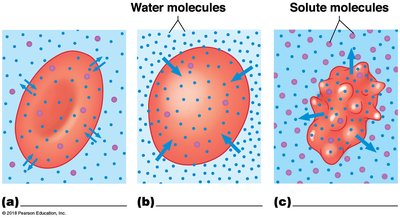
Osmosis is the diffusion of water across a semi-permeable membrane in response to solute concentration differences. Water moves toward areas with higher solute concentration.
Osmotic pressure: The force that pulls water into a solution due to solute concentration.
Tonicity: The effect of a solution on cell volume (isotonic, hypotonic, hypertonic).
Carrier-Mediated Transport
Carrier Proteins and Transport Mechanisms
Carrier proteins facilitate the movement of specific molecules across the membrane. Transport can be passive (facilitated diffusion) or active (requiring ATP).
Specificity: Each carrier protein transports a specific substance.
Saturation: There is a maximum rate of transport when all carriers are occupied.
Regulation: Carrier activity can be regulated by various factors.
Cotransport: Two substances move in the same direction.
Counter-transport: Two substances move in opposite directions.
Facilitated Diffusion
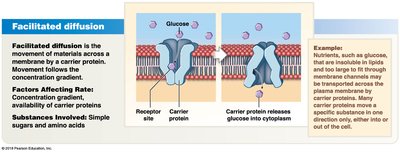
Facilitated diffusion is a passive process where substances move down their concentration gradient with the help of a carrier protein. No ATP is required.
Example: Glucose transport into cells via a specific carrier protein.
Active Transport
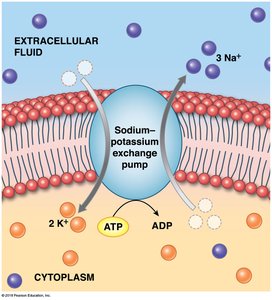
Active transport moves substances against their concentration gradients using energy from ATP. This process is essential for maintaining ion gradients across the membrane.
Ion pumps: Transport ions such as Na+, K+, Ca2+ against their gradients.
Example: Sodium-potassium exchange pump (Na+/K+ ATPase).
Membrane Potential and Bioelectricity
Transmembrane Potential
The transmembrane potential is the difference in electrical charge across the cell membrane. It is essential for nerve and muscle cell function.
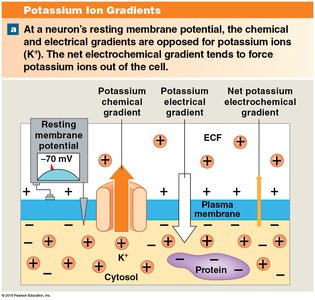
Resting membrane potential: Typically -70 mV in neurons, -85 mV in skeletal muscle cells.
Ion distribution: More K+ and negatively charged proteins inside; more Na+, Cl-, and Ca2+ outside.
Sodium-potassium pump: Maintains the resting potential by pumping 3 Na+ out and 2 K+ in per ATP hydrolyzed.
Electrochemical Gradients
Electrochemical gradients combine chemical and electrical forces acting on ions. These gradients drive ion movement and influence membrane potential.
Na+: Both gradients favor movement into the cell.
K+: Chemical gradient favors movement out; electrical gradient favors movement in; net movement is slower out of the cell.
Ion Channels and Gated Channels
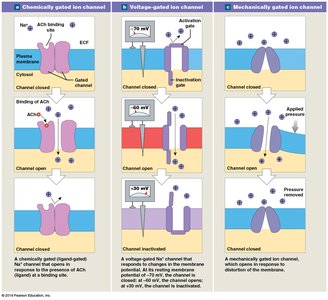
Ion channels allow ions to cross the membrane. Gated channels open or close in response to specific stimuli, regulating ion flow and membrane potential changes.
Chemically gated channels: Open in response to binding of specific molecules (e.g., neurotransmitters).
Voltage-gated channels: Open or close in response to changes in membrane potential.
Mechanically gated channels: Open in response to physical deformation of the membrane.
Changes in Membrane Potential
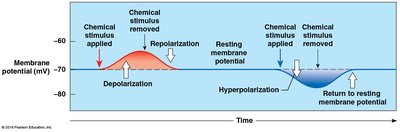
Membrane potential can change in response to stimuli, leading to depolarization, hyperpolarization, or repolarization.
Depolarization: Membrane potential becomes less negative.
Hyperpolarization: Membrane potential becomes more negative.
Repolarization: Membrane potential returns toward resting value after depolarization.
Summary Table: Types of Membrane Transport
Transport Type | Energy Required? | Direction | Example |
|---|---|---|---|
Simple Diffusion | No | Down gradient | O2, CO2 |
Facilitated Diffusion | No | Down gradient | Glucose, amino acids |
Osmosis | No | Down water gradient | Water |
Active Transport | Yes (ATP) | Against gradient | Na+/K+ pump |
Secondary Active Transport | Indirect (uses gradient) | Against gradient (for one substance) | Glucose/Na+ cotransport |
Additional info: These concepts are foundational for understanding nerve impulses, muscle contraction, and cellular homeostasis in human physiology.
