 Back
Metabolism and Cellular Energy Production – Guided Study Notes
Study Guide - Smart Notes
 Tailored notes based on your materials, expanded with key definitions, examples, and context.
Q1. What does the abbreviation "ATP" stand for?
Background
Topic: Cellular Energy Molecules
This question tests your understanding of the primary energy-carrying molecule in cells.
Key Terms:
ATP: The main molecule that stores and transfers energy in cells.
Step-by-Step Guidance
Recall that ATP is a nucleotide composed of adenine, ribose, and three phosphate groups.
Think about the full name for ATP, which reflects its structure and function.
Try solving on your own before revealing the answer!
Q2. The energy of ATP is held in the __________ bonds.
Background
Topic: Chemical Bonds and Energy Storage
This question focuses on where energy is stored within the ATP molecule.
Key Terms:
Phosphate bonds: The bonds between phosphate groups in ATP.
Step-by-Step Guidance
Consider the structure of ATP, which contains three phosphate groups linked together.
Recall which bonds are considered "high-energy" and are broken to release energy for cellular processes.
Try solving on your own before revealing the answer!
Q3. Each ATP high energy phosphate __________ has an energy content of 7.3 kcal.
Background
Topic: Energy Yield from ATP
This question asks about the amount of energy released when a high-energy bond in ATP is broken.
Key Terms:
High-energy phosphate bond: The bond whose hydrolysis releases significant energy.
Step-by-Step Guidance
Think about what is released when ATP is converted to ADP and inorganic phosphate.
Recall the typical energy value associated with the hydrolysis of one of these bonds.
Try solving on your own before revealing the answer!
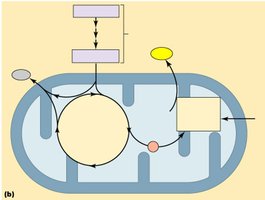
Q4. Fill in the blanks of the overview of the role of the mitochondria in energy production. (See Ch 3 Figure 3-9)
Background
Topic: Mitochondrial Function in Cellular Respiration
This question tests your ability to identify the steps and components involved in mitochondrial energy production.
Key Concepts:
Mitochondria: Organelles known as the "powerhouses" of the cell.
Cellular respiration: The process by which cells generate ATP from nutrients.
Step-by-Step Guidance
Review the main stages of cellular respiration: glycolysis, citric acid cycle (Krebs cycle), and electron transport chain.
Identify where each process occurs within the mitochondrion (matrix, inner membrane, etc.).
Use Figure 3-9 to match the diagram components to the correct steps in energy production.
Try solving on your own before revealing the answer!
Q5. Define Metabolism
Background
Topic: Metabolic Processes
This question asks for a definition of metabolism, a foundational concept in physiology.
Key Terms:
Metabolism: The sum of all chemical reactions in the body.
Step-by-Step Guidance
Think about how metabolism includes both building up (anabolic) and breaking down (catabolic) processes.
Consider how metabolism relates to energy use and production in the body.
Try solving on your own before revealing the answer!
