 Back
BackMetabolism, Energy, and Carbohydrate Metabolism: Study Notes for ANP College Students
Study Guide - Smart Notes
 Tailored notes based on your materials, expanded with key definitions, examples, and context.
Metabolism & Energy
Introduction to Metabolism
Metabolism refers to all the chemical reactions that occur within the body to maintain life. These reactions provide energy for vital processes, supply building blocks for cellular structures, and allow for the storage of excess nutrients for later use.
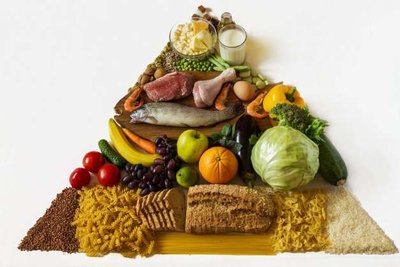
Energy Source: The food we eat is our only source of energy, fueling processes such as mitosis and muscle contraction.
Building Blocks: Nutrients from food are used to construct proteins and other substances needed by the body.
Storage: Excess nutrients are stored as fat or glycogen for future energy needs.
Control of Metabolism
The nervous and endocrine systems regulate metabolic reactions, ensuring that energy production and usage are balanced according to the body's needs.
Basic Energy Concepts
What is Energy?
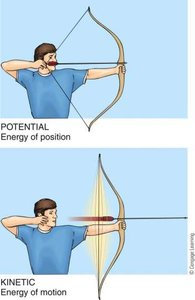
Energy is the capacity to do work. In biological systems, energy is measured as heat energy in kilocalories (kcal).
Potential Energy: Stored energy, such as chemical energy in bonds.
Kinetic Energy: Energy of motion, such as muscle contraction.
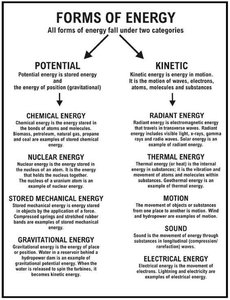
Forms of Energy
Energy exists in various forms, but in the context of metabolism, chemical energy stored in the bonds of molecules is most important.
Chemical Energy: Stored in the bonds of molecules like glucose and ATP.
Heat Energy: Released during metabolic reactions.
Energy Flow in Living Systems
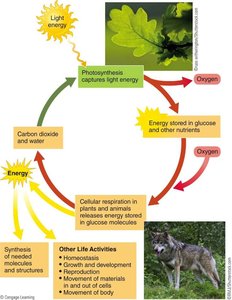
Plants capture energy from sunlight and store it as chemical energy in glucose. Animals and humans obtain this energy by consuming plants or other organisms.
Photosynthesis: Captures light energy and stores it in glucose.
Cellular Respiration: Releases energy from glucose for cellular work.
Metabolic Reactions
Anabolism and Catabolism
Metabolism is divided into two main types of reactions:
Anabolism: Synthesis of complex molecules from simpler ones; requires energy (ATP).
Catabolism: Breakdown of complex molecules into simpler ones; releases energy (ATP).
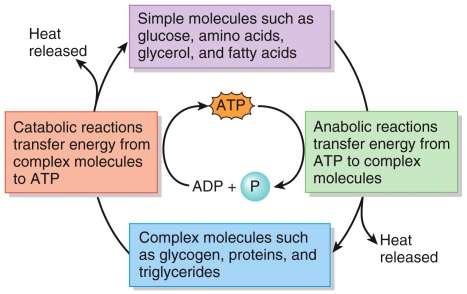
Catabolic reactions generate ATP, which is then used by anabolic reactions to build cellular components.
Key Metabolic Pathways
Glycogenesis (Anabolic): Conversion of glucose to glycogen for storage in the liver; stimulated by insulin.
Glycogenolysis (Catabolic): Breakdown of glycogen to glucose; stimulated by glucagon and epinephrine.
Gluconeogenesis (Anabolic): Formation of glucose from non-carbohydrate sources (proteins, fats); stimulated by cortisol, thyroid hormone, epinephrine, glucagon, and growth hormone.
Carbohydrate Metabolism
Overview
Carbohydrate metabolism primarily involves the breakdown and synthesis of glucose. Glucose catabolism provides energy for ATP production, while its anabolism supports blood glucose regulation, cell repair, and growth.
ATP Production: Main energy source for cells.
Amino Acid Synthesis: Glucose can be used to synthesize non-essential amino acids.
Glycogen Synthesis: Storage form of glucose in liver and muscle.
Triglyceride Synthesis: Excess glucose can be converted to fat for long-term storage.
Human Respiration vs Cellular Respiration
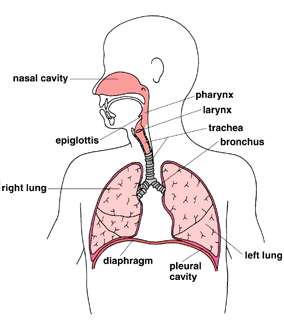
Human Respiration is the act of breathing (inhaling O2, exhaling CO2), while cellular respiration is the process by which cells use oxygen to break down glucose, releasing energy, carbon dioxide, and water.
Overall Equation:
Stages of Aerobic Respiration
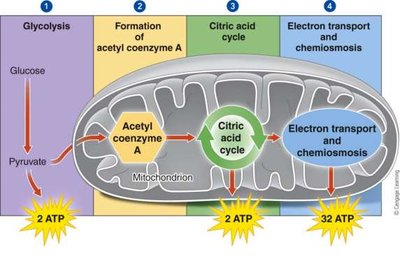
Aerobic respiration consists of four main stages, each occurring in specific cellular locations:
Glycolysis: Occurs in the cytosol; glucose is split into two pyruvate molecules. Anaerobic (does not require O2).
Formation of Acetyl CoA: Occurs in mitochondria; pyruvate is converted to acetyl CoA, linking glycolysis to the citric acid cycle.
Citric Acid Cycle (Krebs Cycle): Occurs in mitochondria; acetyl CoA is degraded to CO2, producing NADH, FADH2, and ATP.
Electron Transport Chain & Chemiosmosis: Occurs in mitochondria; electrons from NADH and FADH2 are transferred to oxygen, generating the majority of ATP.
Summary Table: Aerobic Respiration
Stage | Summary | Some Starting Materials | Some End Products |
|---|---|---|---|
Glycolysis (in cytosol) | Glucose is degraded to pyruvate; net gain of 2 ATP; electrons transferred to carriers | Glucose, ATP, NAD+ | Pyruvate, ATP, NADH |
Formation of acetyl CoA (in mitochondria) | Pyruvate is converted to acetyl CoA; electrons transferred to carriers; CO2 released | Pyruvate, coenzyme A, NAD+ | Acetyl CoA, CO2, NADH |
Citric acid cycle (in mitochondria) | Acetyl CoA is degraded to CO2; electrons transferred to carriers; ATP synthesized | Acetyl CoA, H2O, NAD+, FAD, ADP, Pi | CO2, NADH, FADH2, ATP |
Electron transport (in mitochondria) | Electrons passed along transport molecules; oxygen is final electron acceptor; ATP synthesized | NADH, FADH2, O2, ADP, Pi | ATP, H2O, NAD+, FAD |
ATP Yield from Glucose
The complete aerobic breakdown of one glucose molecule yields up to 36-38 ATP molecules, with the majority produced during the electron transport chain and chemiosmosis.
Key Terms and Concepts
Metabolism: All chemical reactions in the body.
Anabolism: Building complex molecules from simpler ones (requires energy).
Catabolism: Breaking down complex molecules into simpler ones (releases energy).
ATP (Adenosine Triphosphate): The main energy currency of the cell.
Glycolysis: Anaerobic breakdown of glucose to pyruvate.
Citric Acid Cycle (Krebs Cycle): Aerobic process that generates NADH, FADH2, and ATP.
Electron Transport Chain: Series of proteins in mitochondria that produce most of the cell's ATP.
