 Back
Unit 10.2: Metabolism, Nutrition, and Energetics
Study Guide - Smart Notes
 Tailored notes based on your materials, expanded with key definitions, examples, and context.
Metabolism, Nutrition, and Energetics
Introduction to Metabolism and Energetics
Metabolism encompasses all chemical and physical changes occurring in body tissues, including both the breakdown and synthesis of organic molecules. Energetics refers to how the body manages heat gains and losses, and is closely tied to metabolic processes. Cells require oxygen and nutrients (such as water, vitamins, mineral ions, and organic substrates) to carry out these reactions.
Metabolism: The sum of all chemical and physical changes in the body.
Catabolism: Breakdown of large molecules into smaller ones, releasing energy used to synthesize ATP.
Anabolism: Synthesis of new organic molecules from smaller units, requiring energy input.
Nutrient Pool: The collection of all available nutrient molecules in the blood.
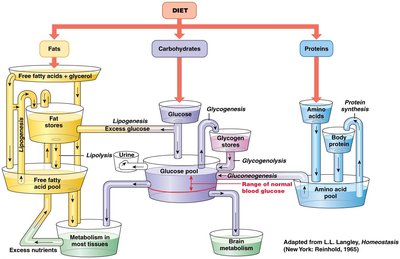
Functions of Anabolism
Structural maintenance and repair
Support of growth
Production of secretions
Storage of nutrient reserves
Nutrient reserves include triglycerides (storage lipids), glycogen (storage carbohydrate), and proteins (most abundant organic components in the body).
Carbohydrate Metabolism
Overview of Carbohydrate Catabolism
Carbohydrate catabolism is the process by which glucose is broken down to generate ATP and other high-energy compounds. This process, known as cellular respiration, involves three main stages: glycolysis, the citric acid cycle, and the electron transport chain.
Overall reaction: Glucose + Oxygen → Carbon Dioxide + Water
Net gain: 30–32 ATP molecules per glucose molecule
Glycolysis
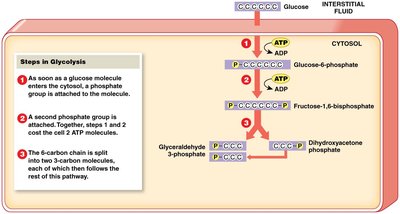
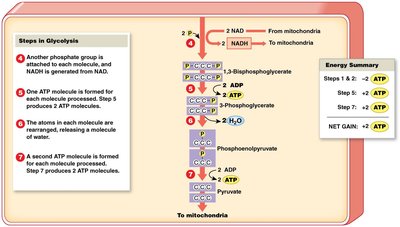
Glycolysis is the anaerobic breakdown of glucose into two molecules of pyruvate, occurring in the cytosol. It consists of a series of enzymatic steps that generate a small amount of ATP and NADH.
Initial phosphorylation steps require ATP investment.
Glucose is split into two 3-carbon molecules.
Net gain: 2 ATP and 2 NADH per glucose molecule.
The Citric Acid Cycle (Krebs Cycle)
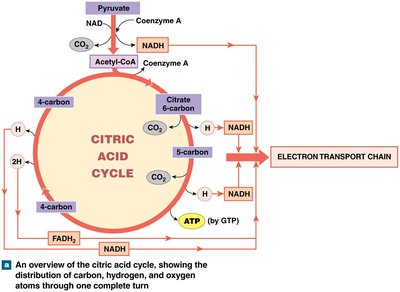
The citric acid cycle occurs in the mitochondrial matrix and completes the oxidation of organic molecules. Acetyl-CoA enters the cycle, and through a series of reactions, energy is captured in the form of NADH, FADH2, and GTP (converted to ATP).
Supplies hydrogen atoms for the electron transport chain.
Generates CO2 as a waste product.
Produces NADH and FADH2 for oxidative phosphorylation.
Electron Transport Chain and Oxidative Phosphorylation
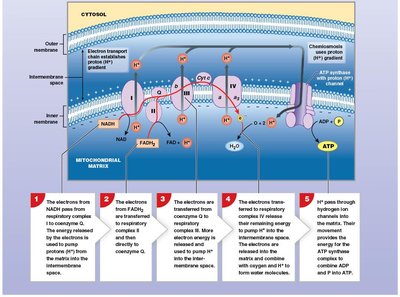
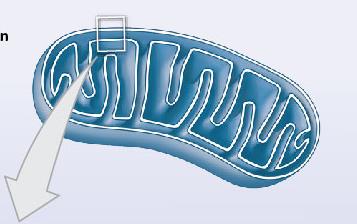
The electron transport chain (ETC) is located in the inner mitochondrial membrane. It uses electrons from NADH and FADH2 to pump protons across the membrane, creating a gradient that drives ATP synthesis. Oxygen acts as the final electron acceptor, forming water.
Produces over 90% of the ATP used by the body.
Key protein complexes and electron carriers (cytochromes) are involved.
Overall reaction:
Gluconeogenesis, Glycogenesis, and Glycogenolysis
Gluconeogenesis: Synthesis of glucose from non-carbohydrate molecules (e.g., 3-carbon molecules other than pyruvate).
Glycogenesis: Formation of glycogen from excess glucose, requiring UTP.
Glycogenolysis: Rapid breakdown of glycogen to glucose monomers.
Lipid Metabolism
Lipid Catabolism (Lipolysis)
Lipids are broken down into glycerol and fatty acids. Glycerol can be converted to pyruvate, while fatty acids undergo beta-oxidation to form acetyl-CoA, which enters the citric acid cycle.
One 18-carbon fatty acid yields about 120 ATP, more than glucose.
Triglycerides are the most abundant storage lipids.
Lipid Synthesis (Lipogenesis) and Storage
Lipogenesis can use almost any organic substrate to synthesize lipids.
Lipids are stored as energy reserves, but are less accessible than carbohydrates.
Lipid Transport and Lipoproteins
Lipids are transported in the blood as lipoproteins (complexes of lipids and proteins).
Types of lipoproteins: Chylomicrons, VLDLs, LDLs ("bad cholesterol"), HDLs ("good cholesterol").
Protein Metabolism
Overview of Protein Metabolism
The body synthesizes a vast array of proteins from 20 amino acids, 8 of which are essential (must be obtained from the diet). Proteins serve as enzymes, hormones, structural elements, and neurotransmitters. Only a small amount of protein is used for energy.
Essential amino acids: isoleucine, leucine, lysine, threonine, tryptophan, phenylalanine, valine, methionine.
Conditionally essential: arginine, histidine.
Amino Acids and ATP Production
When glucose and lipid reserves are low, amino acids can be deaminated and used for ATP production.
Different amino acids enter the citric acid cycle at different points, so ATP yield varies.
Summary Table: Major Metabolic Pathways
Pathway | Substrate | Main Products | Location |
|---|---|---|---|
Glycolysis | Glucose | Pyruvate, ATP, NADH | Cytosol |
Citric Acid Cycle | Acetyl-CoA | CO2, NADH, FADH2, GTP/ATP | Mitochondrial matrix |
Electron Transport Chain | NADH, FADH2, O2 | ATP, H2O | Inner mitochondrial membrane |
Lipolysis | Triglycerides | Glycerol, Fatty acids | Cytosol, mitochondria |
Beta-oxidation | Fatty acids | Acetyl-CoA | Mitochondria |
Deamination | Amino acids | Ammonia, Carbon skeletons | Liver, mitochondria |
