 Back
Metabolism, Nutrition, and Energetics: Study Notes for ANP College Students
Study Guide - Smart Notes
 Tailored notes based on your materials, expanded with key definitions, examples, and context.
Metabolism, Nutrition, and Energetics
Introduction to Metabolism and Energetics
Metabolism encompasses all chemical and physical changes occurring in body tissues, enabling cells to carry out essential reactions. It involves the breakdown and synthesis of organic molecules, with energy stored and utilized as ATP. Energetics refers to how the body balances heat gains and losses during these metabolic processes.
Nutrients: Essential elements and molecules required for metabolic activity, including oxygen, water, vitamins, mineral ions, and organic substrates.
Metabolic Activity: Organic molecules are broken down to obtain energy, which is stored as ATP and used to construct new organic molecules.
Nutrient Pool: All available nutrient molecules distributed in the blood.
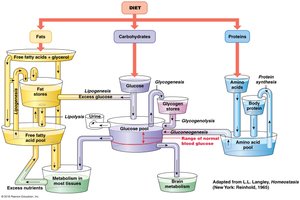
Metabolic Pathways
Catabolism and Anabolism
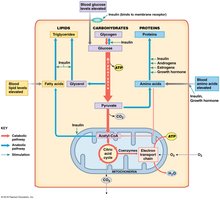
Metabolism consists of two main types of reactions: catabolism and anabolism. These processes are fundamental to maintaining cellular and organismal function.
Catabolism: Converts large molecules into smaller ones, releasing energy used to synthesize ATP.
Anabolism: Converts small molecules into larger ones, forming new chemical bonds. Functions include structural maintenance, growth, production of secretions, and storage of nutrient reserves.
Nutrient Reserves
Triglycerides: Most abundant storage lipids, consisting primarily of fatty acids.
Glycogen: Most abundant storage carbohydrate, a branched chain of glucose molecules.
Proteins: Most abundant organic components in the body, performing vital cellular functions.
Carbohydrate Metabolism
Cellular Respiration and Glycolysis
Carbohydrate catabolism generates ATP and other high-energy compounds through cellular respiration, which involves glycolysis, the citric acid cycle, and the electron transport chain. One molecule of glucose provides a net gain of 30–32 molecules of ATP.
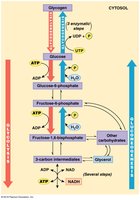
Glycolysis: Breaks down glucose in the cytosol into two 3-carbon molecules of pyruvate. This process is anaerobic and begins with the phosphorylation of glucose to glucose-6-phosphate.
Requirements: Glucose, cytosolic enzymes, ATP, ADP, inorganic phosphate, and NAD (coenzyme).
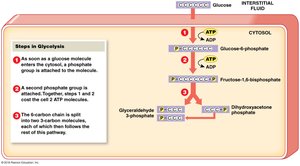
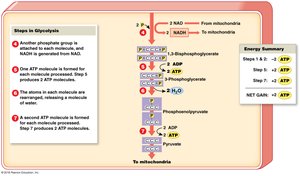
Energy Yield of Glycolysis and Aerobic Metabolism
For each glucose molecule broken down by glycolysis, only 2 ATP (net) are produced. However, additional ATP is generated through the citric acid cycle and electron transport chain, utilizing NADH and FADH2.
Summary: Glycolysis yields 2 ATP and 2 NADH. The citric acid cycle and electron transport chain produce many more ATP molecules.
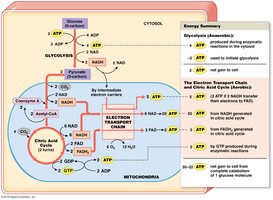
Gluconeogenesis
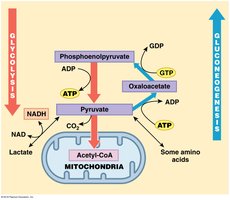
Gluconeogenesis is the synthesis of glucose from noncarbohydrate molecules, such as certain amino acids, lactate, and glycerol. Glucose is stored as glycogen in the liver and skeletal muscle.
Key Point: Many reactions are reversible, but separate regulatory enzymes control key steps.
Lipid Metabolism
Lipid Catabolism (Lipolysis) and Beta-Oxidation
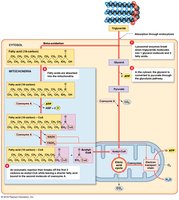
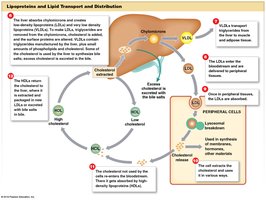
Lipid catabolism breaks lipids down into pieces that can be converted to pyruvate or channeled directly into the citric acid cycle. Hydrolysis splits triglycerides into glycerol and fatty acids, with enzymes converting glycerol to pyruvate.
Beta-oxidation: Sequence of reactions inside mitochondria breaking fatty acids into 2-carbon fragments, generating acetyl-CoA, NADH, and FADH2.
Energy Production: One 18-carbon fatty acid molecule can yield 120 ATP, more than three 6-carbon glucose molecules.
Lipid Synthesis (Lipogenesis)
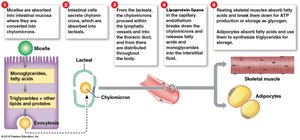
Lipid synthesis can use almost any organic substrate, as lipids, amino acids, and carbohydrates can be converted to acetyl-CoA. Glycerol is synthesized from dihydroxyacetone phosphate, an intermediate of glycolysis and gluconeogenesis.
Nonessential Fatty Acids and Steroids: Synthesized from acetyl-CoA.
Essential Fatty Acids: Must be consumed, e.g., linoleic acid and linolenic acid.
Protein Metabolism
Amino Acid Catabolism
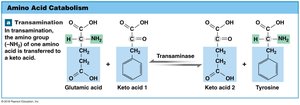
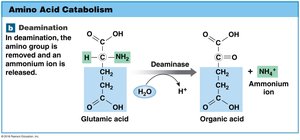
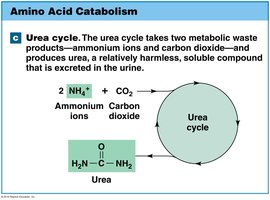
Proteins are built from 20 amino acids and function as enzymes, hormones, structural elements, and neurotransmitters. For proteins to be used as energy, they must be converted into substances that can enter the citric acid cycle, involving transamination, deamination, and the urea cycle.
Transamination: Amino group of an amino acid is transferred to a keto acid, converting it into an amino acid for protein synthesis.
Deamination: Prepares amino acid for breakdown in the citric acid cycle, removing the amino group and generating a toxic ammonium ion.
Urea Cycle: Liver cells remove toxic ammonium ions by synthesizing urea, which is excreted in urine.
Protein Synthesis and Amination
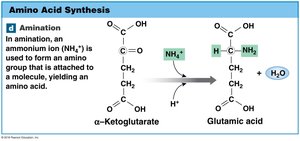
The body synthesizes half of the amino acids needed to build proteins. Ten essential amino acids must be obtained from the diet, while nonessential amino acids are made by the body on demand through amination.
Amination: Addition of an amino group to a molecule, yielding an amino acid.
Metabolic States
Absorptive and Postabsorptive States
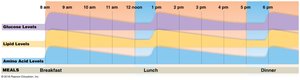
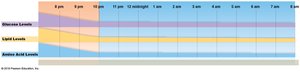
Metabolic activity varies throughout the day, with two main patterns: the absorptive state (following a meal, when nutrient absorption is underway) and the postabsorptive state (when the body relies on internal energy reserves and maintains normal blood glucose levels).
Absorptive State: Lasts about four hours after a meal; nutrients are absorbed and stored.
Postabsorptive State: Most cells break down lipids or amino acids, preserving glucose for nervous tissue.
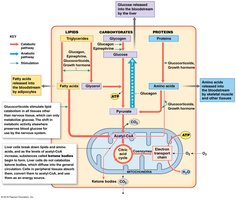
Summary Table: Metabolic Pathways and Key Features
Pathway | Main Substrates | Key Products | Energy Yield |
|---|---|---|---|
Glycolysis | Glucose | Pyruvate, ATP, NADH | 2 ATP (net) |
Citric Acid Cycle | Acetyl-CoA | CO2, NADH, FADH2, GTP | 2 ATP (as GTP) |
Electron Transport Chain | NADH, FADH2 | ATP, H2O | ~28 ATP |
Beta-Oxidation | Fatty acids | Acetyl-CoA, NADH, FADH2 | High (e.g., 120 ATP for 18-carbon fatty acid) |
Transamination/Deamination | Amino acids | Keto acids, ammonium ions, urea | Variable |
