 Back
Microbial Genetics Part II: Gene Expression – Study Notes
Study Guide - Smart Notes
 Tailored notes based on your materials, expanded with key definitions, examples, and context.
Gene Expression and Phenotype
Phenotype: Definition and Examples
The phenotype of an organism refers to its observable physical features and functional traits, which result from the expression of its genetic information. Phenotypes include structures, morphology, and metabolic capabilities.
Structures: Physical components such as cell shape or organelles.
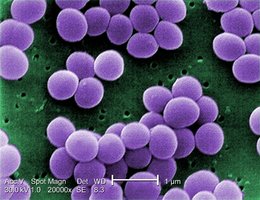
Morphology: The form and structure of organisms, such as cocci or bacilli in bacteria.
Metabolism: The set of life-sustaining chemical reactions, such as the ability to ferment lactose.
Gene Expression: Overview
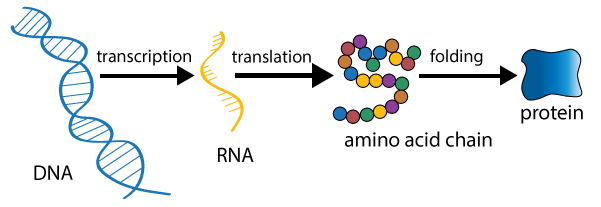
Central Dogma of Molecular Biology
Gene expression is the process by which information from a gene is used to synthesize functional gene products, typically proteins. This process involves two main steps: transcription and translation.
Transcription: The synthesis of messenger RNA (mRNA) from a DNA template.
Translation: The synthesis of proteins using the information encoded in mRNA.
Transcription
Major Elements and Events
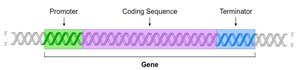
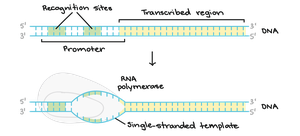
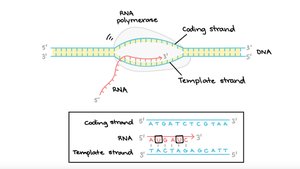
Transcription is the process by which RNA is synthesized from a DNA template. It occurs in three main stages: initiation, elongation, and termination.
Initiation: RNA polymerase binds to the promoter region of the gene.
Elongation: RNA polymerase moves along the DNA, synthesizing a complementary mRNA strand using ribose-based nucleotides (A, U, C, G). Base pairing rules: C pairs with G, A pairs with U in RNA.
Termination: Transcription ends when RNA polymerase reaches the terminator sequence.
Translation
Major Elements and Events
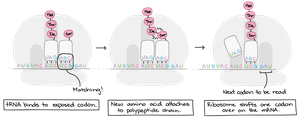
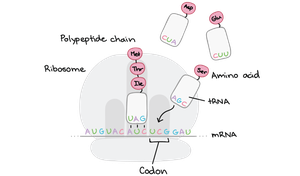
Translation is the process by which ribosomes synthesize proteins using the sequence of codons in mRNA. It involves the following key components:
Ribosomes: Read mRNA three nucleotides at a time (codons).
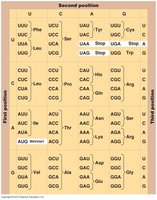
Start codon (AUG): Signals the beginning of translation and codes for methionine.
Stop codons (UAA, UAG, UGA): Signal the end of translation; do not code for amino acids.
Transfer RNA (tRNA): Each tRNA has an anticodon that pairs with a codon on mRNA and carries a specific amino acid.
The Genetic Code
Properties and Significance
The genetic code is the set of rules by which the sequence of nucleotides in mRNA is translated into the sequence of amino acids in a protein. It is considered universal (used by almost all organisms) and redundant (more than one codon can specify the same amino acid).
64 codons: 61 code for amino acids, 3 are stop codons.
Redundancy: Protects against mutations by allowing some changes in DNA to not affect the protein sequence.
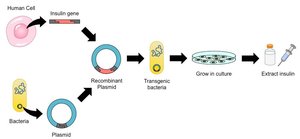
Universality: Allows for genetic engineering, such as producing human proteins in bacteria.
Gene Expression in Prokaryotes vs. Eukaryotes
Coupling of Transcription and Translation
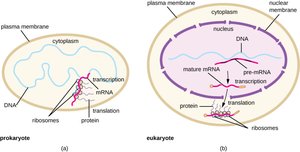
In prokaryotes, transcription and translation are coupled, meaning translation can begin before transcription is complete because both processes occur in the cytoplasm. In eukaryotes, transcription occurs in the nucleus and translation in the cytoplasm, so the processes are separated by space and time.
Prokaryotes: No nuclear membrane; mRNA is translated as it is being transcribed.
Eukaryotes: mRNA must be processed and transported out of the nucleus before translation.
Summary Table: Key Differences in Gene Expression
Feature | Prokaryotes | Eukaryotes |
|---|---|---|
Location of Transcription | Cytoplasm | Nucleus |
Location of Translation | Cytoplasm | Cytoplasm |
Coupling of Processes | Yes | No |
mRNA Processing | None | 5' cap, poly-A tail, splicing |
Key Terms and Concepts
Phenotype: Observable traits of an organism.
Gene Expression: Process by which genetic information is used to synthesize proteins.
Transcription: Synthesis of RNA from DNA.
Translation: Synthesis of protein from mRNA.
Genetic Code: Rules for translating mRNA codons into amino acids.
Codon: Sequence of three mRNA nucleotides that codes for an amino acid.
Anticodon: Sequence of three nucleotides on tRNA complementary to an mRNA codon.
