 Back
Microbial Metabolism: Cellular Respiration and Fermentation
Study Guide - Smart Notes
 Tailored notes based on your materials, expanded with key definitions, examples, and context.
Carbohydrate (Glucose) Catabolism
Overview of Glucose Catabolism
Glucose catabolism is the process by which cells break down glucose to extract energy. There are two major pathways: cellular respiration and fermentation. The extent of glucose breakdown and the final products differ between these pathways.
Cellular Respiration: Complete breakdown of glucose to carbon dioxide (CO2) and water (H2O).
Fermentation: Partial breakdown of glucose, resulting in organic waste products such as lactic acid or ethanol.
Cellular Respiration
Types of Cellular Respiration
Cellular respiration can be classified based on the final electron acceptor used in the electron transport chain (ETC):
Aerobic Respiration: Oxygen (O2) is the final electron acceptor.
Anaerobic Respiration: An inorganic molecule other than oxygen (e.g., nitrate, sulfate) is the final electron acceptor. This yields less energy than aerobic respiration.
Stages of Cellular Respiration
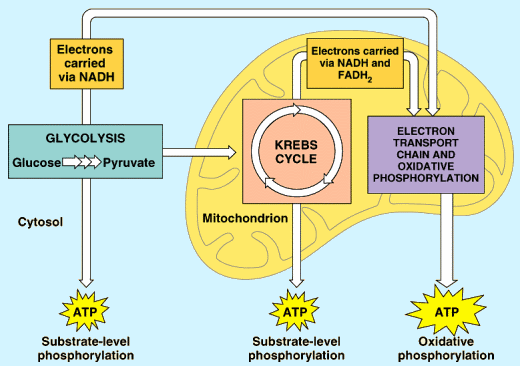
Cellular respiration of glucose occurs in four main stages. The location of each stage differs between prokaryotes and eukaryotes.
Glycolysis ("splitting sugar")
Occurs in the cytoplasm of both prokaryotes and eukaryotes.
Glucose is oxidized to 2 pyruvic acid molecules.
NAD+ is reduced to NADH (electron carrier).
2 ATP are produced by substrate-level phosphorylation.
Net products: 2 ATP, 2 NADH, 2 pyruvic acid.
Acetyl-CoA Formation
Prokaryotes: cytoplasm; Eukaryotes: mitochondrial matrix.
Pyruvic acid is oxidized and decarboxylated (CO2 removed) to form Acetyl-CoA.
NAD+ is reduced to NADH.
Net products: 2 NADH, 2 CO2, 2 Acetyl-CoA.
Krebs Cycle (Citric Acid Cycle)
Prokaryotes: cytoplasm; Eukaryotes: mitochondrial matrix.
Acetyl-CoA is oxidized, generating CO2, NADH, FADH2, and ATP.
Substrate-level phosphorylation produces 2 ATP.
Net products: 6 NADH, 2 FADH2, 2 ATP, 4 CO2.
Electron Transport Chain (ETC) and Chemiosmosis
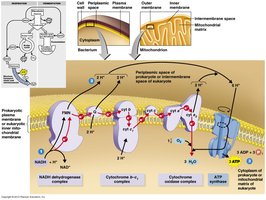
Prokaryotes: plasma membrane; Eukaryotes: inner mitochondrial membrane.
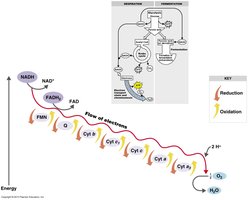
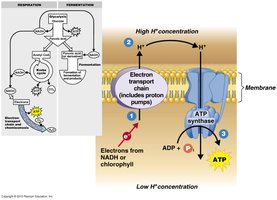
Electrons from NADH and FADH2 are transferred through a series of carriers, releasing energy to pump H+ ions and create a gradient.
O2 (aerobic) or another inorganic molecule (anaerobic) is the final electron acceptor.
ATP synthase uses the H+ gradient to generate ATP (oxidative phosphorylation).
ATP Yield in Cellular Respiration
The total ATP generated from one glucose molecule differs between prokaryotes and eukaryotes due to the energy cost of transporting NADH into mitochondria in eukaryotes.
Prokaryotes: 38 ATP per glucose
Eukaryotes: 36 ATP per glucose
Equation for aerobic respiration:
This process is a giant redox reaction, with glucose being oxidized and oxygen being reduced.
Fermentation
Definition and Overview
Fermentation is an anaerobic process that partially oxidizes glucose without the use of oxygen. It produces organic waste products and regenerates NAD+ to allow glycolysis to continue. The only ATP produced comes from glycolysis.
O2 is not required.
Produces less ATP than respiration.
Common waste products: lactic acid, ethanol.
Importance of NAD+ Recycling
Fermentation is vital for recycling NAD+, which is necessary for glycolysis to continue. NADH is oxidized, and pyruvic acid is reduced to form the waste product.
Major Types of Glucose Fermentation
Lactic Acid Fermentation:
Pyruvic acid is reduced to lactic acid.
Occurs in bacteria and some animal cells (e.g., muscle cells).
Used in the production of cheese and yogurt.
Alcohol Fermentation:
Pyruvic acid is converted to acetaldehyde, which is then reduced to ethanol.
Occurs in yeast and some bacteria.
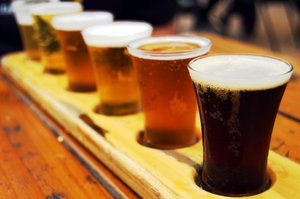
Used in the production of wine and beer.

Summary Table: Comparison of Respiration and Fermentation
Feature | Cellular Respiration | Fermentation |
|---|---|---|
Oxygen Requirement | May require O2 (aerobic) | Does not require O2 |
Extent of Glucose Breakdown | Complete (to CO2 and H2O) | Partial (to organic waste) |
ATP Yield (per glucose) | 36-38 ATP | 2 ATP |
Final Electron Acceptor | O2 or other inorganic molecule | Organic molecule (e.g., pyruvate, acetaldehyde) |
Major Products | CO2, H2O, ATP | Lactic acid, ethanol, ATP |
Key Terms
Redox Reaction: A chemical reaction involving the transfer of electrons between two species.
Substrate-level Phosphorylation: Direct transfer of a phosphate group to ADP to form ATP.
Oxidative Phosphorylation: ATP production using energy derived from the transfer of electrons in the ETC.
Decarboxylation: Removal of a carbon atom as CO2.
