 Back
BackMicrobial Metabolism: Enzymes and Energy in Biological Systems
Study Guide - Smart Notes
 Tailored notes based on your materials, expanded with key definitions, examples, and context.
Microbial Metabolism
Introduction to Microbial Metabolism
Microbial metabolism encompasses all the chemical reactions that occur within microorganisms, allowing them to acquire energy and nutrients. These processes are fundamental to understanding how pathogens affect human health, how fermentation produces foods like wine and bread, and how antimicrobial drugs function.
Metabolism: The sum of all chemical reactions in an organism.
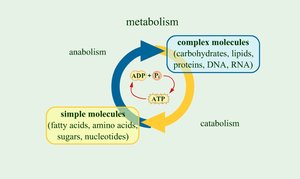
Catabolism: The breakdown of complex molecules into simpler ones, releasing energy (ATP).
Anabolism: The synthesis of complex molecules from simpler ones, requiring energy (uses ATP).
The Role of ATP in Metabolism
Adenosine triphosphate (ATP) acts as the main energy currency in cells, linking catabolic and anabolic reactions. Catabolic reactions generate ATP, which is then used to drive anabolic processes.
ATP is hydrolyzed to ADP (adenosine diphosphate) and inorganic phosphate (Pi), releasing energy for cellular work.
ATP is regenerated from ADP during catabolic reactions.
Enzymes and Chemical Reactions
Activation Energy and Reaction Rate
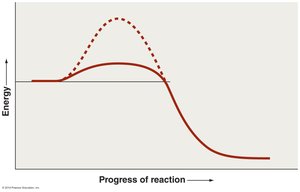
Chemical reactions require a certain amount of energy to proceed, known as activation energy. The reaction rate is the frequency of collisions between reactant molecules, which can be increased by raising temperature, pressure, or by using enzymes.
Activation energy: The minimum energy needed to disrupt electron arrangements in reactants, allowing bonds to break and new ones to form.
Reaction rate: The speed at which reactants are converted to products.
Enzymes lower activation energy, increasing reaction rates without being consumed.
Enzymes: Structure and Function
Enzymes are biological catalysts that speed up chemical reactions by lowering activation energy. Each enzyme is specific to a particular substrate (reactant) and is not altered during the reaction.
Apoenzyme: The protein portion of an enzyme.
Cofactor: Non-protein component required for enzyme activity. Can be inorganic (ions like Ca2+, Zn2+) or organic (coenzymes such as NAD).
Holoenzyme: The complete, active enzyme with its cofactor.
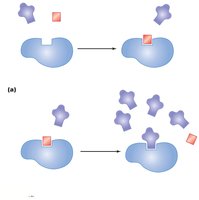
Active site: The region on the enzyme where the substrate binds.

Mechanism of Enzyme Action
The enzymatic reaction involves several steps, ensuring specificity and efficiency:
Specific substrate binds to the enzyme's active site (induced fit model).
Substrate is transformed—bonds are rearranged or broken.
Products are released; they no longer fit the active site.
Enzyme remains unchanged and can catalyze additional reactions.
Factors Influencing Enzyme Activity
Substrate Concentration
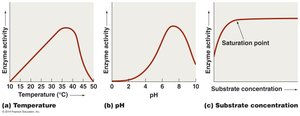
Increasing substrate concentration increases the reaction rate up to a maximum velocity (Vmax), where all enzyme active sites are occupied (enzyme saturation).
Beyond Vmax, adding more substrate does not increase the rate unless more enzyme is added.

Temperature and pH
Enzyme activity is highly sensitive to temperature and pH:
Each enzyme has an optimal temperature and pH for maximum activity.
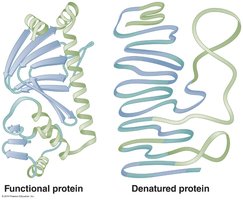
High temperatures or extreme pH can denature enzymes, altering their structure and function.
At low temperatures, enzymes are not denatured but become inactive (frozen).
Enzyme Inhibition
Enzyme activity can be regulated by inhibitors, which are crucial for controlling metabolic pathways:
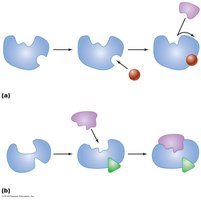
Competitive inhibitors: Compete with the substrate for the active site. Example: Sulfanilamide inhibits folic acid synthesis in bacteria.
Noncompetitive inhibitors: Bind to an allosteric site (not the active site), changing the enzyme's shape and preventing substrate binding. Example: Feedback inhibition in metabolic pathways.
Feedback Inhibition
Feedback inhibition is a regulatory mechanism where the end-product of a metabolic pathway inhibits an enzyme involved early in the pathway. This prevents the overproduction of the end-product and conserves resources.
Common in biosynthetic (anabolic) pathways.
Ensures metabolic balance and efficiency.
Summary Table: Enzyme Regulation Mechanisms
Type of Inhibition | Binding Site | Effect on Enzyme | Example |
|---|---|---|---|
Competitive | Active site | Blocks substrate binding | Sulfanilamide (antibiotic) |
Noncompetitive (Allosteric) | Allosteric site | Changes enzyme shape | Feedback inhibition |
Additional info: Enzyme regulation is essential for cellular homeostasis and is a target for many antimicrobial drugs. Understanding these mechanisms is crucial for fields such as microbiology, medicine, and biotechnology.
