 Back
BackMicrobial Nutrition & Growth: Measuring Bacterial Population Growth
Study Guide - Smart Notes
 Tailored notes based on your materials, expanded with key definitions, examples, and context.
Growth of Bacterial Cultures
Binary Fission and Generation Time
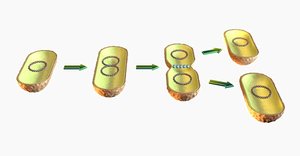
Bacteria primarily reproduce by a process called binary fission, in which a single cell divides to form two genetically identical daughter cells. The generation time is the period required for a bacterial population to double in number. This time can vary widely among species and environmental conditions. For example, Escherichia coli can double every 20 minutes under optimal laboratory conditions, leading to exponential population growth.
Binary Fission: The cell grows to twice its size, replicates its DNA, and divides into two equal daughter cells.
Generation Time: The time it takes for the population to double; calculated using the formula: where is the final number of cells, is the initial number, and is the number of generations.
Example: Starting with one E. coli cell, after 24 hours (with a 20-minute generation time), the population can reach approximately cells.
Phases of Microbial Population Growth
Growth Curve Phases
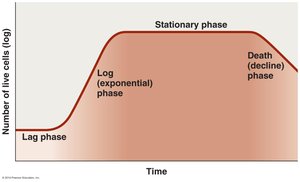
Bacterial populations in a closed system (batch culture) exhibit a characteristic growth curve with four distinct phases:
Lag Phase: Cells adjust to their environment; metabolic activity is high, but cell division is minimal.
Log (Exponential) Phase: Cells divide at a constant, rapid rate; population increases logarithmically.
Stationary Phase: Nutrient depletion and waste accumulation slow growth; cell division rate equals cell death rate.
Death (Decline) Phase: Cells die at an exponential rate due to unfavorable conditions.
Example: In laboratory cultures, these phases are observed by plotting the logarithm of cell number versus time.
Measuring Bacterial Growth
Direct Methods
Direct methods involve counting individual cells or colonies to estimate population size. These methods are precise but may be time-consuming.
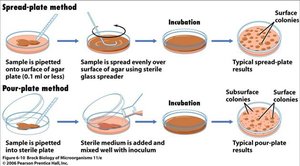
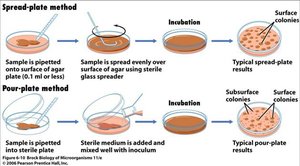
Plate Counts: Involves spreading a diluted sample on solid agar and counting colony-forming units (CFUs) after incubation. Common techniques include the spread plate and pour plate methods.
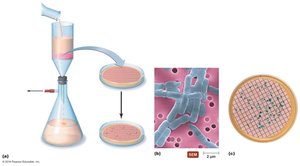
Membrane Filtration: Used for samples with low bacterial numbers. The sample is filtered, trapping bacteria on a membrane, which is then placed on a culture medium to count CFUs.
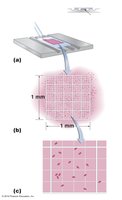
Microscopic Counts: Cells are stained and counted directly under a microscope using a counting chamber (hemocytometer). This method provides rapid results but cannot distinguish between live and dead cells without special stains.
Indirect Methods
Indirect methods estimate bacterial growth by measuring factors correlated with cell number, such as turbidity, biomass, or metabolic activity.
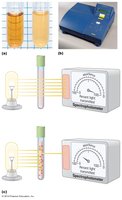
Turbidity (Cloudiness): The cloudiness of a bacterial suspension increases with cell density. A spectrophotometer measures light absorbance, which is proportional to the number of bacteria present.
Dry Weight: Cells are harvested, dried, and weighed. An increase in dry weight indicates growth.
Metabolic Activity: The amount of a metabolic product (e.g., acid, gas) is measured. Higher product levels indicate more growth.

Summary Table: Methods for Measuring Bacterial Growth
Method | Type | Principle | Advantages | Limitations |
|---|---|---|---|---|
Plate Count | Direct | Counts CFUs on agar plates | Measures viable cells | Time-consuming; only counts culturable cells |
Membrane Filtration | Direct | Filters sample, counts colonies on filter | Good for low cell numbers | Requires filtration apparatus |
Microscopic Count | Direct | Counts cells under microscope | Quick; total cell count | Cannot distinguish live/dead cells |
Turbidity | Indirect | Measures light absorbance | Rapid; non-destructive | Less accurate at high densities |
Dry Weight | Indirect | Weighs dried biomass | Good for filamentous organisms | Destructive; not for small samples |
Metabolic Activity | Indirect | Measures metabolic products | Useful for slow growers | Indirect estimate; may not reflect cell number |
