 Back
BackMicrocirculation and Regulation of Blood Flow and Pressure
Study Guide - Smart Notes
 Tailored notes based on your materials, expanded with key definitions, examples, and context.
Microcirculation and Blood Vessels
Types of Blood Vessels
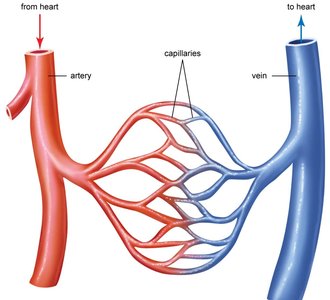
The circulatory system is composed of several types of blood vessels, each with distinct roles in transporting blood and facilitating exchange of materials.
Arteries: Carry blood away from the heart under high pressure.
Arterioles: Small branches of arteries that regulate blood flow into capillaries.
Capillaries: Microscopic vessels where material exchange occurs between blood and tissues.
Venules: Collect blood from capillaries and transport it to veins.
Veins: Return blood to the heart under lower pressure.
Capillary Structure and Types
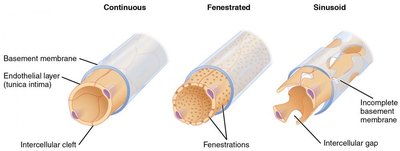
Capillaries are specialized for exchange and vary in structure depending on tissue needs.
Continuous Capillaries: Have uninterrupted endothelial lining; found in muscle, connective, and neural tissue.
Fenestrated Capillaries: Contain pores (fenestrations) that increase permeability; found in kidneys, intestines, and endocrine glands.
Sinusoidal (Discontinuous) Capillaries: Have large gaps and incomplete basement membranes; found in bone marrow, liver, and spleen.
Key Point: Most cells are within 0.1 mm of a capillary, enabling efficient diffusion. Tissues with higher metabolic activity (e.g., muscle) have more capillaries.
Blood Flow and Velocity in Capillaries
Velocity of Blood Flow
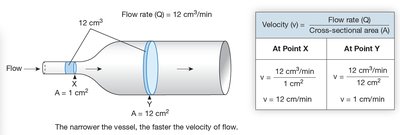
Blood flow velocity is lowest in capillaries, allowing time for exchange of materials.
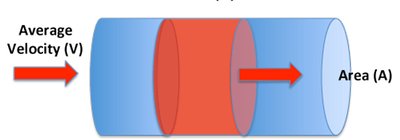
Velocity (V) is defined as the distance a certain volume of blood travels per unit time.
Formula: where = velocity, = flow rate, = cross-sectional area.
Capillaries have the largest total cross-sectional area, resulting in the slowest velocity.
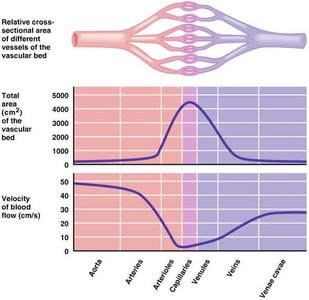
Example: The total exchange area of capillaries in the human body exceeds 6,300 m2 (about two football fields).
Capillary Exchange Mechanisms
Pathways and Mechanisms
Exchange of substances across capillary walls occurs via several mechanisms:
Paracellular Pathway: Movement between endothelial cells.
Transcellular Pathway: Movement through endothelial cells.
Diffusion: Passive movement of small lipophilic solutes and gases (e.g., O2, CO2) down concentration gradients.
Transcytosis: Active transport of larger molecules (e.g., proteins) via vesicles.
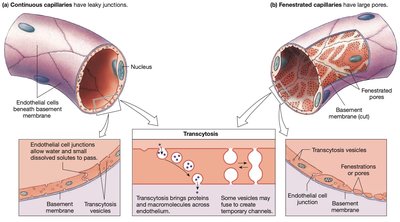
Example: Glucose is transported via GLUT1 transporters; antibodies and lipoproteins use receptor-mediated transcytosis.
Bulk Flow: Filtration and Absorption
Bulk Flow Regulation
Bulk flow refers to the movement of fluid (water, ions, small solutes) across capillary walls, driven by hydrostatic and osmotic pressures.
Filtration: Fluid moves out of capillaries into interstitial space.
Absorption: Fluid moves from interstitial space into capillaries.
These processes are governed by Starling forces:
Hydrostatic Pressure (P): Pushes fluid out of capillaries.
Colloid Osmotic Pressure (𝛑): Pulls fluid into capillaries, determined by plasma protein concentration.
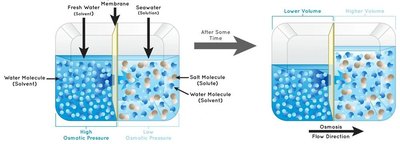
Calculation of Net Pressure
Net filtration pressure is calculated as the difference between hydrostatic and colloid osmotic pressures:
At arterial end: (net filtration)
At venous end: (net absorption)
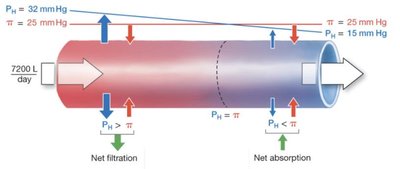
Key Point: Filtration exceeds absorption by about 3 liters per day, with excess fluid returned to circulation via the lymphatic system.
Regulation of Arterial Blood Pressure
Determinants of Mean Arterial Pressure (MAP)
Mean arterial pressure is regulated by multiple factors:
Resistance (mainly at arterioles)
Myogenic autoregulation
Sympathetic innervation and neurohormones
Hormones
Paracrine signals
Blood volume
Cardiac output (CO = heart rate × stroke volume)
Blood distribution
Resistance and Poiseuille’s Law
Resistance (R) to blood flow is determined by vessel length, blood viscosity, and especially vessel radius:
Poiseuille’s Law:
Small changes in radius have large effects on resistance.
Arterioles are the primary site of resistance regulation.
Vasoconstriction and Vasodilation Regulation
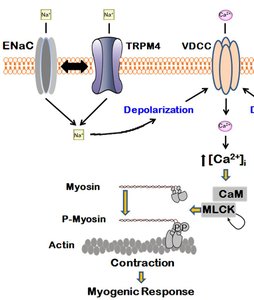
Myogenic Autoregulation: Smooth muscle responds to stretch by contracting, maintaining constant blood flow.
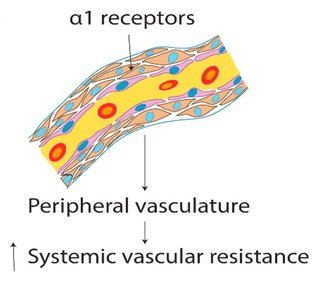
Sympathetic Innervation: Norepinephrine (NE) causes vasoconstriction via α1 receptors; epinephrine can cause vasodilation in some tissues via β2 receptors.
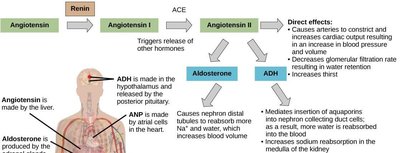
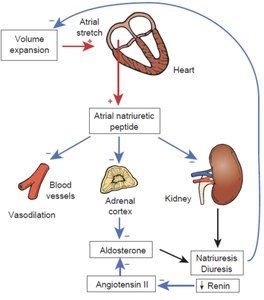
Hormonal Regulation: Renin-angiotensin-aldosterone system increases blood pressure; atrial natriuretic peptide (ANP) decreases it.
Paracrine Signals: Local factors (e.g., NO, CO2, H+) modulate vessel diameter in response to tissue needs.
Blood Volume and Distribution
Blood volume is tightly regulated by the kidneys and hormones. Distribution of blood flow is adjusted by arteriolar resistance, ensuring tissues receive appropriate perfusion.
Cardiac Output and Heart Rate
Cardiac output (CO) is the product of heart rate (HR) and stroke volume (SV):
Regulated by autonomic nervous system and hormones (e.g., epinephrine).
Summary Table: Major Hormones Affecting Blood Pressure
Hormone | Origin | Effect on BP |
|---|---|---|
Renin | Kidney | ↑ |
Angiotensin II | Liver (precursor) | ↑ |
Aldosterone | Adrenal gland | ↑ |
ANP | Heart (atria) | ↓ |
ADH | Pituitary gland | ↑ |
Clinical Note: Shock
Shock is a life-threatening condition where insufficient blood flow fails to meet tissue metabolic demands, often due to low blood volume or pressure.
Blood Distribution in the Body
Total blood flow through all arterioles equals cardiac output. Blood is distributed according to tissue needs and arteriolar resistance, regulated by myogenic, autonomic, local, and hormonal factors.
