 Back
BackMicroscope Field and Metric Units of Length
Study Guide - Smart Notes
 Tailored notes based on your materials, expanded with key definitions, examples, and context.
Microscope Field and Metric Units of Length
Understanding the Microscope Field
The microscope field refers to the visible area seen through the microscope eyepiece. As magnification increases, the diameter of this field decreases, making it important to understand how to estimate the size of objects viewed under the microscope.
Field Diameter: The actual width of the visible area at a specific magnification.
Estimating Object Size: If you know the field diameter, you can estimate the size of an object by comparing how much of the field it occupies. For example, if the field diameter is 4 mm and the object spans half the field, its length is approximately 2 mm.
Application: This method is commonly used in biology and anatomy labs to measure cells, tissues, and other microscopic specimens.
Metric Units of Length
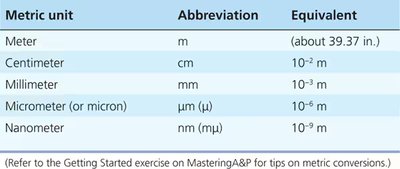
Microscopic specimens are typically measured using units from the metric system, such as millimeters and micrometers. Understanding these units and their relationships is essential for accurate measurement and reporting in scientific contexts.
Meter (m): The base unit of length in the metric system.
Centimeter (cm): Equal to meters.
Millimeter (mm): Equal to meters.
Micrometer (\mu m): Equal to meters. Also called a micron.
Nanometer (nm): Equal to meters.
These units allow for precise measurement of very small objects, such as cells and organelles, which are often only a few micrometers or nanometers in size.
Metric unit | Abbreviation | Equivalent |
|---|---|---|
Meter | m | (about 39.37 in.) |
Centimeter | cm | m |
Millimeter | mm | m |
Micrometer (or micron) | \mu m (\mu) | m |
Nanometer | nm (m\mu) | m |
Conversions and Practical Use
When working with microscopes, it is important to convert between these units as needed. For example, 1 mm = 1,000 μm, and 1 μm = 1,000 nm. Mastery of these conversions is essential for accurate scientific measurement and reporting.
Example: If a cell measures 50 μm in length, this is equivalent to 0.05 mm or 50,000 nm.
