 Back
Mini-Textbook Study Notes: Compartmentation, Membranes, and Homeostasis in Human Physiology
Study Guide - Smart Notes
 Tailored notes based on your materials, expanded with key definitions, examples, and context.
Introduction to Human Body Systems
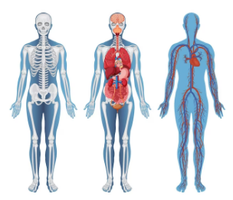
Overview of Body Systems
The human body is organized into distinct systems, each with specialized functions that contribute to overall physiological balance. Understanding these systems is foundational for studying physiology.
Key Point 1: Body systems include skeletal, muscular, cardiovascular, respiratory, digestive, urinary, reproductive, and integumentary systems.
Key Point 2: Each system interacts with others to maintain homeostasis and support life processes.
Example: The cardiovascular system transports nutrients and oxygen, while the respiratory system exchanges gases.
Compartmentation: Cells and Tissues
Body Compartments and Fluid Distribution
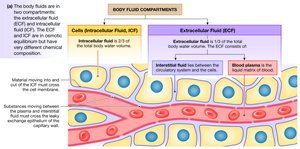
Compartmentation refers to the division of the body into distinct spaces, each with unique chemical environments. This organization is essential for cellular function and tissue specialization.
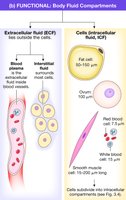
Key Point 1: The body is divided into intracellular (ICF) and extracellular (ECF) fluid compartments.
Key Point 2: ECF includes blood plasma and interstitial fluid, while ICF is the fluid within cells.
Example: Substances must cross membranes to move between compartments, such as nutrients entering cells from the bloodstream.
Membranes and Their Functions
Biological membranes are critical for maintaining compartment boundaries and regulating exchange.
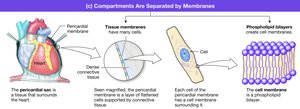
Key Point 1: Multicellular membranes separate body cavities and fluid compartments.
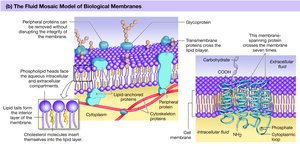
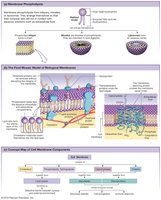
Key Point 2: Membranes are composed of phospholipid bilayers and associated proteins, creating selective barriers.
Example: The pericardial membrane surrounds the heart, while cell membranes separate intracellular and extracellular environments.
Cell Membrane Structure and Function
The cell membrane is a dynamic structure that controls the movement of substances and communication between cells.
Key Point 1: The fluid mosaic model describes the membrane as a phospholipid bilayer with embedded proteins and cholesterol.
Key Point 2: Membrane proteins mediate transport, signaling, and cell recognition.
Example: Glycoproteins in the membrane act as recognition molecules for immune responses.
Membranous Organelles
Membranous organelles are specialized compartments within cells, each performing unique functions.
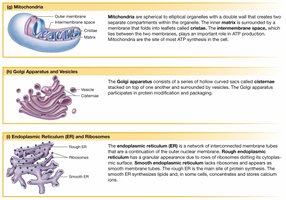
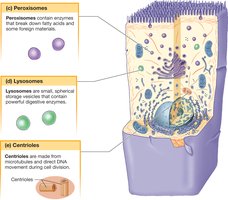
Key Point 1: Organelles such as mitochondria, Golgi apparatus, and endoplasmic reticulum are bound by phospholipid membranes.
Key Point 2: These organelles compartmentalize cellular processes, enhancing efficiency and regulation.
Example: Mitochondria generate ATP, while the Golgi apparatus modifies and packages proteins.
Types of Tissues and Membranes
Epithelial Tissue
Epithelial tissues form protective barriers and regulate exchange between compartments.
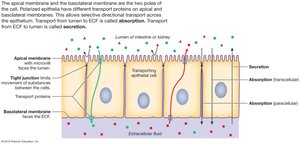
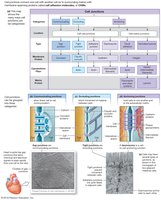
Key Point 1: Epithelial membranes have distinct sides: apical (luminal), basolateral, and external face.
Key Point 2: Tight junctions limit movement between cells, while transport proteins enable selective exchange.
Example: Intestinal epithelium absorbs nutrients from the lumen into the bloodstream.
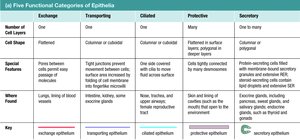
Category | Cell Layers | Cell Shape | Special Features | Where Found |
|---|---|---|---|---|
Exchange | One | Flattened | Pores permit easy passage of molecules | Lungs, lining of blood vessels |
Transporting | One | Columnar or cuboidal | Tight junctions prevent movement between cells; surface area increased by microvilli | Intestine, kidney, some exocrine glands |
Ciliated | One | Columnar or cuboidal | One side covered with cilia to move fluid across surface | Nose, trachea, upper respiratory tract, female reproductive tract |
Protective | Many | Flattened in surface layers, polygonal in deeper layers | Cells tightly connected by many desmosomes | Skin, lining of mouth, pharynx, esophagus |
Secretory | One to many | Columnar or polygonal | Protein-secreting cells filled with rough ER; steroid-secreting cells contain lipid droplets and SER | Exocrine glands, pancreas, sweat glands, salivary glands, stomach, endocrine glands |
Connective Tissue
Connective tissues provide structural support, bind tissues, and store energy.
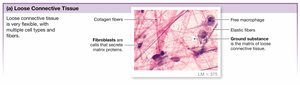
Key Point 1: Loose connective tissue is flexible and contains multiple cell types and fibers.
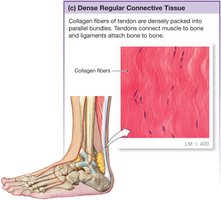
Key Point 2: Dense connective tissue forms strong, parallel bundles for tendons and ligaments.
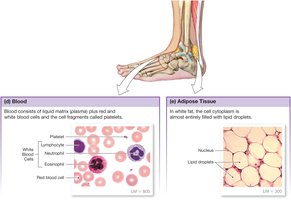
Example: Blood and adipose tissue are specialized connective tissues for transport and energy storage.
Membrane Dynamics and Fluid Compartments
Fluid Compartments and Water Balance
The body maintains distinct fluid compartments, each with specific solute concentrations and functions.
Key Point 1: Intracellular fluid (ICF) makes up about 2/3 of total body water; extracellular fluid (ECF) is about 1/3.
Key Point 2: Water balance is crucial for maintaining solute concentrations, blood viscosity, and cellular function.
Example: Plasma, interstitial fluid, and lymph have different protein and electrolyte concentrations.
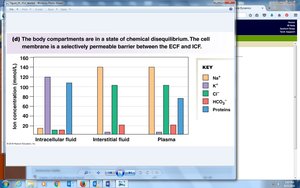
Compartment | Water Content | Protein Content |
|---|---|---|
ICF | 70-80% | 12% |
Blood Plasma | 93% | 7% |
ISF/Lymph | 70-80% | ~0% |
Driving Forces for Exchange
Exchange between compartments is governed by physical and chemical gradients.
Key Point 1: Filtration is driven by pressure gradients (e.g., blood pressure).
Key Point 2: Diffusion and osmosis are driven by concentration gradients of solutes and water.
Example: Water moves from areas of low solute concentration to high solute concentration via osmosis.
Homeostasis: Regulation and Feedback
Definition and Principles
Homeostasis is the body's ability to maintain stable internal conditions despite external changes.
Key Point 1: Homeostasis involves dynamic regulation, not static equilibrium.
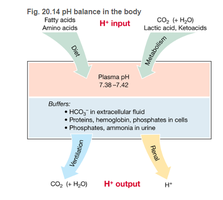
Key Point 2: Variables under homeostatic control include osmolarity, temperature, pH, water balance, and nutrient levels.
Example: The body adjusts blood pressure and temperature in response to environmental changes.
Feedback Loops
Feedback loops are essential for maintaining homeostasis.
Key Point 1: Negative feedback reduces deviations from set points, restoring balance.
Key Point 2: Positive feedback amplifies responses, often in special circumstances (e.g., childbirth).
Example: Thermoregulation uses negative feedback to maintain body temperature.
Mass Balance Equation
The mass balance principle explains how the body maintains constant levels of substances.
Key Point 1: Total amount of substance = (intake + production) - (excretion + metabolism).
Key Point 2: Gains and losses must be balanced for homeostasis.
Acid-Base Balance and pH Regulation
pH and Its Importance
The pH of body fluids is tightly regulated to ensure proper protein function and metabolic activity.
Key Point 1: pH is a measure of free hydrogen ion (H+) concentration.
Key Point 2: Normal blood pH is 7.35–7.45; deviations cause acidosis or alkalosis.
Example: Metabolic and respiratory processes can alter pH.
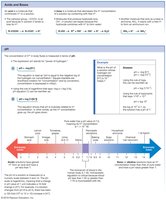
Acids, Bases, and Buffer Systems
Acids donate H+ ions, while bases accept them. Buffer systems stabilize pH by reversible reactions.
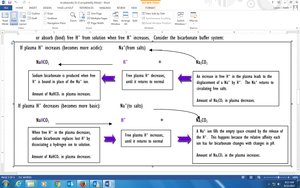
Key Point 1: The bicarbonate buffer system is the main extracellular buffer.
Key Point 2: Protein and phosphate buffers are important in intracellular and urinary compartments.
Example: The reaction occurs rapidly in red blood cells.
Molecular Interactions: Chemistry Review
Atoms and Subatomic Particles
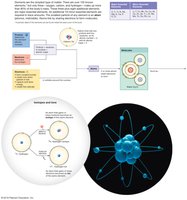
Atoms are composed of protons, neutrons, and electrons, which determine their chemical properties.
Key Point 1: The number of protons defines the element; neutrons create isotopes; electrons determine reactivity.
Key Point 2: Molecular mass is the sum of protons and neutrons.
Chemical Bonds
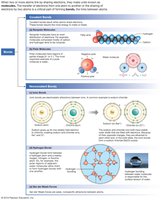
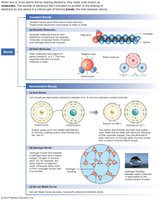
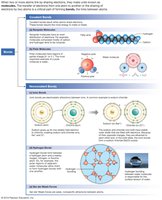
Chemical bonds form between atoms to create molecules, with different types affecting stability and solubility.
Key Point 1: Covalent bonds are strong and stable; ionic bonds are weaker and dissociate in water; hydrogen bonds are very weak.
Key Point 2: Polar covalent bonds create water-soluble molecules; nonpolar bonds create lipid-soluble molecules.
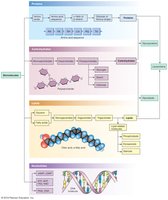
Biomolecules: Structure and Function
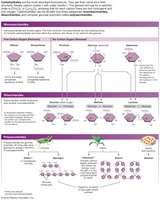
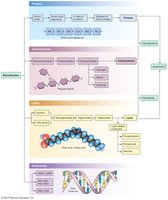
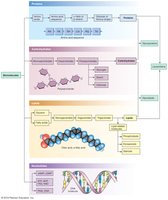
Carbohydrates
Carbohydrates are essential for energy storage, structural support, and cell signaling.
Key Point 1: Monosaccharides are simple sugars; disaccharides are two covalently bonded monosaccharides; polysaccharides are complex carbohydrates.
Key Point 2: Glycogen and starch are storage forms; cellulose and chitin are structural.
Nucleic Acids
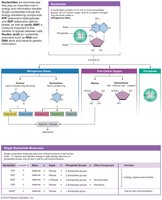
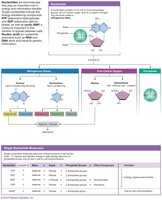
Nucleic acids store and transfer genetic information and energy.
Key Point 1: Nucleotides consist of a sugar, phosphate, and nitrogenous base.
Key Point 2: DNA and RNA are polymers of nucleotides; ATP, NADH, and FADH2 are energy transfer molecules.
Lipids
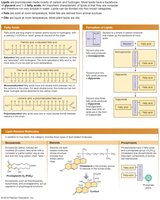
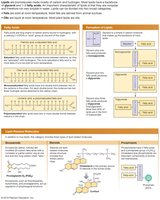
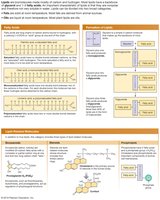
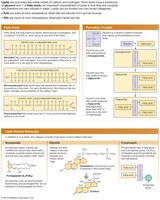
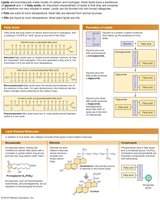
Lipids are nonpolar molecules used for energy storage, membrane structure, and signaling.
Key Point 1: True lipids have one to three fatty acid tails; phospholipids are main membrane components.
Key Point 2: Saturated fatty acids have no double bonds; unsaturated fatty acids have at least one, causing bends.
Example: Cholesterol stabilizes membranes and is a precursor for steroid hormones.
Proteins
Proteins are versatile biomolecules with structural and functional roles.
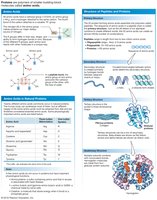
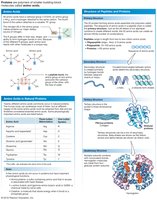
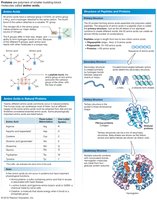
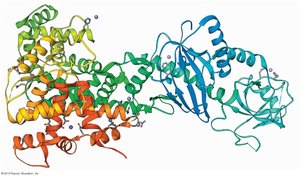
Key Point 1: Amino acids are joined by peptide bonds; proteins have primary, secondary, tertiary, and quaternary structures.
Key Point 2: Structural proteins provide support; functional proteins include enzymes, transporters, receptors, and antibodies.
Protein Function and Regulation
Binding, Specificity, and Affinity
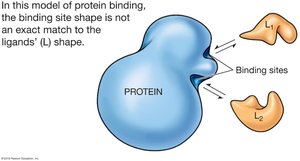
Proteins interact with substrates based on specificity and affinity, which determine their functional responses.
Key Point 1: Specificity is the ability to bind only certain substrates; affinity is the strength of binding.
Key Point 2: Competition and saturation affect protein function.
Protein Modulation
Protein activity can be modulated chemically or environmentally to regulate cellular responses.
Key Point 1: Modulation alters binding affinity or protein population.
Key Point 2: Chemical modulators, temperature, and pH can change protein activity.
Enzymes
Enzymes are proteins that catalyze biochemical reactions, enabling life processes to occur efficiently.
Key Point 1: Enzymes orient reactants and lower activation energy; they are not consumed in reactions.
Key Point 2: Enzyme activity is regulated by cofactors, coenzymes, and environmental conditions.
Membrane Transport and Receptors
Channel and Carrier Proteins
Membrane transport proteins facilitate movement of molecules across cell membranes.
Key Point 1: Channel proteins form water-filled pores for rapid transport; carrier proteins bind and transport specific molecules.
Key Point 2: Active transporters use ATP to move molecules against gradients.
Membrane Receptors
Membrane receptors mediate cell signaling and recognition.
Key Point 1: Types include ligand-gated ion channels, receptor-enzymes, G-protein linked receptors, and integrin receptors.
Key Point 2: Receptors enable communication and response to hormones, neurotransmitters, and environmental cues.
Hemoglobin and Gas Transport
Hemoglobin Function
Hemoglobin is a protein in red blood cells that transports oxygen and buffers hydrogen ions.
Key Point 1: Hemoglobin's affinity for oxygen and CO2 is modulated by pH, temperature, and gas concentrations.
Key Point 2: Proper regulation ensures efficient gas exchange and acid-base balance.
Summary Table: Major Fluid Compartments and Their Properties
Compartment | Major Solutes | Function |
|---|---|---|
Intracellular Fluid (ICF) | K+, proteins | Cellular metabolism, signal transduction |
Interstitial Fluid (ISF) | Na+, Cl- | Exchange between blood and cells |
Blood Plasma | Na+, Cl-, proteins | Transport of nutrients, gases, waste |
Key Equations
Mass Balance:
Bicarbonate Buffer:
Conclusion
These notes provide a comprehensive overview of compartmentation, membrane dynamics, homeostasis, acid-base balance, and biomolecular structure and function, forming a foundation for advanced study in human physiology. Additional info: Academic context and logical grouping were added to ensure completeness and clarity for exam preparation.
