 Back
Mini-Textbook Study Notes: Foundations of Human Physiology
Study Guide - Smart Notes
 Tailored notes based on your materials, expanded with key definitions, examples, and context.
Introduction to Physiology
Definition and Scope
Physiology is the study of the normal functioning of living organisms and their component parts, including all chemical and physical processes. It is an integrative science closely tied to anatomy, as the structure of cells, tissues, and organs provides the physical basis for their function.
Emergent properties: Properties of complex systems that cannot be explained by knowledge of individual components, resulting from nonlinear interactions.
Levels of organization: Atoms → molecules → cells → tissues → organs → organ systems → organisms → populations → ecosystems → biosphere.
Cells: Smallest unit capable of life processes.
Tissues: Collections of cells with related functions.
Organs: Structural and functional units formed from tissues.
Organ systems: Integrated groups of organs, often studied separately but highly interconnected.
Function vs. Mechanism
Physiology distinguishes between the function ("why" - teleological approach) and mechanism ("how" - mechanistic approach) of biological processes. Modern physiology focuses on mechanisms.
Homeostasis and Pathophysiology
Homeostasis
Homeostasis is the regulation of the body's internal environment to maintain stability within a range of values, not a fixed point. The term was coined by Walter B. Cannon.
Internal environment: Extracellular fluid (ECF) acts as a buffer zone between cells and the outside world.
Mass balance: To maintain homeostasis, the body must balance input and output of substances.
Law of mass balance equation:
Mass flow: Describes the rate of transport of a substance through body fluids.
Clearance: Volume of blood cleared of a substance per unit time, primarily by the kidney and liver.
Homeostasis does not mean equilibrium; instead, it refers to a dynamic steady state where materials are constantly exchanged but concentrations remain relatively stable.
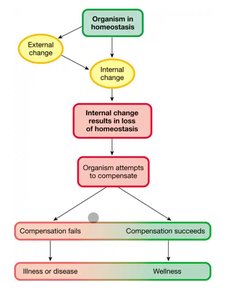
Pathophysiology
If homeostasis fails, normal function is disrupted, leading to disease. Diseases can arise from internal failures (e.g., cancer, autoimmune disorders) or external sources (e.g., toxins, trauma, infections).
Control Systems and Feedback
Components of Control Systems
All physiological control systems have three components: input signal, integrating center, and output signal.
Local control: Restricted to the tissue or cell involved.
Reflex control: Long-distance pathways using the nervous and/or endocrine systems.
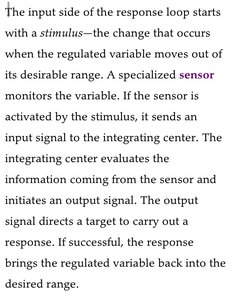
Feedback Loops
Negative feedback: Response opposes the stimulus, stabilizing the regulated variable and aiding homeostasis.
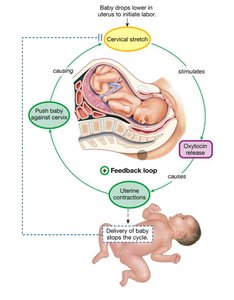
Positive feedback: Response reinforces the stimulus, driving the system away from its normal value. Requires an external event to stop the cycle.
Feedforward control: Anticipates change and initiates response before it occurs.
Compartmentation: Cells and Tissues
Body Compartments
The body is divided into three major cavities: cranial, thoracic, and abdominopelvic, each lined with tissue membranes. Fluid-filled compartments include blood vessels, eyes, cerebrospinal fluid, and hollow organs.
Lumen: Interior of hollow organs, may be an extension of the external environment.
Functional fluid compartments: Extracellular fluid (ECF) and intracellular fluid (ICF), separated by the cell membrane.
Biological Membranes
Membranes consist of phospholipid bilayers with embedded proteins and carbohydrates. Functions include physical isolation, regulation of exchange, communication, and structural support.
Phospholipids: Hydrophilic heads and hydrophobic tails form bilayers.
Sphingolipids: Longer, may have glycolipid heads.
Cholesterol: Maintains membrane flexibility and impermeability to small water-soluble molecules.
Membrane proteins: Integral, peripheral, transmembrane, and lipid-anchored proteins.
Glycoproteins and glycolipids: Form protective glycocalyx layer.
Membrane Dynamics
Osmosis and Tonicity
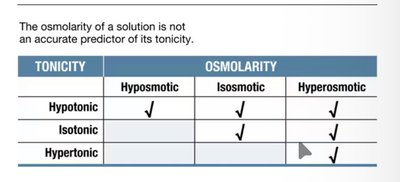
Water moves freely between cells and ECF, reaching osmotic equilibrium. Chemical disequilibrium exists due to differing solute concentrations. Osmolarity is the number of osmotically active particles per liter; tonicity describes the effect of a solution on cell volume.
Osmolarity:
Tonicity: Depends on nonpenetrating solutes; can be hypotonic, isotonic, or hypertonic.
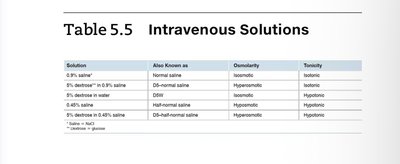
Intravenous Solutions
Clinical solutions are classified by their osmolarity and tonicity, which affect cell volume and fluid balance.
Solution | Also Known As | Osmolarity | Tonicity |
|---|---|---|---|
0.9% saline | Normal saline | Isosmotic | Isotonic |
5% dextrose in 0.9% saline | D5-normal saline | Hyperosmotic | Isotonic |
5% dextrose in water | D5W | Isosmotic | Hypotonic |
0.45% saline | Half-normal saline | Hyposmotic | Hypotonic |
5% dextrose in 0.45% saline | D5-half-normal saline | Hyperosmotic | Hypotonic |
Membrane Transport
Diffusion and Fick's Law
Diffusion is the passive movement of molecules from high to low concentration. The rate of diffusion depends on surface area, concentration gradient, and membrane permeability.

Simple diffusion: Directly across the lipid bilayer; only lipophilic molecules can pass.
Facilitated diffusion: Uses carrier proteins; passive, moves molecules down their gradient.
Active transport: Requires energy (ATP); moves molecules against their gradient.
Protein-Mediated Transport
Channel proteins: Create water-filled passageways for ions and water.
Carrier proteins: Bind substrates and change conformation to transport molecules.
Specificity, competition, and saturation: Transporters are specific, can be competitively inhibited, and have a maximum transport rate.
Summary
This guide covers foundational concepts in physiology, including homeostasis, control systems, compartmentation, membrane dynamics, and transport mechanisms. Understanding these principles is essential for further study in human physiology and related health sciences.
