Back
BackModule 13.4: Role of the Peripheral Nervous System (PNS) in Sensation
Study Guide - Smart Notes
 Tailored notes based on your materials, expanded with key definitions, examples, and context.
Module 13.4: Role of the Peripheral Nervous System (PNS) in Sensation
Overview of Sensory Receptors
The peripheral nervous system (PNS) plays a critical role in detecting and transmitting sensory information from the environment and the body to the central nervous system (CNS). Sensory receptors are specialized cells or nerve endings that respond to specific types of stimuli.
Types of Sensory Receptors
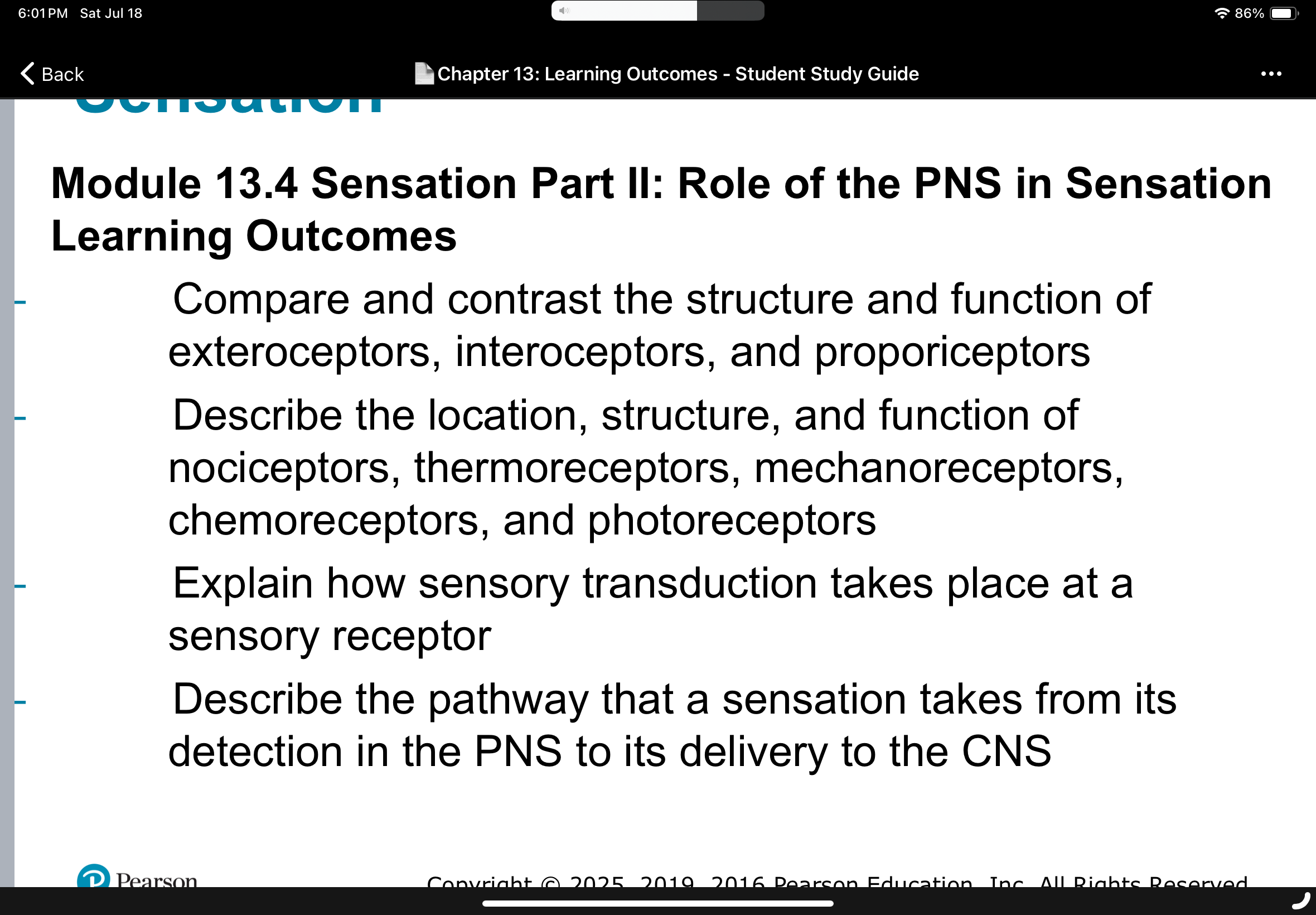
Exteroceptors: Located near the body surface, these receptors detect external stimuli such as touch, temperature, pain, and special senses (vision, hearing, etc.).
Interoceptors: Found within internal organs, these receptors monitor internal conditions such as blood pressure, pH, and the chemical composition of body fluids.
Proprioceptors: Located in muscles, tendons, and joints, proprioceptors provide information about body position and movement.
Comparison: Exteroceptors primarily sense the external environment, interoceptors monitor the internal environment, and proprioceptors provide feedback about body position and movement.
Classification by Stimulus Type
Nociceptors: Detect pain caused by tissue damage or potentially harmful stimuli. Found throughout the body except in the brain.
Thermoreceptors: Respond to changes in temperature. Located in the skin and hypothalamus.
Mechanoreceptors: Respond to mechanical forces such as pressure, vibration, stretch, and touch. Found in the skin, muscles, and inner ear.
Chemoreceptors: Detect chemical changes, such as changes in blood pH, oxygen, or carbon dioxide levels. Located in the carotid bodies, aortic bodies, and taste buds.
Photoreceptors: Respond to light and are found only in the retina of the eye.
Example: Thermoreceptors in the skin detect a drop in temperature, triggering a response to maintain body heat.
Sensory Transduction
Sensory transduction is the process by which a sensory receptor converts a physical or chemical stimulus into an electrical signal (action potential) that can be interpreted by the nervous system.
The stimulus alters the receptor's membrane potential, generating a receptor potential.
If the receptor potential reaches threshold, it triggers an action potential in the associated sensory neuron.
Equation:
where is the change in membrane potential, is the potential after stimulation, and is the resting membrane potential.
Pathway of Sensation from PNS to CNS
Once a stimulus is detected and transduced by a sensory receptor, the information is transmitted to the CNS through a series of steps:
Detection: Sensory receptor detects the stimulus and generates an action potential.
Transmission: The action potential travels along the sensory neuron to the spinal cord or brainstem.
Relay: The signal is relayed through synapses to second-order and third-order neurons, eventually reaching the appropriate region of the cerebral cortex for interpretation.
Example: Touch receptors in the skin send signals via the dorsal column pathway to the somatosensory cortex, where the sensation of touch is perceived.