Back
BackModule 14.2: The Sympathetic Nervous System – Structure, Function, and Homeostasis
Study Guide - Smart Notes
 Tailored notes based on your materials, expanded with key definitions, examples, and context.
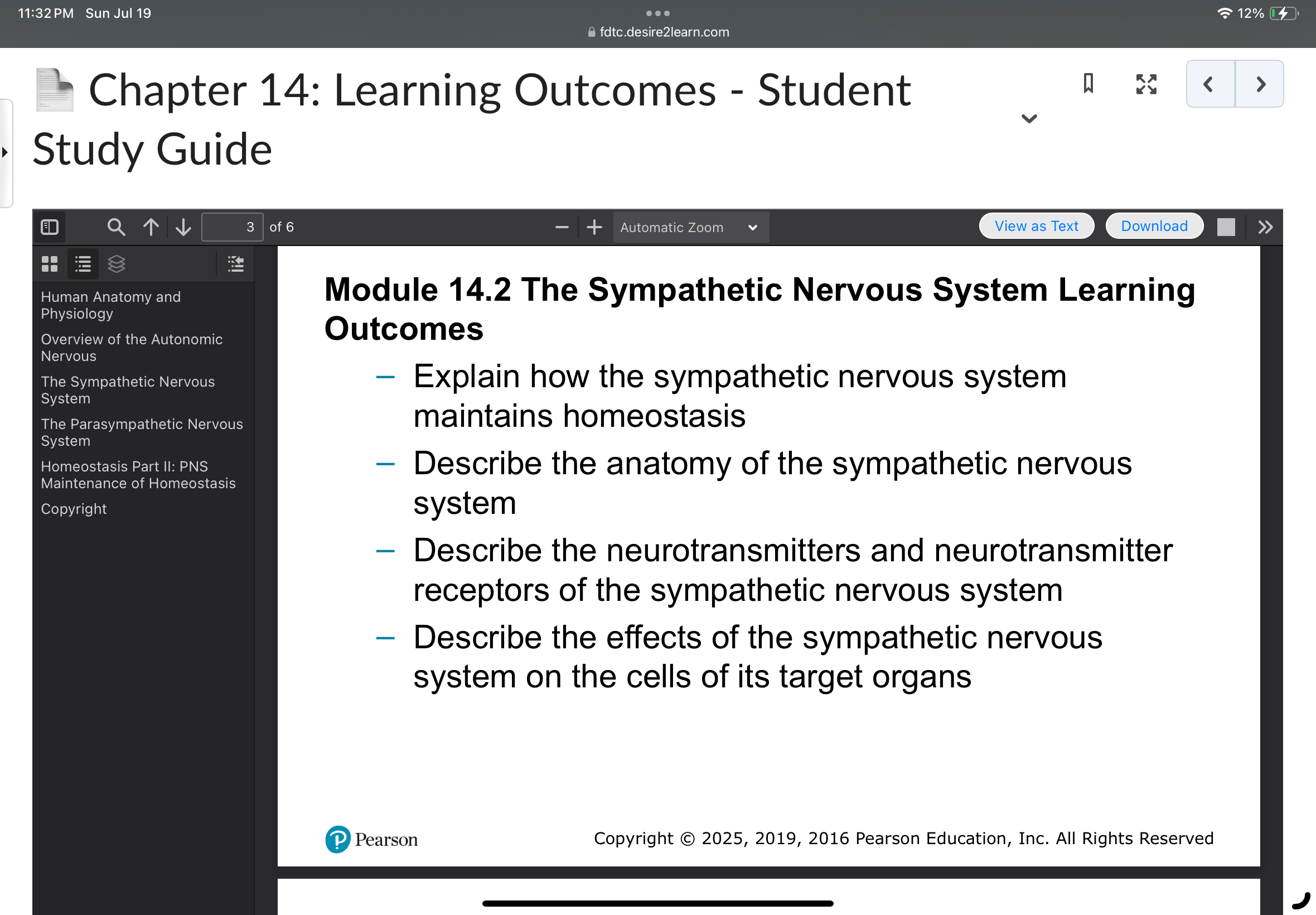
Module 14.2 The Sympathetic Nervous System
Overview of the Sympathetic Nervous System
The sympathetic nervous system is one of the two main divisions of the autonomic nervous system (ANS), responsible for regulating involuntary body functions. It plays a crucial role in maintaining homeostasis, especially during stress or emergency situations, by preparing the body for 'fight or flight' responses.
Autonomic Nervous System (ANS): Controls involuntary functions such as heart rate, digestion, and respiratory rate.
Sympathetic Division: Activates body systems to respond to perceived threats or increased activity.
Homeostasis: The body's ability to maintain stable internal conditions despite external changes.
Anatomy of the Sympathetic Nervous System
The anatomy of the sympathetic nervous system is characterized by a network of neurons originating from the thoracic and lumbar regions of the spinal cord. These neurons form synapses in ganglia located near the spinal cord and then project to various target organs.
Origin: Preganglionic neurons arise from the thoracolumbar region (T1–L2) of the spinal cord.
Sympathetic Ganglia: Synapses occur in paravertebral (chain) ganglia or prevertebral ganglia.
Postganglionic Neurons: Extend from ganglia to target organs such as the heart, lungs, and blood vessels.
Pathways: Sympathetic fibers are distributed throughout the body, influencing multiple organ systems.
Neurotransmitters and Neurotransmitter Receptors
The sympathetic nervous system utilizes specific neurotransmitters to communicate between neurons and target cells. The main neurotransmitters are acetylcholine and norepinephrine, which bind to distinct receptors to elicit physiological responses.
Acetylcholine (ACh): Released by preganglionic neurons; binds to nicotinic receptors in ganglia.
Norepinephrine (NE): Released by most postganglionic neurons; binds to adrenergic receptors on target organs.
Adrenergic Receptors: Include alpha (α) and beta (β) subtypes, each mediating different effects.
Receptor Specificity: The response depends on the type of receptor present on the target cell.
Effects of the Sympathetic Nervous System on Target Organs
The sympathetic nervous system exerts widespread effects on various organs, enabling the body to respond rapidly to stress. These effects are mediated by neurotransmitter-receptor interactions and are essential for survival and adaptation.
Heart: Increases heart rate and force of contraction (via β1 adrenergic receptors).
Lungs: Dilates bronchioles to enhance airflow (via β2 adrenergic receptors).
Blood Vessels: Constricts or dilates vessels to regulate blood pressure (via α and β receptors).
Digestive System: Inhibits digestion by reducing motility and secretion.
Pupils: Dilates pupils to improve vision in low light.
Example: During a stressful event, the sympathetic nervous system increases heart rate, dilates airways, and redirects blood flow to muscles, preparing the body for rapid action.
Additional info: The sympathetic nervous system works in opposition to the parasympathetic nervous system, which promotes 'rest and digest' functions. Together, these systems maintain physiological balance and homeostasis.