 Back
BackMuscle Metabolism and Mechanics: Energy, Fiber Types, and Levers
Study Guide - Smart Notes
 Tailored notes based on your materials, expanded with key definitions, examples, and context.
Muscle Metabolism and Energy for Contraction
ATP: The Energy Currency of Muscle
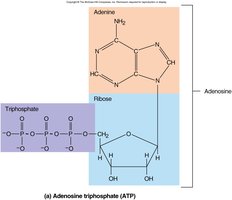
Muscle contraction requires large and rapid supplies of energy, primarily in the form of adenosine triphosphate (ATP). ATP consists of adenine, ribose, and three phosphate groups. Muscles can use up to 2500 ATP molecules per second during intense activity.
Sources of ATP in Muscle
Muscles obtain ATP through two main mechanisms: stored energy supplies and cellular respiration. The stored energy includes creatine phosphate, while cellular respiration involves the breakdown of glucose and fatty acids.
Creatine Phosphate System
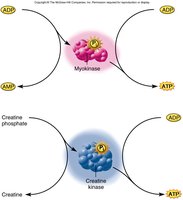
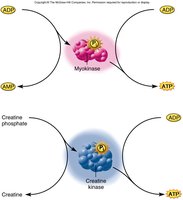
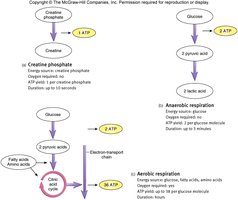
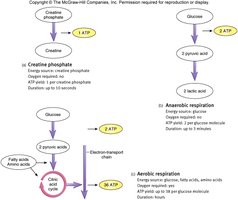
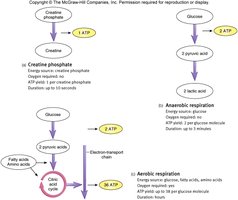
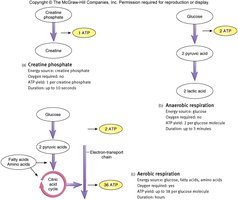
Muscles store extra phosphates as creatine phosphate. When ATP is abundant, surplus ATP is used to convert creatine into creatine phosphate. During contraction, creatine phosphate rapidly donates its phosphate to ADP, regenerating ATP for immediate use.
Cellular Respiration in Muscle
Cellular respiration is the primary long-term source of ATP in muscle. It involves three main steps:
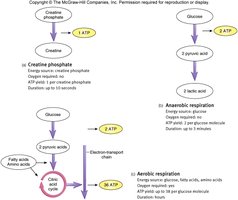
Glycolysis: Glucose or fatty acids are converted to pyruvic acid, yielding 2 ATP molecules without oxygen (anaerobic).
Krebs (Citric Acid) Cycle: Pyruvic acid is further metabolized to CO2, H2O, and up to 34 ATP molecules, requiring oxygen (aerobic).
Muscle Storage of Oxygen and Glucose
Muscles store their own backup supplies for cellular respiration:
Myoglobin: Stores extra oxygen within muscle fibers.
Glycogen: Stores extra glucose for rapid mobilization.
Short-Term and Long-Term Energy Needs
Short-Term Energy Needs
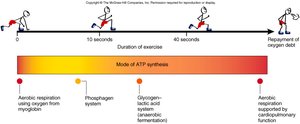
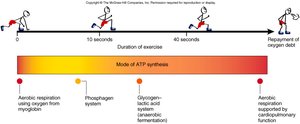
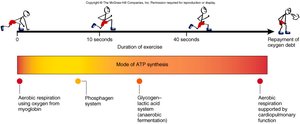
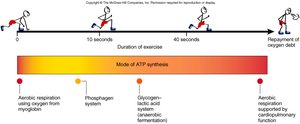
For brief, intense activity, muscles rely on creatine phosphate and anaerobic glycolysis. Creatine phosphate provides energy for about 15 seconds, suitable for short bursts like sprinting. Anaerobic glycolysis supplies ATP for 30–40 seconds of maximal activity, such as running bases in baseball.
Long-Term Energy Needs
For sustained activity, muscles use aerobic respiration, which is more efficient and can provide ATP for extended periods. Initially, muscles use myoglobin and glycogen stores, then shift to aerobic metabolism as cardiovascular and respiratory systems supply more oxygen.
Oxygen Debt
After intense exercise, muscles experience an oxygen debt. Additional oxygen is required to metabolize lactic acid and replenish ATP, creatine phosphate, glycogen, and myoglobin stores.
Muscle Fiber Types
Classification of Muscle Fibers
Muscle fibers are classified based on their contraction speed and metabolic pathways:
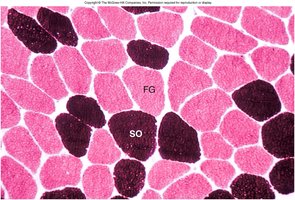
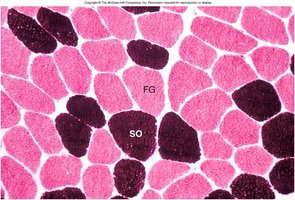
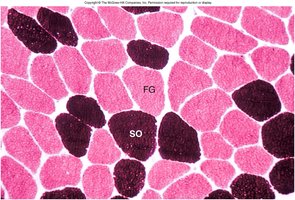
Slow Oxidative (SO) Fibers: Small, dark red, high in myoglobin and mitochondria, use aerobic respiration, resist fatigue, and are found in postural muscles.
Fast Oxidative-Glycolytic (FOG) Fibers: Intermediate size, red to pink, use both aerobic and anaerobic metabolism, moderately resistant to fatigue, common in leg muscles of sprinters.
Fast Glycolytic (FG) Fibers: Largest, white, low myoglobin, few mitochondria, rely on glycolysis, fatigue quickly, found in muscles used for rapid, powerful movements.
Motor Units and Fiber Recruitment
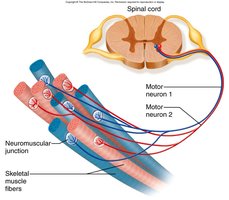
Each motor unit contains only one type of muscle fiber. The body recruits different motor units depending on the required force:
Weak contraction: Slow-twitch fibers
Stronger contraction: Mix of fiber types
Maximal contraction: Fast-twitch fibers
Fiber Types in Athletes
Endurance athletes (marathoners) have a higher proportion of red (slow oxidative) fibers, while sprinters have more white (fast glycolytic) fibers.
Muscle Tension and Contraction Types
Isometric and Isotonic Contractions
Muscle contractions can be classified as:
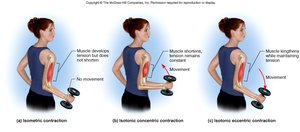
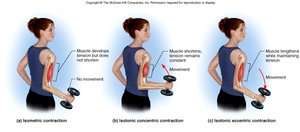
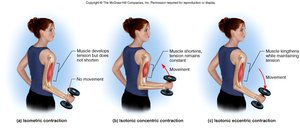
Isometric: Muscle generates tension without changing length; no movement occurs.
Isotonic: Muscle changes length while tension remains constant; movement occurs.
Types of Isotonic Contractions
Concentric: Muscle shortens as it contracts, lifting a load.
Eccentric: Muscle lengthens while maintaining tension, lowering a load.
Levers and Mechanical Advantage in the Musculoskeletal System
Levers in the Body
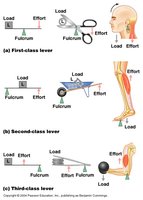
A lever is a rigid structure (bone) that moves on a fixed point called a fulcrum (joint). Muscles provide the effort, and the weight of the body part or object is the resistance (load).
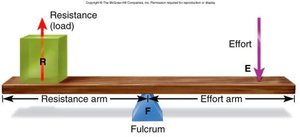
Types of Levers
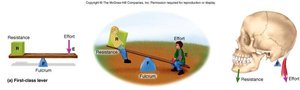
First-Class Lever: Fulcrum between effort and resistance (e.g., neck joint).
Second-Class Lever: Resistance between fulcrum and effort (rare in the human body).
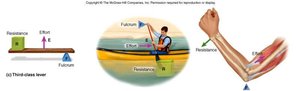
Third-Class Lever: Effort between fulcrum and resistance (e.g., elbow joint); most common in the body.
Mechanical Advantage
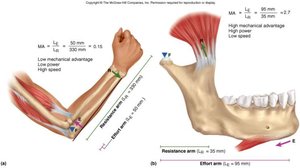
Mechanical advantage (MA) compares the force and speed of a lever system. It is calculated as:
MA > 1: More force, less speed
MA < 1: More speed, less force
Summary Table: Muscle Fiber Types
Fiber Type | Color | Metabolism | Fatigue Resistance | Example Location |
|---|---|---|---|---|
Slow Oxidative (SO) | Dark Red | Aerobic | High | Postural muscles |
Fast Oxidative-Glycolytic (FOG) | Red/Pink | Aerobic & Anaerobic | Moderate | Leg muscles |
Fast Glycolytic (FG) | White | Anaerobic | Low | Arms, eyes |
