Back
Muscle Physiology: Motor Units, Contraction, and Exercise Adaptations
Study Guide - Smart Notes
 Tailored notes based on your materials, expanded with key definitions, examples, and context.
Motor Units and Muscle Control
Definition of Motor Unit
A motor unit consists of one somatic motor neuron and all the muscle fibers it innervates. The size and function of motor units vary depending on the muscle and its required precision.
Fine motor control: Small motor units, each nerve supplies only a few muscle fibers. Enables precise movements (e.g., fingers, eye muscles).
Gross motor control: Large motor units, each nerve supplies thousands of muscle fibers. Enables powerful, less precise movements (e.g., gastrocnemius, gluteal muscles, biceps).
Muscle Twitch and Graded Response
Muscle Twitch
A muscle twitch is the response of a motor unit to a single action potential (AP) from its motor neuron. It can be visualized as a tracing (myogram).
Latent phase: Stimulation occurs, but tension is not yet measurable.
Contraction phase: Cross bridges are active, muscle develops tension, may shorten.
Relaxation phase: Tension decreases, cross bridges detach, calcium returns to the sarcoplasmic reticulum (SR).
Graded Muscle Response
Skeletal muscles typically contract smoothly and with variable strength, not in isolated twitches. Graded responses are achieved by:
Frequency of stimulation: Temporal summation occurs when a second contraction happens before the first has fully relaxed, increasing force.
Strength of stimulation: Recruitment of motor units increases contractile strength.
Strength of Stimulation and Recruitment
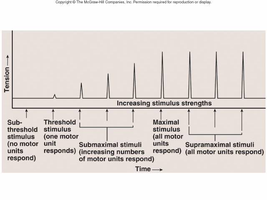
Muscle contraction strength depends on the stimulus intensity:
Subthreshold stimulus: No observable contraction.
Threshold stimulus: First observable contraction (one motor unit responds).
Maximal stimulus: All motor units are recruited.
Recruitment: Motor units are recruited according to the size principle—smaller units are activated first, followed by larger, less excitable units.
Asynchronous Recruitment
Motor units are recruited asynchronously, which helps delay muscle fatigue and allows for smooth, sustained movements.
Types of Muscle Contractions
Isotonic and Isometric Contractions
Isotonic contraction: Muscle changes length and moves a load.
Concentric: Muscle shortens.
Eccentric: Muscle lengthens while contracting (e.g., lowering a weight).
Isometric contraction: Muscle contracts but does not change length.
Energy for Muscle Contraction
ATP and Its Role
ATP is the only energy source used directly for muscle contraction. It is required to:
Move and detach cross bridges
Pump Ca2+ into the SR
Fuel the Na-K pump
Pathways for ATP Production
Direct phosphorylation: Creatine phosphate in muscle cells rapidly regenerates ATP, sufficient for about 15 seconds of maximal effort.
Anaerobic pathway: Glucose is broken down without oxygen, producing lactic acid. Provides ATP for 30–40 seconds.
Aerobic pathway: Occurs in mitochondria, uses oxygen to break down glucose, fatty acids, and amino acids. High yield, supports hours of activity.
Force of Muscle Contraction
Factors Affecting Force
Number of fibers recruited: More motor units recruited, greater force.
Size of muscle fibers: Larger fibers generate more tension.
Frequency of stimulation: Temporal summation increases force.
Degree of muscle stretch: Optimal force is produced when muscle is slightly stretched (length-tension relationship).
Muscle Fiber Types
Classification of Muscle Fibers
Muscle fibers are classified based on their metabolic properties:
Oxidative fibers: Rely on aerobic pathways.
Glycolytic fibers: Rely on anaerobic pathways and creatine phosphate.
Fiber Type | Metabolism | Speed | Fatigue Resistance |
|---|---|---|---|
Slow oxidative | Aerobic | Slow | High |
Fast oxidative | Aerobic | Fast | Moderate |
Fast glycolytic | Anaerobic | Fast | Low |
Muscles contain a mix of these fiber types, which is genetically determined but can be modified with training.
Skeletal Muscle Response to Exercise
Adaptations to Training
The overload principle states that muscles adapt to increased demand, while inactivity leads to atrophy.
Aerobic training: Increases capillaries, mitochondria, and myoglobin in muscle fibers. May convert fast glycolytic fibers to fast oxidative.
Resistance training: Causes hypertrophy (increase in size) of fast glycolytic fibers. Increases mitochondria, glycogen storage, and may convert fast oxidative to fast glycolytic.
Application Example
Muscle Fiber Type in Athletic Performance
Different sports and activities require different muscle fiber types. For example, endurance athletes benefit from slow oxidative fibers, while sprinters and weightlifters rely more on fast glycolytic fibers.