 Back
BackMuscle Physiology: Muscle Metabolism and Fiber Types
Study Guide - Smart Notes
 Tailored notes based on your materials, expanded with key definitions, examples, and context.
Muscle Metabolism and Energy for Contraction
ATP: The Essential Energy Source
Muscle contraction relies on adenosine triphosphate (ATP) as the sole energy source for contractile activities. ATP is required to:
Move and detach cross bridges during contraction cycles
Pump calcium back into the sarcoplasmic reticulum (SR)
Pump sodium (Na+) and potassium (K+) across the cell membrane after excitation-contraction coupling
Muscle fibers rapidly deplete their available ATP stores within 4–6 seconds, necessitating quick regeneration of ATP for sustained activity.
ATP Regeneration: Three Energy Systems
ATP is regenerated by three primary energy systems:
ATP-PCr (Phosphagen) System
Lactic Acid System (Anaerobic & Aerobic Glycolysis)
Oxygen System (Aerobic Respiration)
ATP-PCr (Phosphagen) System
The ATP-PCr system utilizes creatine phosphate (CP) to rapidly donate a phosphate group to ADP, forming ATP. The enzyme creatine kinase catalyzes this reaction:
Creatine phosphate + ADP → creatine + ATP
Provides energy for 5–20 seconds of intense effort
No oxygen is required, and the system is ideal for short bursts of activity.
Lactic Acid System: Glycolysis and Anaerobic Pathways
ATP can also be generated from glucose via glycolysis, which does not require oxygen (anaerobic). Glycolysis breaks down glucose into two pyruvic acid molecules, yielding 2 ATP per glucose. When oxygen is limited, pyruvic acid is converted to lactic acid:
Occurs during high-intensity activity (30–120 seconds)
Lactic acid diffuses into the bloodstream and can be used as fuel or converted back to glucose in the liver (Cori cycle)
Anaerobic respiration produces ATP quickly but less efficiently (5% of aerobic yield)
Oxygen System: Aerobic Respiration
Aerobic respiration occurs in the mitochondria and requires oxygen. It is slower but produces 95% of ATP during rest and moderate exercise. This pathway breaks down glucose, fatty acids, and amino acids to produce CO2, H2O, and a large amount of ATP (up to 32 per glucose):
Fuels: Glycogen, blood glucose, free fatty acids, amino acids
Fatty acids become the main fuel after 30 minutes of exercise
Supports prolonged activity (hours)
Energy Systems in Sports
Different sports utilize different energy systems:
Aerobic glycolysis: High-intensity aerobic events (5k, 10k, up to 2 hours)
Aerobic lipolysis: Long-duration events (ultramarathons)
Muscle Fatigue and Recovery
Muscle Fatigue
Muscle fatigue is the physiological inability to contract despite continued stimulation. Causes include:
Ionic imbalances (K+, Na+, Ca2+) disrupting membrane potential
Increased inorganic phosphate (Pi) interfering with calcium release or power generation
Excess Postexercise Oxygen Consumption (EPOC)
After exercise, muscles require extra oxygen to restore their pre-exercise state. This process, formerly called "oxygen debt," includes:
Replenishing oxygen reserves
Reconverting lactic acid to pyruvic acid
Replacing glycogen stores
Resynthesizing ATP and creatine phosphate
Muscle Fiber Types: Velocity and Duration of Contraction
Classification of Muscle Fibers
Skeletal muscle fibers are classified based on:
Speed of contraction: Slow or fast twitch (based on myosin ATPase activity)
Metabolic pathway for ATP synthesis: Oxidative (aerobic) or glycolytic (anaerobic)
Three main types:
Slow-twitch oxidative fibers (Type I)
Fast-twitch oxidative fibers (Type IIa)
Fast-twitch glycolytic fibers (Type IIb)
Most muscles contain a mix of fiber types, with all fibers in a motor unit being the same type. Genetics determine individual fiber composition.
Functional Roles of Muscle Fiber Types
Slow-twitch oxidative fibers: Endurance, low-intensity activities (e.g., maintaining posture)
Fast-twitch oxidative fibers: Medium-intensity activities (e.g., sprinting, walking)
Fast-twitch glycolytic fibers: Short-term, intense or powerful movements (e.g., hitting a baseball)
Structural and Functional Characteristics of Muscle Fiber Types
The following table summarizes the key differences among the three types of skeletal muscle fibers:
Characteristic | Slow Oxidative Fibers | Fast Oxidative Fibers | Fast Glycolytic Fibers |
|---|---|---|---|
Speed of Contraction | Slow | Fast | Fast |
Myosin ATPase Activity | Slow | Fast | Fast |
Primary Pathway for ATP Synthesis | Aerobic | Aerobic (some anaerobic) | Anaerobic glycolysis |
Myoglobin Content | High | High | Low |
Glycogen Stores | Low | Intermediate | High |
Recruitment Order | First | Second | Third |
Fatigue Resistance | High | Intermediate | Low |
Best Suited For | Endurance activities | Sprinting, walking | Short-term intense movements |
Fiber Diameter | Small | Large | Intermediate |
Capillaries | Many | Many | Few |
Color | Red | Red | White (pale) |
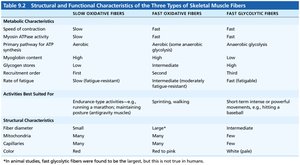
Additional info: Fast glycolytic fibers are largest in animal studies, but this is not true in humans.
