 Back
BackLecture 4.3: Muscle Systems
Study Guide - Smart Notes
 Tailored notes based on your materials, expanded with key definitions, examples, and context.
Muscle Systems
Introduction to the Muscular System
The muscular system consists exclusively of skeletal muscles, which are responsible for voluntary movements of the body. The organization of these muscles significantly influences the power, range, and speed of movement.
Skeletal muscles are attached to bones and facilitate movement by contracting and pulling on the skeleton.
Muscle structure and arrangement determine their functional capabilities.
Fascicle Arrangement in Skeletal Muscles
Overview of Fascicle Arrangements
Skeletal muscle fibers are grouped into bundles called fascicles. The arrangement of these fascicles forms the basis for classifying muscles and directly impacts their function.
Parallel muscles: Fascicles run parallel to the long axis of the muscle.
Convergent muscles: Fascicles spread out over a broad area and converge at a common attachment site.
Pennate muscles: Fascicles are arranged at an angle to the tendon.
Circular muscles (sphincters): Fascicles are arranged concentrically around an opening.
Parallel Muscles
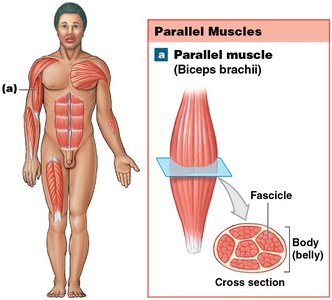
In parallel muscles, the fascicles are aligned with the long axis of the muscle, allowing for efficient contraction and movement. Most skeletal muscles are of this type.
Contraction shortens and fattens the muscle.
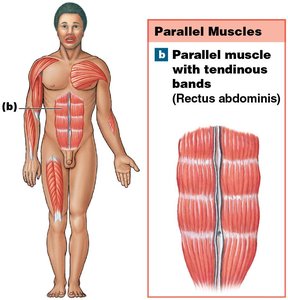
Examples include the biceps brachii and rectus abdominis.
Convergent Muscles
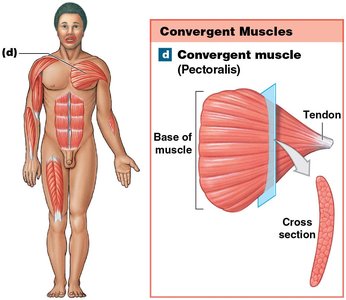
Convergent muscles have a broad origin and converge to a single tendon. This arrangement allows for versatile movement but less force than parallel muscles.
Example: Pectoralis major of the chest.
Pennate Muscles
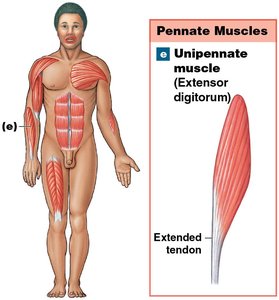
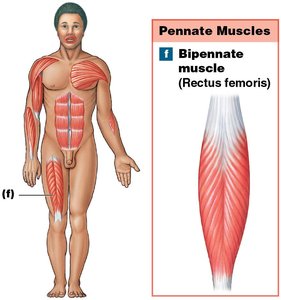
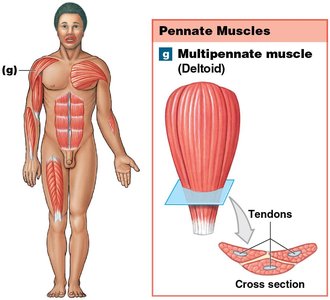
Pennate muscles have fascicles that attach obliquely to a central tendon, resembling a feather. This arrangement allows for greater force production but less range of motion compared to parallel muscles.
Unipennate: Fascicles on one side of the tendon (e.g., extensor digitorum).
Bipennate: Fascicles on both sides of a central tendon (e.g., rectus femoris).
Multipennate: Tendon branches within the muscle (e.g., deltoid).
Circular Muscles (Sphincters)
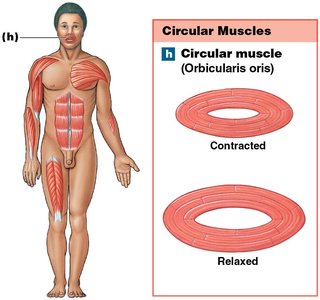
Circular muscles, or sphincters, are arranged in concentric rings and function as valves to open and close body passages.
Example: Orbicularis oris of the mouth.
Levers and Muscle Efficiency
Levers in the Musculoskeletal System
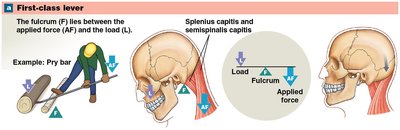
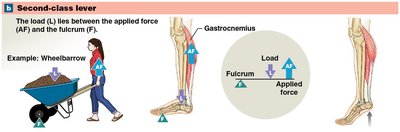
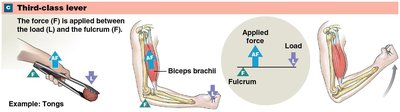
Most skeletal muscles act on bones as levers, which are rigid structures that move around a fixed point called a fulcrum. The arrangement of the applied force, fulcrum, and load determines the type of lever and its mechanical advantage.
Levers can change the direction, distance, speed, and strength of movement.
There are three classes of levers in the body:
First-class lever: Fulcrum between applied force and load (e.g., extension of the neck).
Second-class lever: Load between applied force and fulcrum (e.g., ankle extension by calf muscles).
Third-class lever: Applied force between load and fulcrum (most common; e.g., biceps brachii at the elbow).
Origins, Insertions, and Muscle Actions
Origins and Insertions
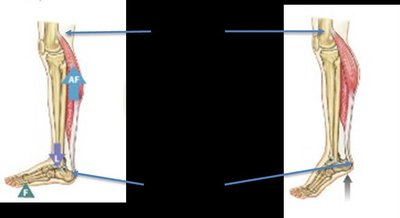
The origin of a muscle is its fixed attachment point, usually proximal, while the insertion is the movable attachment, usually distal. Muscle contraction pulls the insertion toward the origin, producing movement at a joint.
Muscle Actions and Interactions
Muscles work together to produce coordinated movements. The main roles include:
Agonist (prime mover): Main muscle responsible for a movement.
Antagonist: Opposes the action of the agonist.
Synergist: Assists the agonist in performing its action.
Fixator: Stabilizes the origin of the agonist to allow efficient movement.
Agonists and antagonists typically work in pairs, such as flexors and extensors.
Naming Muscles
Principles of Muscle Nomenclature
Muscle names often provide clues about their location, attachments, fascicle arrangement, position, structure, or action. Common naming conventions include:
Location: e.g., abdominus (abdomen)
Origin and insertion: e.g., genioglossus (chin to tongue)
Fascicle organization: e.g., rectus (straight), oblique (angled)
Position: e.g., externus (external), profundus (deep)
Structural characteristics: e.g., trapezius, biceps (two heads)
Action: e.g., flexor, extensor, abductor
Effects of Exercise and System Integration
Muscular System and Other Body Systems
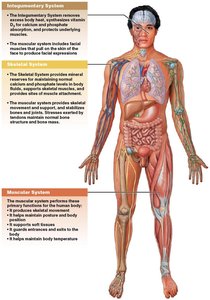
The muscular system interacts closely with other body systems to maintain homeostasis and support movement:
Cardiovascular system: Delivers oxygen and nutrients, removes waste.
Respiratory system: Meets increased oxygen demand during activity.
Integumentary system: Disperses heat generated by muscle activity.
Nervous and endocrine systems: Regulate and coordinate muscle function.
Age-Related Changes to the Muscular System
With aging, muscles may lose mass and strength, and recovery from injury slows. Regular exercise can help mitigate these effects by maintaining muscle tone and function.
Summary Table: Muscle Types by Fascicle Arrangement
Muscle Type | Arrangement | Example |
|---|---|---|
Parallel | Fascicles parallel to long axis | Biceps brachii |
Parallel with tendinous bands | Parallel with transverse bands | Rectus abdominis |
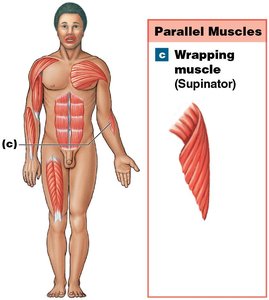
Wrapping | Parallel, wrapping around bone | Supinator |
Convergent | Broad origin, converges to tendon | Pectoralis major |
Unipennate | Fascicles on one side of tendon | Extensor digitorum |
Bipennate | Fascicles on both sides of tendon | Rectus femoris |
Multipennate | Tendon branches within muscle | Deltoid |
Circular | Concentric rings | Orbicularis oris |
Key Equations
Mechanical Advantage (MA) of a Lever:
Force Output:
Additional info: Equations above are general for lever mechanics and help in understanding how muscle attachment affects force and movement.
