 Back
BackMuscle Tension and Regulation of Muscle Contraction
Study Guide - Smart Notes
 Tailored notes based on your materials, expanded with key definitions, examples, and context.
Muscle Tension
Definition and Importance
Muscle tension refers to the force generated by muscle contraction. This force is essential for producing movement and maintaining posture in the human body. The amount of tension produced determines the amount of work a muscle can perform.
Factors Determining Muscle Tension
Key Determinants
Frequency of Stimulation: The rate at which a muscle receives nerve impulses affects the force of contraction.
Number of Fibers Contracting: The more muscle fibers (cells) that contract, the greater the overall tension.
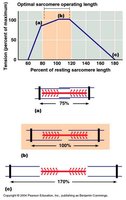
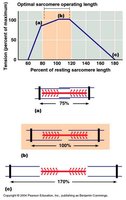
Length of Sarcomeres: The initial length of the muscle fibers' sarcomeres influences the force generated during contraction.
Frequency of Stimulation
Effects on Muscle Contraction
Increasing the frequency of neuronal stimulation leads to more forceful muscle contractions.
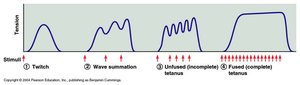
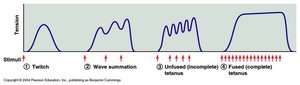
A single stimulus produces a twitch, while multiple stimuli can result in tetanus or treppe.
Twitch
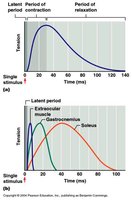
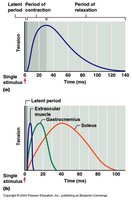
A twitch is the response of a motor unit to a single stimulus. It consists of three phases: latent period, contraction period, and relaxation period.
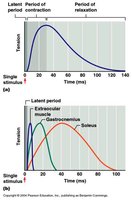
Elements of a Twitch
Latent Period: Time during which Ca2+ is released from the sarcoplasmic reticulum.
Contraction Period: Filaments slide together, generating force.
Relaxation Period: Ca2+ is actively transported back into the sarcoplasmic reticulum, and tension decreases.
Refractory Period: The muscle cannot respond to another stimulus. Duration varies: skeletal muscle (~5 ms), cardiac muscle (~300 ms).
Tetanus
Tetanus occurs when two or more stimuli are applied in rapid succession, causing the muscle contractions to merge and force to increase due to Ca2+ buildup.
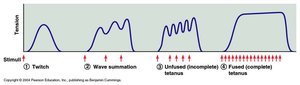
Incomplete Tetanus
Occurs at a slow rate of stimulation, allowing partial relaxation between stimuli.
Complete Tetanus
Occurs when there is no relaxation between stimuli, resulting in a sustained, maximal contraction due to continuous Ca2+ presence.
Regulation of the Force of Contraction
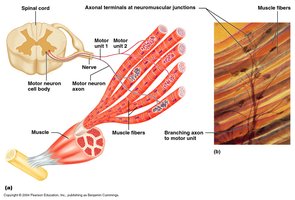
Motor Units and the All-or-None Principle
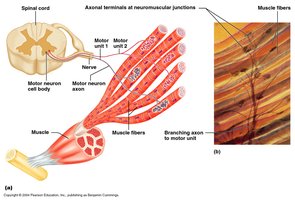
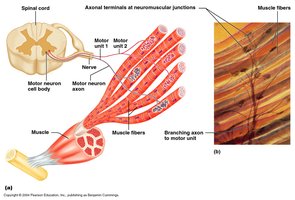
The force of contraction increases with the number of muscle fibers contracting.
Within a motor unit, all fibers contract fully if the stimulus reaches threshold (all-or-none principle); if not, none contract.
Varying the Strength of Contraction
The muscle as a whole can produce contractions of varying strength (strong, moderate, weak).
This is achieved by recruiting different numbers and sizes of motor units.
Larger motor units and more units activated result in stronger contractions.
Sustained Contractions
Motor units take turns contracting to maintain muscle tension over time, preventing fatigue.
Length of Sarcomere
Effect on Muscle Tension
Optimal Length: Maximum tension is generated when there is perfect overlap of thick and thin filaments in the sarcomere.
Too Much Stretch: Fewer cross-bridges can form, decreasing force.
Too Little Stretch: Filament binding sites are blocked, also reducing force.
Muscle Tone
Definition and Function
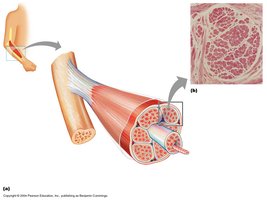
Muscle tone is the continuous, passive partial contraction of muscles. At any given time, some muscle fibers in every muscle are contracted, which helps maintain posture and readiness for action.
Muscle Atrophy and Hypertrophy
Atrophy
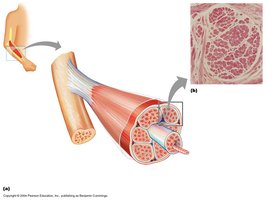
Atrophy is the decrease in muscle size due to lack of nerve stimulation, loss of myofibrils, and replacement of muscle tissue with fibrous tissue.
Hypertrophy
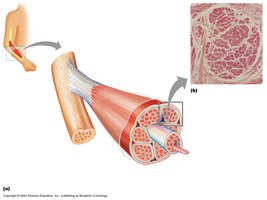
Hypertrophy is the increase in muscle size resulting from increased myofibrils, mitochondria, and sarcoplasmic reticulum, typically caused by forceful or repetitive activity.
Summary Table: Factors Affecting Muscle Tension
Factor | Effect on Tension |
|---|---|
Frequency of Stimulation | Higher frequency increases tension (tetanus) |
Number of Fibers Contracting | More fibers = greater tension |
Length of Sarcomere | Optimal length = maximum tension; too stretched or too compressed = less tension |
Motor Unit Recruitment | More/larger units = stronger contraction |
Muscle Tone | Maintains readiness and posture |
Atrophy | Decreases muscle size and tension |
Hypertrophy | Increases muscle size and tension |
