 Back
BackMuscles Crossing the Shoulder and Elbow Joints: Movements of the Arm and Forearm
Study Guide - Smart Notes
 Tailored notes based on your materials, expanded with key definitions, examples, and context.
Muscles Crossing the Shoulder Joint: Movements of the Arm (Humerus)
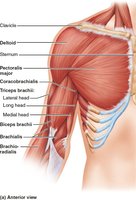
Overview of Shoulder Joint Musculature
The shoulder joint is a highly mobile ball-and-socket joint, allowing for a wide range of arm movements. Muscles crossing this joint are responsible for flexion, extension, abduction, adduction, and rotation of the humerus.
Deltoid: Main abductor of the arm; also assists in flexion and extension.
Pectoralis major: Flexes, adducts, and medially rotates the arm.
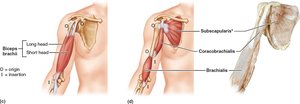
Coracobrachialis: Assists in flexion and adduction of the arm.
Biceps brachii: Flexes the elbow and assists in shoulder flexion.
Triceps brachii (long head): Assists in shoulder extension and adduction.
Rotator Cuff Muscles
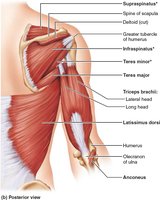
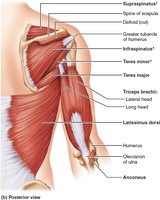
The rotator cuff is a group of four muscles that stabilize the shoulder joint and allow for rotation and lifting of the arm. These muscles are the supraspinatus, infraspinatus, teres minor, and subscapularis.
Supraspinatus: Initiates abduction of the arm.
Infraspinatus: Laterally rotates the arm.
Teres minor: Also laterally rotates the arm.
Subscapularis: Medially rotates the arm.
Muscles Crossing the Elbow Joint: Movements of the Forearm
Flexion of the Forearm (Elbow) – Anterior Muscles
Flexion at the elbow is primarily produced by muscles located on the anterior aspect of the arm.
Biceps brachii: Main flexor of the forearm; also supinates the forearm.
Brachialis: Strongest flexor of the elbow, deep to the biceps brachii.
Brachioradialis: Assists in flexion, especially when the forearm is in mid-pronation.
Extension of the Forearm – Posterior Muscles
Extension at the elbow is produced by muscles on the posterior aspect of the arm.
Triceps brachii: Main extensor of the forearm; has three heads (long, lateral, and medial).
Anconeus: Assists triceps in elbow extension.
Muscles of the Forearm: Movements of the Wrist, Hand, and Fingers
Anterior Compartment Muscles
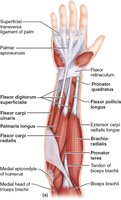
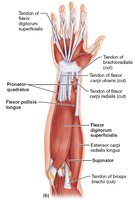
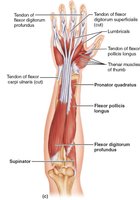
Muscles in the anterior compartment of the forearm are primarily responsible for flexion of the wrist and fingers, as well as pronation of the forearm.
Flexor carpi radialis: Flexes and abducts the wrist.
Flexor carpi ulnaris: Flexes and adducts the wrist.
Flexor digitorum superficialis/profundus: Flex the fingers.
Pronator teres and pronator quadratus: Pronate the forearm.
Posterior Compartment Muscles
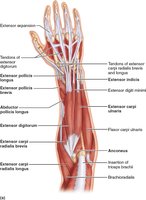
Muscles in the posterior compartment of the forearm are primarily responsible for extension of the wrist and fingers, as well as supination of the forearm.
Extensor carpi radialis longus/brevis: Extend and abduct the wrist.
Extensor carpi ulnaris: Extends and adducts the wrist.
Extensor digitorum: Extends the fingers.
Supinator: Supinates the forearm.
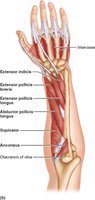
Deep Muscles of the Forearm
Deep muscles of the forearm contribute to fine movements of the wrist, hand, and fingers, as well as pronation and supination.
Pronator quadratus: Main muscle for pronation of the forearm.
Supinator: Main muscle for supination of the forearm.
Flexor pollicis longus: Flexes the thumb.
Abductor pollicis longus: Abducts the thumb.
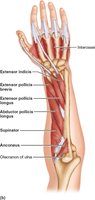
Summary Table: Major Muscles Acting on the Arm and Forearm
Muscle | Location | Primary Action |
|---|---|---|
Deltoid | Shoulder | Abduction of arm |
Pectoralis major | Chest | Flexion, adduction, medial rotation of arm |
Biceps brachii | Anterior arm | Flexion and supination of forearm |
Brachialis | Anterior arm (deep) | Flexion of forearm |
Triceps brachii | Posterior arm | Extension of forearm |
Flexor carpi radialis | Anterior forearm | Flexion and abduction of wrist |
Extensor carpi ulnaris | Posterior forearm | Extension and adduction of wrist |
Supinator | Posterior forearm (deep) | Supination of forearm |
Additional info: The above table summarizes the main muscles discussed, their anatomical location, and their primary actions for quick review.
