 Back
Muscles of the Thigh and Leg: Origins, Insertions, and Actions
Study Guide - Smart Notes
 Tailored notes based on your materials, expanded with key definitions, examples, and context.
Muscles of the Thigh and Leg
Anterior Thigh Muscles
The anterior thigh muscles are primarily responsible for extension of the knee and flexion of the thigh. They play a crucial role in walking, running, and maintaining posture.
Tensor Fascia Latae: Origin: Iliac crest Insertion: Iliotibial tract Action: Steadies the knee by tightening the iliotibial band.
Rectus Femoris: Origin: Anterior iliac spine Insertion: Patella and tibial tuberosity Action: Extends the knee and flexes the thigh at the hip.
Vastus Lateralis: Origin: Greater trochanter Insertion: Patella and tibial tuberosity Action: Extends the knee.
Vastus Medialis: Origin: Diaphysis of femur Insertion: Patella and tibial tuberosity Action: Extends the knee.
Sartorius: Origin: Anterior iliac spine Insertion: Proximal tibia Action: Flexes, abducts, and laterally rotates the thigh.
Gracilis: Origin: Pubis, ischium Insertion: Medial tibia Action: Adducts the thigh.
Anterior Leg Muscle
The anterior leg muscle is essential for dorsiflexion, which is the movement of the foot upwards towards the shin.
Tibialis Anterior: Origin: Tibia Insertion: Medial cuneiform, 1st metatarsal Action: Dorsiflexion of the foot.
Posterior Thigh Muscles
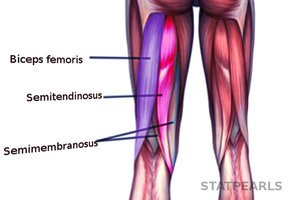
The posterior thigh muscles, also known as the hamstring group, are responsible for flexing the knee and extending the thigh. These muscles are vital for activities such as running, jumping, and climbing.
Biceps Femoris: Origin: Ischial tuberosity Insertion: Fibula Action: Flexes the knee and extends the thigh.
Semitendinosus: Origin: Ischial tuberosity Insertion: Tibia Action: Flexes the knee and extends the thigh.
Semimembranosus: Origin: Ischial tuberosity Insertion: Tibia Action: Flexes the knee and extends the thigh.
Posterior Leg Muscles
The posterior leg muscles are involved in plantar flexion, which is the movement of pointing the toes downward. This action is important for walking, running, and jumping.
Gastrocnemius: Origin: Distal femur Insertion: Calcaneus Action: Plantar flexion of the foot.
Soleus: Origin: Fibula, tibia Insertion: Calcaneus Action: Plantar flexion of the foot.
Summary Table: Thigh and Leg Muscles
The following table summarizes the origin, insertion, and action of the major muscles discussed:
Muscle | Origin | Insertion | Action |
|---|---|---|---|
Tensor Fascia Latae | Iliac crest | Iliotibial tract | Steadies knee |
Rectus Femoris | Anterior iliac spine | Patella, tibial tuberosity | Extends knee, flexes thigh |
Vastus Lateralis | Greater trochanter | Patella, tibial tuberosity | Extends knee |
Vastus Medialis | Diaphysis of femur | Patella, tibial tuberosity | Extends knee |
Sartorius | Anterior iliac spine | Proximal tibia | Flexes, abducts, laterally rotates thigh |
Gracilis | Pubis, ischium | Medial tibia | Adducts thigh |
Tibialis Anterior | Tibia | Medial cuneiform, 1st metatarsal | Dorsiflexion |
Biceps Femoris | Ischial tuberosity | Fibula | Flexes knee, extends thigh |
Semitendinosus | Ischial tuberosity | Tibia | Flexes knee, extends thigh |
Semimembranosus | Ischial tuberosity | Tibia | Flexes knee, extends thigh |
Gastrocnemius | Distal femur | Calcaneus | Plantar flexion |
Soleus | Fibula, tibia | Calcaneus | Plantar flexion |
Example: During running, the hamstring muscles (biceps femoris, semitendinosus, semimembranosus) contract to flex the knee and extend the hip, while the quadriceps (rectus femoris, vastus lateralis, vastus medialis) extend the knee for forward propulsion.
