 Back
Chapter 11 Muscular System: Fascicle Arrangements, Levers, Origins & Insertions, Muscle Actions, and Naming
Study Guide - Smart Notes
 Tailored notes based on your materials, expanded with key definitions, examples, and context.
Q1. What are the different types of fascicle arrangements in muscles, and how do they relate to muscle function?
Background
Topic: Fascicle Arrangements
This question explores the structural organization of muscle fibers (fascicles) and how their arrangement affects muscle function, such as force generation and range of motion.
Key Terms and Concepts:
Fascicle: A bundle of muscle fibers surrounded by perimysium.
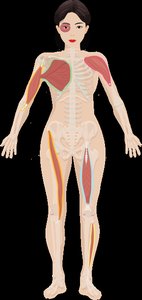
Parallel: Fascicles run parallel to the long axis of the muscle (e.g., sartorius).
Fusiform: Spindle-shaped muscle with a central belly (e.g., biceps brachii).
Circular: Fascicles arranged in concentric rings (e.g., orbicularis oculi).
Pennate: Short fascicles attach obliquely to a central tendon (unipennate, bipennate, multipennate).
Convergent: Broad origin, fascicles converge toward a single tendon (e.g., pectoralis major).
Step-by-Step Guidance
Identify the arrangement of fascicles in the muscle (e.g., parallel, fusiform, circular, pennate, convergent).
Recall that the length of muscle fibers is related to the range of contraction, while the number of fibers is related to the force of contraction.
Consider examples of each arrangement and their functional implications (e.g., pennate muscles generate more force, parallel muscles allow greater range of motion).
Think about which arrangement would be best for generating force over a small distance versus a large range of motion.
Try solving on your own before revealing the answer!
Q2. Based on the image of the infraspinatus muscle in a cadaver, what type of fascicle arrangement does it have, and is it optimized for force or range of movement?
Background
Topic: Fascicle Arrangement Identification
This question asks you to visually identify the fascicle arrangement of a specific muscle and relate it to its functional optimization.
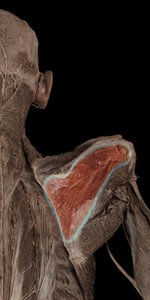
Key Terms:
Infraspinatus: A muscle of the rotator cuff located on the scapula.
Fascicle Arrangement: The pattern in which muscle fibers are organized.
Step-by-Step Guidance
Observe the direction and pattern of the muscle fibers in the image.
Compare the observed pattern to the definitions of parallel, pennate, convergent, and circular arrangements.
Recall which arrangements are typically optimized for force (pennate) versus range of movement (parallel/fusiform).
Try solving on your own before revealing the answer!
Q3. Which fascicle arrangement is most well suited to a muscle that needs to generate a lot of force over a small distance?
Background
Topic: Muscle Force Generation
This question tests your understanding of how fascicle arrangement affects the force and range of muscle contraction.
Key Terms:
Unipennate, Bipennate, Multipennate: Types of pennate muscles with increasing numbers of fiber orientations, generally producing more force.
Fusiform: Suited for range of motion, not maximal force.
Step-by-Step Guidance
Recall the relationship between fiber arrangement and force production.
Review the definitions of each arrangement in the answer choices.
Identify which arrangement allows for the greatest number of fibers in a given area, maximizing force.
Try solving on your own before revealing the answer!
Q4. What are the three types of lever systems in the body, and how do they relate to muscle movement?
Background
Topic: Lever Systems in the Muscular System
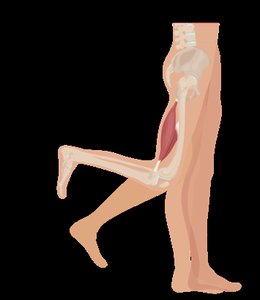
This question explores how muscles use bones as levers to produce movement, and how the arrangement of the fulcrum, load, and effort determines mechanical advantage or disadvantage.
Key Terms and Formulas:
Lever: A rigid bar (bone) that moves on a fixed point (fulcrum).
Fulcrum: The pivot point (joint).
Load: The resistance (body weight or object).
Effort: The force applied by muscle contraction.
Step-by-Step Guidance
Recall the three classes of levers: first-class (fulcrum between effort and load), second-class (load between fulcrum and effort), third-class (effort between fulcrum and load).
Identify examples of each lever type in the human body.
Understand how the position of the fulcrum affects mechanical advantage (force vs. speed/range of motion).
Try solving on your own before revealing the answer!
Q5. How do origin and insertion determine the movement produced by a muscle?
Background
Topic: Muscle Attachments and Movement
This question focuses on how the location of a muscle's origin and insertion determines the type of movement it produces when it contracts.
Key Terms:
Origin: The fixed attachment site of a muscle.
Insertion: The movable attachment site of a muscle.
Movement Types: Flexion, extension, abduction, adduction, rotation.
Step-by-Step Guidance
Identify the origin and insertion points for a given muscle.
Recall that the insertion moves toward the origin during contraction.
Determine the movement produced based on the direction of muscle contraction and the joints involved.
Try solving on your own before revealing the answer!
Q6. What are the roles of agonist, antagonist, synergist, and fixator muscles in movement?
Background
Topic: Muscle Actions
This question examines the different functional roles muscles can play during movement, including prime movers, antagonists, synergists, and fixators.
Key Terms:
Agonist (Prime Mover): Main muscle responsible for a movement.
Antagonist: Muscle that opposes the action of the agonist.
Synergist: Muscle that assists the agonist.
Fixator: Muscle that stabilizes the origin of the agonist.
Step-by-Step Guidance
Identify the primary movement and the muscle responsible (agonist).
Determine which muscle opposes this movement (antagonist).
Locate muscles that assist the agonist (synergists) and those that stabilize the origin (fixators).
Try solving on your own before revealing the answer!
Q7. How are muscles named, and what information can you gather from a muscle's name?
Background
Topic: Muscle Naming Conventions
This question explores the various factors that influence muscle names, such as location, shape, size, action, direction of fibers, attachment sites, and number of origins.
Key Terms:
Body Region: Where the muscle is located.
Shape/Size: Describes the muscle's appearance.
Action: The movement the muscle produces.
Direction of Fibers: Orientation of muscle fibers.
Number of Heads: Number of origins (e.g., biceps = two heads).
Step-by-Step Guidance
Break down the muscle name into its components (e.g., "biceps brachii" = two heads, arm).
Identify what each part of the name tells you about the muscle (location, action, shape, etc.).
Use this information to infer the muscle's characteristics and function.
Try solving on your own before revealing the answer!
