 Back
Muscular System: Structure, Function, and Movements
Study Guide - Smart Notes
 Tailored notes based on your materials, expanded with key definitions, examples, and context.
The Muscular System
Overview of Skeletal Muscles
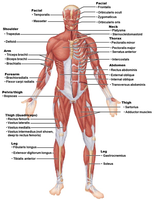
The muscular system is responsible for producing movement, maintaining posture, stabilizing joints, and generating heat. Skeletal muscles are attached to bones and are under voluntary control. They work by contracting, which pulls on bones to produce movement at joints.
Principles of Skeletal Muscle Activity
The Five Golden Rules of Skeletal Muscle Activity
Muscle-Joint Relationship: With few exceptions, all skeletal muscles cross at least one joint.
Muscle Bulk Location: The bulk of a skeletal muscle typically lies proximal to the joint it crosses.
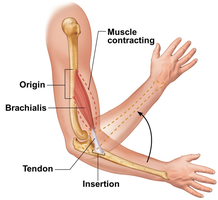
Attachments: All skeletal muscles have at least two attachments: the origin (immovable or less movable bone) and the insertion (movable bone).
Action: Skeletal muscles can only pull; they never push.
Movement Direction: During contraction, the muscle's insertion moves toward its origin.
Types of Body Movements
General Principles
Body movement occurs when muscles contract across joints, causing the insertion to move toward the origin. Movements are classified based on the change in angle or position of the bones involved.
Flexion, Extension, and Hyperextension
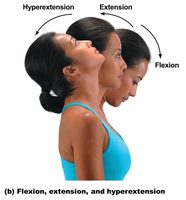
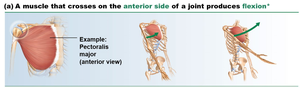
Flexion: Decreases the angle of the joint, bringing two bones closer together. Common in hinge joints (e.g., elbow, knee) and ball-and-socket joints (e.g., hip).
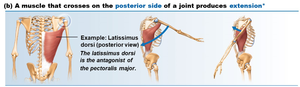
Extension: Increases the angle between two bones, typical of straightening the elbow or knee.
Hyperextension: Extension beyond the anatomical position.
Rotation
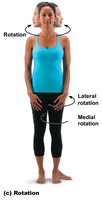
Rotation: Movement of a bone around its longitudinal axis. Common in ball-and-socket joints (e.g., shoulder, hip).
Example: Shaking the head "no" involves rotation of the atlas around the dens of the axis.
Abduction, Adduction, and Circumduction
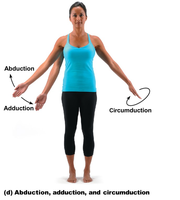
Abduction: Movement of a limb away from the midline of the body.
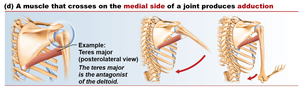
Adduction: Movement of a limb toward the midline of the body.
Circumduction: Circular movement that combines flexion, extension, abduction, and adduction. The proximal end remains stationary while the distal end moves in a circle.
Special Movements of the Foot
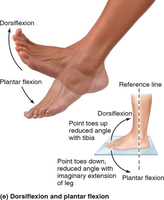
Dorsiflexion: Lifting the foot so the superior surface approaches the shin.
Plantar Flexion: Pointing the toes downward, away from the head.
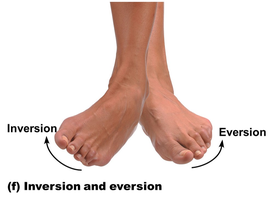
Inversion: Turning the sole of the foot medially.
Eversion: Turning the sole of the foot laterally.
Special Movements of the Forearm and Hand
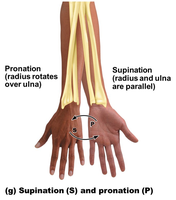
Supination: Rotating the forearm laterally so the palm faces anteriorly; radius and ulna are parallel.
Pronation: Rotating the forearm medially so the palm faces posteriorly; radius and ulna cross each other.
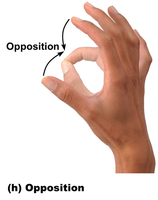
Opposition: Moving the thumb to touch the tips of other fingers on the same hand, a movement essential for grasping objects.
Interactions of Skeletal Muscles
Muscle Actions and Coordination
Prime Mover (Agonist): The muscle with the major responsibility for a specific movement.
Antagonist: Muscle that opposes or reverses the action of a prime mover.
Synergist: Muscle that aids a prime mover by promoting the same movement or by reducing undesirable movements.
Fixator: Specialized synergist that holds a bone still or stabilizes the origin of a prime mover.
Muscles that produce opposite actions are generally located on opposite sides of a joint.
Naming Skeletal Muscles
Criteria for Naming Muscles
Direction of Muscle Fibers: e.g., rectus (straight)
Relative Size: e.g., maximus (largest)
Location: e.g., temporalis (temporal bone)
Number of Origins: e.g., triceps (three heads)
Origin and Insertion: e.g., sternocleidomastoid
Shape: e.g., deltoid (triangular)
Action: e.g., flexor and extensor (flexes or extends a bone)
Arrangement of Fascicles
Patterns of Fascicle Arrangement
Circular: Fascicles arranged in concentric rings (e.g., orbicularis oris).
Convergent: Fascicles converge toward a single insertion tendon (e.g., pectoralis major).
Parallel: Fascicles run parallel to the long axis of the muscle (e.g., sartorius).
Fusiform: Modified parallel arrangement resulting in a spindle-shaped muscle (e.g., biceps brachii).
Pennate: Short fascicles attach obliquely to a central tendon (e.g., rectus femoris).
Developmental Aspects of the Muscular System
Muscle Health and Aging
Regular exercise is essential for maintaining muscle health.
Without exercise, muscles atrophy (decrease in size and strength).
Vigorous exercise can cause muscles to hypertrophy (increase in size).
With aging, muscle mass decreases and muscles become more sinewy, but exercise helps retain muscle mass and strength.
