 Back
BackNephron Physiology: Structure and Function of Renal Tubules
Study Guide - Smart Notes
 Tailored notes based on your materials, expanded with key definitions, examples, and context.
Nephron Physiology
Overview of Nephron Structure and Function
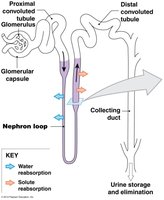
The nephron is the functional unit of the kidney, responsible for filtering blood, reabsorbing essential substances, and excreting waste products in urine. Each nephron consists of several segments, each with distinct physiological roles in the process of urine formation.
Renal Corpuscle: Site of blood filtration, producing filtrate that enters the tubules.
Proximal Convoluted Tubule (PCT): Major site for reabsorption of water, ions, and nutrients.
Nephron Loop (Loop of Henle): Establishes osmotic gradient for water conservation.
Distal Convoluted Tubule (DCT): Fine-tunes reabsorption and secretion, regulated by hormones.
Collecting System: Final adjustments to urine composition, regulated by aldosterone and ADH.
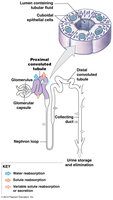
Proximal Convoluted Tubule (PCT)
Functions and Mechanisms
The PCT is responsible for the reabsorption of the majority of filtered water, ions, and nutrients. It uses both active and passive transport mechanisms to reclaim substances from the filtrate.
Reabsorption: Glucose, amino acids, sodium, chloride, bicarbonate, and water are reabsorbed efficiently.
Secretion: Hydrogen ions, ammonium ions, and certain drugs are secreted into the tubular fluid.
Mechanisms: Carrier-mediated transport, cotransport, and countertransport with sodium ions.
Example: Glucose reabsorption occurs via sodium-glucose cotransporters.
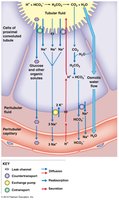
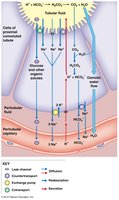
Glucose Reabsorption in the PCT
Glucose is reabsorbed in the PCT through sodium-glucose cotransporters. This process is essential for preventing glucose loss in urine and maintaining blood glucose levels.
Key Point: Nearly all filtered glucose is reabsorbed in the PCT under normal conditions.
Clinical Relevance: Glucosuria (glucose in urine) occurs when transporters are saturated, as in diabetes mellitus.
Nephron Loop (Loop of Henle)
Structure and Function
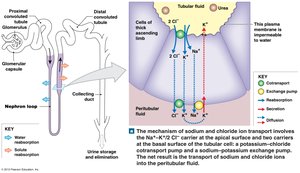
The Loop of Henle consists of descending and ascending limbs, each with unique permeability characteristics. It is crucial for establishing the osmotic gradient in the renal medulla, which enables water conservation and concentration of urine.
Descending Limb: Permeable to water, allowing water reabsorption.
Ascending Limb: Permeable to sodium and chloride, but not water; active transport of ions creates osmotic gradient.
Mechanisms: Countercurrent multiplication and active transport of Na+ and Cl-.
Example: The osmotic gradient established by the loop is essential for water reabsorption in the collecting duct.
Distal Convoluted Tubule (DCT)
Functions and Regulation
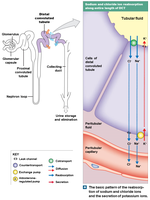
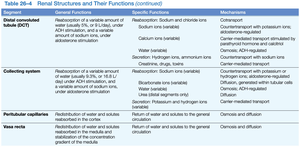
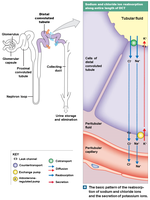
The DCT is involved in the selective reabsorption and secretion of ions, regulated by hormones such as aldosterone and antidiuretic hormone (ADH). It plays a key role in acid-base balance and electrolyte homeostasis.
Reabsorption: Sodium and chloride ions, calcium ions (under parathyroid hormone stimulation).
Secretion: Hydrogen ions, potassium ions, ammonium ions.
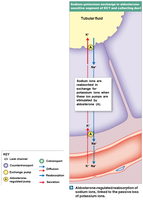
Regulation: Aldosterone increases sodium reabsorption and potassium secretion; ADH increases water reabsorption.
Collecting System/Duct
Regulatory Factors: Aldosterone and ADH
The collecting duct is the final site for regulation of water and solute reabsorption. Aldosterone and ADH are the primary hormones controlling its function.
Aldosterone: Stimulates sodium reabsorption and potassium secretion.
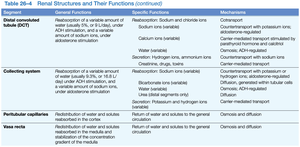
ADH (Antidiuretic Hormone): Increases water reabsorption by making the duct more permeable to water.
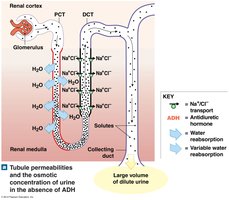
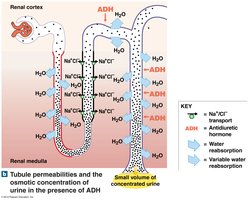
Example: In the presence of ADH, urine becomes concentrated; in its absence, urine is dilute.
No ADH vs. With ADH
The presence or absence of ADH dramatically affects the volume and concentration of urine produced by the kidneys.
No ADH: Collecting duct is impermeable to water, resulting in large volume of dilute urine.
With ADH: Collecting duct becomes permeable to water, resulting in small volume of concentrated urine.
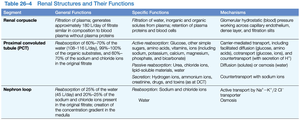
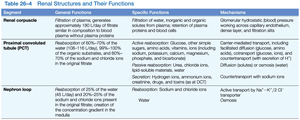
Summary Table: Renal Structures and Their Functions
The following table summarizes the main functions and mechanisms of each nephron segment:
Segment | General Functions | Specific Functions | Mechanisms |
|---|---|---|---|
Renal corpuscle | Filtration of plasma; generates filtrate | Filtration of water, inorganic and organic solutes from plasma; retention of plasma proteins and blood cells | Glomerular hydrostatic/blood pressure; selective permeability; filtration slits |
Proximal convoluted tubule (PCT) | Reabsorption of 60–70% of filtrate | Active reabsorption of glucose, amino acids, ions; passive reabsorption of water; secretion of hydrogen ions, ammonium ions, drugs | Carrier-mediated transport; cotransport; countertransport with sodium ions |
Nephron loop | Reabsorption of 25% of filtrate | Reabsorption of sodium and chloride ions; water | Active transport for Na+/Cl-; osmosis |
Distal convoluted tubule (DCT) | Reabsorption of variable amount of water and ions | Reabsorption of sodium, chloride, calcium ions; secretion of hydrogen, potassium, ammonium ions | Cotransport; carrier-mediated transport; regulation by aldosterone and ADH |
Collecting system | Reabsorption of variable amount of water and ions | Reabsorption of sodium, chloride, water; secretion of potassium, hydrogen, ammonium ions | Carrier-mediated transport; regulation by aldosterone and ADH |
