 Back
Sketch #2
Study Guide - Smart Notes
 Tailored notes based on your materials, expanded with key definitions, examples, and context.
Neuronal Action Potentials and Ion Channel Dynamics
Overview of Neuron Structure
The neuron is the fundamental unit of the nervous system, specialized for the transmission of electrical signals. Its structure includes dendrites, a cell body, and an axon, which collectively facilitate the conduction of nerve impulses.
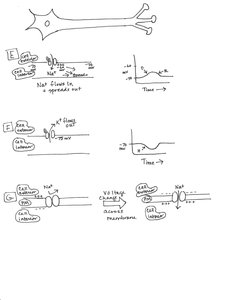
Phases of the Action Potential
An action potential is a rapid, temporary change in a cell's membrane potential, essential for neural communication. The process involves the sequential opening and closing of voltage-gated ion channels.
Depolarization Phase
Definition: Depolarization is the phase during which the membrane potential becomes less negative (moves toward zero or positive values).
Mechanism: Voltage-gated sodium (Na+) channels open, allowing Na+ ions to flow into the neuron.
Result: The influx of Na+ causes the inside of the cell to become more positive.
Graph: The membrane potential rapidly rises on a time vs. voltage graph.
Repolarization Phase
Definition: Repolarization is the return of the membrane potential to a more negative value after depolarization.
Mechanism: Voltage-gated potassium (K+) channels open, allowing K+ ions to flow out of the neuron.
Result: The efflux of K+ restores the negative membrane potential.
Graph: The membrane potential falls back toward the resting value.
Ion Channel Dynamics
Voltage-gated ion channels are crucial for the generation and propagation of action potentials. Their opening and closing are triggered by changes in membrane potential.
Na+ Channels: Open rapidly in response to depolarization, then inactivate.
K+ Channels: Open more slowly, contributing to repolarization and the after-hyperpolarization phase.
Summary Table: Ion Movements During Action Potential
Phase | Main Ion Movement | Channel State | Membrane Potential Change |
|---|---|---|---|
Depolarization | Na+ influx | Na+ channels open | Becomes more positive |
Repolarization | K+ efflux | K+ channels open | Returns to negative |
Resting | Na+/K+ pump active | Most channels closed | Stable, negative |
Key Equations
Nernst Equation: Used to calculate the equilibrium potential for a particular ion:
Goldman-Hodgkin-Katz Equation: Describes the membrane potential considering multiple ions:
Example: Action Potential Propagation
When a neuron is stimulated, voltage-gated Na+ channels open at the site of stimulation, causing local depolarization. This depolarization triggers adjacent Na+ channels to open, propagating the action potential along the axon.
Additional info: The refractory period, during which a neuron cannot fire another action potential, ensures unidirectional propagation and limits firing frequency.
